
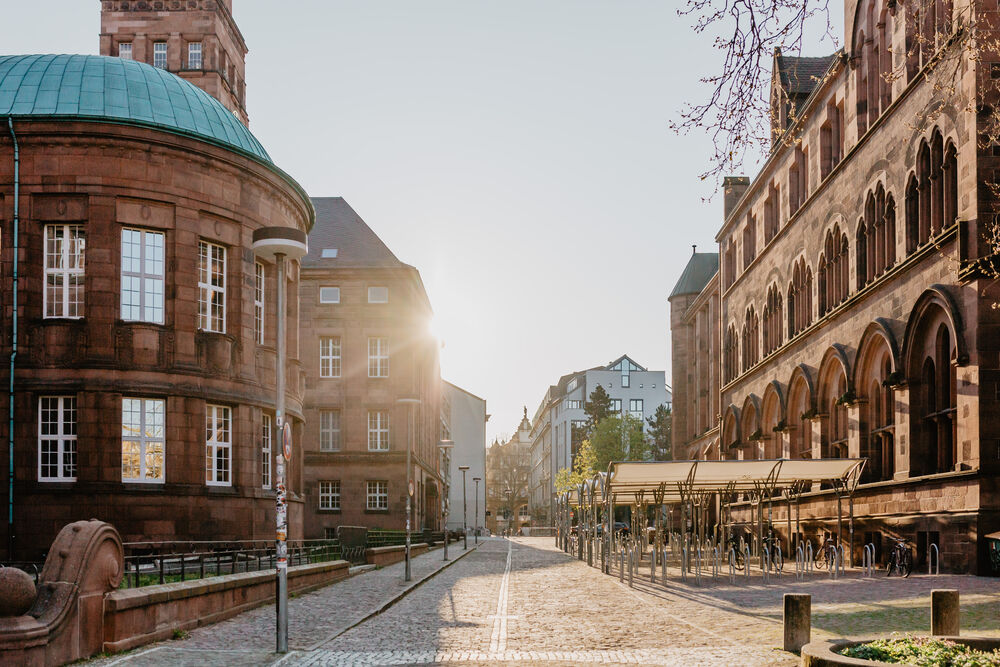

University in Germany
Freiburg im Breisgau, Baden-Württemberg, Germany
University profile
The University of Freiburg (Albert-Ludwigs-Universität Freiburg) is a research university in Freiburg im Breisgau, Baden-Württemberg, founded in 1457 and one of the oldest universities in Germany. It has around 24,500 students, about 240 degree programmes and eleven faculties, and works to the long-term strategy ufr 2040 under the values of quality, responsibility and openness.
The eleven faculties are Biology; Chemistry and Pharmacy; Economics and Behavioural Sciences; Engineering; Environment and Natural Resources; Humanities; Law; Mathematics and Physics; Medicine; Philology; and Theology. The Faculty of Engineering includes computer science, microsystems engineering (IMTEK) and sustainable systems engineering (INATECH), and the Faculty of Medicine works with the Medical Center - University of Freiburg. Max Planck and Fraunhofer institutes are among the university's partners in the region.
Research is organised around three key areas: Languages of Knowledge, Pathways to Sustainability and Signals of Life. The Freiburg Institute for Advanced Studies (FRIAS) and the Graduate Centre (GraCe) support advanced research and doctoral candidates, and all eleven faculties award doctorates. The university states that it is fifth in Germany and in the 101-150 range worldwide in the Shanghai Ranking, and that it receives funding as a University of Excellence from 1 January 2027.
Student life is supported by an orientation week before the winter semester, a First-Year Student Day, the "myUFR" app and a SemesterTicket. The International Office runs a Welcome Day for international students and an Intercultural Mentoring Programme that pairs international first-year students with experienced students. Short stays are possible through Erasmus+, exchange programmes or the Freemover route.
The university belongs to the networks Eucor, Epicur, German U15 and LeRu, and is a signatory of the Charta der Vielfalt. Its central address is Friedrichstraße 39, 79098 Freiburg.
The Semesterbeitrag (semester fee, not tuition) is 190 euros per semester: 103 euros for the Studierendenwerk, 80 euros administrative fee and 7 euros for the student union. International short-term students and visiting doctoral students pay 183 euros. Non-EU/EEA students enrolling in a Bachelor, consecutive Master or state examination programme pay tuition of 1,500 euros per semester in addition; EU/EEA citizens, doctoral candidates, Erasmus students and continuing education and part-time Master students are among the groups exempt, and several statutory exemptions apply. A second degree in Germany carries a fee of 650 euros per semester, and guest studies cost 50 euros per semester. Exemption applications are made through the online portal before lectures begin.
The Deutschlandstipendium provides 300 euros, half from the federal government and half from private donors. Details.
The university has no scholarships specifically for international students, such as for tuition. Scholarship advising is available to prospective and current students through the Scholarship Information Tool. Funding listed includes the DAAD database and Hilde Domin Programme, the Baden-Württemberg Stipendium and foundations such as the Friedrich Naumann Foundation and START-Stiftung. Emergency aid is available through the Studierendenwerk Freiburg, the Friends of the University association and the International Office. Overview: Financing your studies.
Browse the scholarships listed for University of Freiburg and check each award’s eligibility.
View scholarships for University of Freiburg →Almost all applications are made through the university's online application portal (campus.uni-freiburg.de). Applicants choose a programme in the Studiengangfinder, register, upload the requested documents, confirm their entries and submit within the deadline. Admission-free programmes lead directly to online enrolment, while restricted programmes or those with special requirements issue an admission offer and Zulassungsbescheid in the portal mailbox. Human medicine, dentistry and pharmacy applications from German, EU/EEA and Bildungsinländer applicants go through hochschulstart.de; non-EU applicants without a German entrance qualification use the university portal.
Degrees include the Staatsexamen (human medicine, pharmacy, law, dentistry), B.A., B.Sc. and a polyvalent two-major Bachelor with a teaching option. Some subjects require an entrance exam, language proof or an interview, and proof of the Studienorientierungsverfahren is required with the application or at the latest at enrolment. Applicants with a foreign school-leaving certificate that does not yet qualify for German university study, or with an indirect entrance qualification, can apply through the university for the Studienkolleg in Heidelberg.
Applications for the winter semester generally run from 1 June: to 15 July for restricted-admission subjects (including all first-year places in human medicine and pharmacy), to 30 September for subjects with special admission requirements and to 7 October for subjects without special requirements. Summer-semester periods start on 1 December and end between 15 January and 8 April depending on the subject; Master of Education runs 1 June to 15 July (winter) and 1 December to 15 January (summer). Other Master programmes vary and are listed in the Studiengangfinder. These are exclusion deadlines.
German certificates accepted include DSH (levels 1 to 3), TestDaF (levels 3 to 5), telc and Goethe-Zertifikat, with the level required set by each programme's admission regulations. English certificates include IELTS Academic (B2 is 5.5-6.5, C1 is 7.0-8.0), TOEFL iBT (B2 is 72-94, C1 from 95) and telc. An English-taught degree from an anglophone country is accepted for B1, B2 and C1.
Master programmes (M.A., M.Sc., M.Ed., LL.M., MBA) are applied for through the portal; for M.A., M.Sc. and LL.M. the department reviews applications first, then the Team Bewerbung und Zulassung. Language requirements are set per programme.
All eleven faculties award doctorates, either in structured doctoral programmes or as individual doctorates, supported by the Graduate Centre (GraCe).
Applicants who need a visa should apply at the German embassy in their home country as soon as they are admitted, as processing can take weeks or months.
The university's central address is Friedrichstraße 39, 79098 Freiburg, in Freiburg im Breisgau. Faculties and institutions are spread across the city, and the Faculty of Biology includes the Botanical Garden. The Faculty of Medicine includes the university's Medical Center.
Advising and Counselling is at Sedanstraße 6, 1st floor. Interactive maps on the university website locate faculties and institutions across the city.
Study programmes offered at University of Freiburg.
Experiences shared by students of University of Freiburg.
Studied here? Share your experience to help other applicants.

Book a free consultation with our expert counsellors and take the first step towards your dream university.
Copyrights © 2026 StudyMapped. All rights reserved.

Enter your credentials to continue.
Join us and start your study abroad journey.


