
University in Germany
Erfurt, Thüringen, Germany
University profile
The University of Erfurt is a public university in the Thuringian state capital with a profile in the humanities, cultural studies, social sciences, religion and teacher education. It was re-founded in 1994 and traces its origins to the Alma Mater Erfordensis, whose founding privilege dates from 1379 and which Martin Luther attended before its closure in 1816. Today it has about 5,700 students, around 100 professorships, roughly 400 academic staff and 300 administrative staff, and describes itself as a reform university built on Bachelor and Master degrees and interdisciplinarity from the start.
Teaching and research are organised in four faculties: the Faculty of Philosophy (Philosophische Fakultät), the Faculty of Education (Erziehungswissenschaftliche Fakultät), the Faculty of Political Science, Economics and Law (Staatswissenschaftliche Fakultät) and the Faculty of Catholic Theology (Katholisch-Theologische Fakultät). The Max Weber Centre for Advanced Cultural and Social Studies (Max-Weber-Kolleg) is a faculty-like institute that combines an institute for advanced study with a graduate college. Two professional schools sit alongside them: the Willy Brandt School of Public Policy, founded in 2002 and home to the English-taught Master of Public Policy, and the Erfurt School of Education, which has coordinated teacher training since 2006.
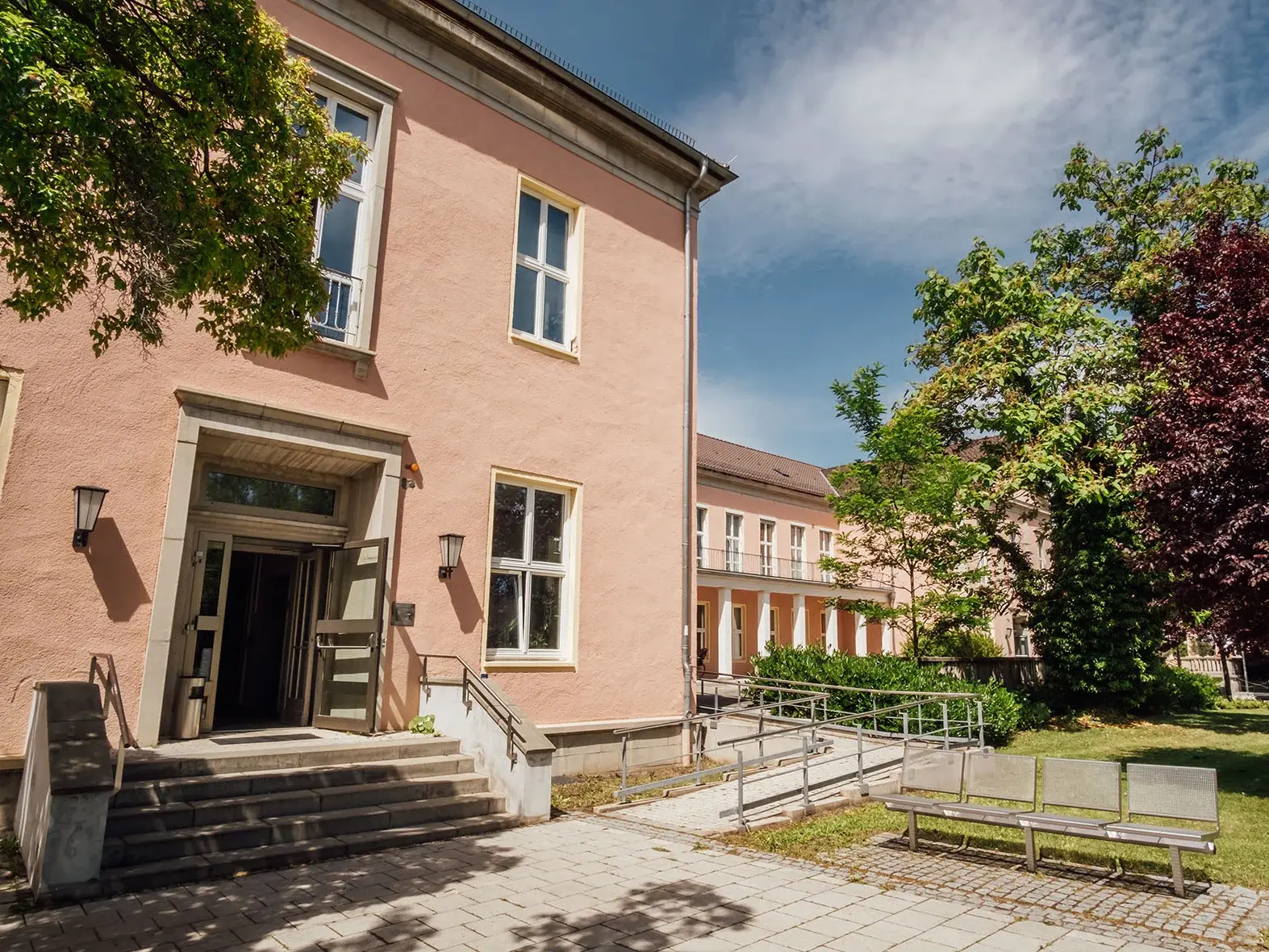
The main campus lies on Nordhauser Strasse close to the city centre, with short distances between lecture halls, the university library, the canteen and cafeterias, and student residences. The university also runs research sites in Gotha, including the Research Library Gotha at Schloss Friedenstein.
Study is organised around a two-subject Bachelor (a major combined with a minor), with Master programmes, a Magister in Catholic Theology, teacher-training degrees (primary, regular school, special needs and vocational), certificate programmes and doctorates. The Studium Fundamentale, a mentoring system and career-field orientation are part of the model.
The university counts 528 international students (without guest students, 2024). Master programmes in Global Communication, Public Policy and Religious Studies are taught in English; all other international applicants need German. The International Office runs a buddy programme that pairs international degree and exchange students with experienced local students, and a welcome programme for the start of study. Student life includes university sport with more than 150 courses in over 80 sports through the university sports club, the student council (StuRa), student initiatives.
The University of Erfurt is a public-law corporation supervised by the Thuringian Ministry for Education, Science and Culture. It has held system accreditation since 2021, has been a DFG member since 2019, and holds the family-friendly university audit (first awarded 2005, renewed 2024) and the Diversity Audit certification (2023).
There are no general tuition fees in Thuringia, so regular study at the University of Erfurt is tuition-free. Students pay a semester contribution (Semesterbeitrag), which is not tuition: about 340 euro per semester covering the Studierendenwerk, the student council, the Deutschlandsemesterticket, the culture ticket and the student card. For full-time doctoral students in winter semester 2026/27 it is 357.80 euro (Studierendenwerk 95.00, student council 13.00, Deutschlandsemesterticket 226.80, culture ticket 3.00, student card 20.00 if no thoska card yet); for part-time doctoral students it is 131.00 euro. Further fees apply in special cases: 500 euro per semester after exceeding the standard period of study by more than four semesters (from the 11th university semester in a Bachelor), 250 euro per semester for senior students aged 60 or over, and a flat 50 euro for guest students.
The university awards the Deutschlandstipendium to talented, high-achieving and socially engaged students of all degree programmes. It is 300 euro per month, funded half by private donors and half by the federal government, independent of income and combinable with BAföG, and normally awarded for two semesters from the winter semester with re-application possible. At least 14 awards are planned for 2026/27. Selection looks at school and study performance, social, political, cultural or scientific engagement and special personal circumstances. Applications are made online in a six-week window between June and August. Students must be enrolled, within the standard period of study and not already funded with more than 30 euro per month by another body. Official Deutschlandstipendium page.
Doctoral candidates can receive support from university scholarships and grants, and the university advises on third-party funding applications through its research and graduate support office. Student advice on financing, BAföG and scholarship databases is available through the university's study finance pages, and the Studierendenwerk Thuringia handles BAföG and residence places (rents of 190 to 393 euro per month including utilities, application opens 1 April for the winter semester and 1 October for the summer semester). Costs and funding overview.
Deutschlandstipendium at the University of Erfurt →
Browse the scholarships listed for University of Erfurt and check each award’s eligibility.
View scholarships for University of Erfurt →Applicants need a higher education entrance qualification (Hochschulzugangsberechtigung): Abitur or subject-restricted entrance qualification, vocational qualification routes for study without Abitur, a first university degree, or a qualification gained abroad. Foreign qualifications recognised as equivalent to the German Abitur give direct access; qualifications that are only indirectly comparable require the assessment test (Feststellungsprüfung) after the Studienkolleg. The State Studienkolleg Thuringia is at Nordhausen, about 70 km north of Erfurt, and applicants apply to the university rather than to the Studienkolleg. Erfurt issues conditional admissions only for the G-course (language and humanities subjects) and the W-course (economics and social sciences), not for the T- or M-course.
Admission-restricted (NC) Bachelor subjects are International Relations, Learning, Teaching and Training Psychology, Primary Education and Sport and Movement Education. Art, Music and Sport and Movement Education require an aptitude test (Eignungsprüfung) and Communication Studies requires an aptitude assessment (Eignungsfeststellungsverfahren).
Applications are made online directly to the university. Non-EU applicants with a foreign qualification apply through the International Office with a separate form; EU applicants and Germans with foreign qualifications apply through the Student Affairs office. Winter semester Bachelor deadlines are 1 May to 15 July (final deadline) for admission-restricted subjects and 1 May to 15 September for open subjects; the aptitude assessment for Communication Studies is due by 15 July; for the art, music and sport aptitude tests the application deadline is 15 September. Master applications run from 1 January to 15 September for programmes without selection, with 15 July (final deadline) for Global Communication, Children's and Youth Media and Health Communication; summer semester applications run from 1 December to 15 March, and applying by 15 July or 15 January is recommended. Master of Education starts in the winter semester (1 May to 15 September), and the Magister in Catholic Theology applies 1 May to 15 September. International applicants are told that the winter semester deadline is generally 15 July.
International applicants must show German at level B1 (CEFR) when applying and must pass DSH-2 or DSH-3 before study starts. Equivalent proofs are telc C1 Hochschule, TestDaF (at least 4 in each part) and the German Language Diploma Level 2. Preparatory B2 and C1 courses are offered by the Erfurt Centre for Language and Integration (EZSI), and applicants of Erfurt universities can take the DSH in September at the Language Centre. German is not required for the English-taught Master programmes Global Communication: Politics and Society, Public Policy and Religious Studies. Some Bachelor programmes (International Relations, Political Science, Economics, Law, Social Sciences, Management, Communication Studies) require English at level B2, which must be proven at the latest at enrolment.
A first university degree with a standard period of study of at least six semesters is the general requirement. Each Master programme sets further requirements in its examination regulations, and the examination board decides whether they are met; its decision is needed for enrolment. Some Master programmes require English, French or other language certificates, and the Global Communication Master recommends applying by 15 June so visas can be arranged in time. Selection procedures apply in Global Communication: Politics and Society, Children's and Youth Media and Health Communication. Applications are submitted fully online with PDF uploads.
Doctorates are possible in the Faculty of Philosophy, the Faculty of Political Science, Economics and Law, the Faculty of Education, the Faculty of Catholic Theology and the Max Weber Centre. Candidates first apply for acceptance as a doctoral candidate under the relevant faculty's doctoral regulations (Promotionsordnung) through the Docata portal, then apply for enrolment, which gives student status. Enrolment for the winter semester is possible from 1 June to 31 March and for the summer semester from 1 January to 30 September.
Study programmes offered at University of Erfurt.
Experiences shared by students of University of Erfurt.
Studied here? Share your experience to help other applicants.

Book a free consultation with our expert counsellors and take the first step towards your dream university.
Copyrights © 2026 StudyMapped. All rights reserved.

Enter your credentials to continue.
Join us and start your study abroad journey.


