
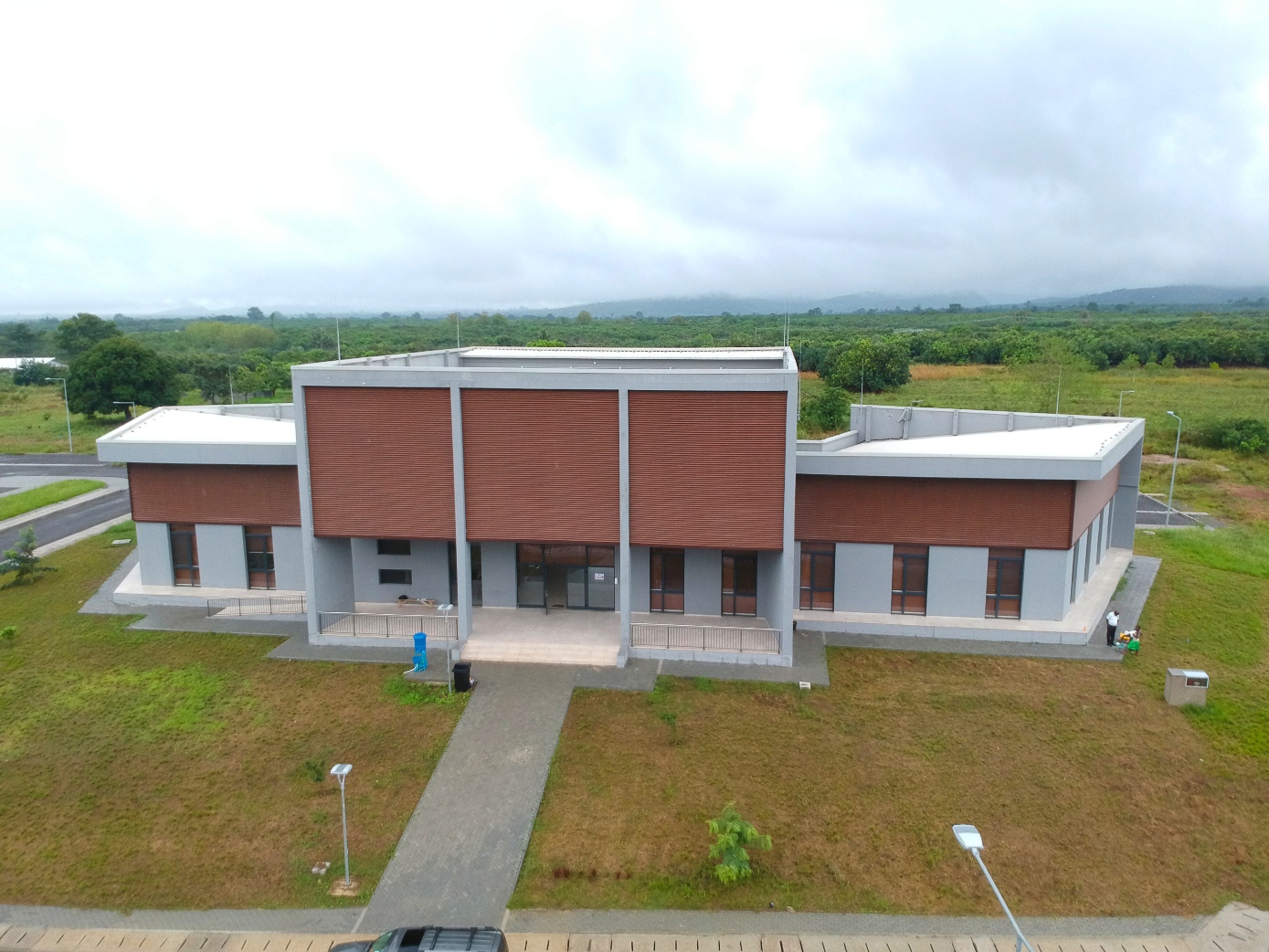

University in Ghana
Somanya, Ghana
University profile
The University of Environment and Sustainable Development (UESD) is a public university at Somanya in the Yilo Krobo Municipality of the Eastern Region, Ghana. It was established by the UESD Act, 2015 (Act 898), to provide higher education and disseminate knowledge related to development in environment and agribusiness education, undertake research and foster relationships beyond the institution. It was inaugurated on 5 August 2020 by President Nana Addo Dankwa Akufo-Addo, and Prof. Eric Nyarko-Sampson is the founding Vice-Chancellor. UESD is accredited by the Ghana Tertiary Education Commission (GTEC) and is an autonomous university, not affiliated with any other university.
Its vision is to be a centre of excellence in knowledge gathering and dissemination in the area of environment for public good, and its mission is to produce graduates equipped with the knowledge and skills to be agents of change in environment and sustainable development. Its core values are summarised by the acronym HOPE: Honesty, Opportunity, Perseverance and Enterprising.
Teaching is organised in the School of Natural and Environmental Sciences (SNES) and the School of Sustainable Development (SSD), with a Department of Built Environment that offers Architecture and Sustainable Design, Urban Planning and Development, and Sustainable Construction Management and Technology. Accredited undergraduate programmes include Environmental and Sustainability Science, Environment and Public Health, Geography and Earth Science, Geoscience, Nature Conservation Management, Mathematics, Statistics, combined science degrees, Energy Sustainability, Water Resources Development, Water, Sanitation and Hygiene, Aquaculture Management, Environmental Economics and Policy, Development Economics and Fisheries Economics and Management. Postgraduate programmes are the MPhil in Sustainable Aquaculture and Biotechnology, and the MPhil and MSc in Environmental Restoration Studies.
The campus lies between the Akwapim Range and the Krobo Hills, and is designed around sustainability features including water treatment and recycling plants, boreholes and rainwater harvesting. The Office of the Dean of Students Affairs provides guidance and counselling, academic advising, accommodation and residence life, financial aid services, student representative council affairs and international student affairs. An on-campus clinic serves the university community, and the campus and hostels have CCTV and 24-hour security.
International students are recruited and supported by the Office of International Education, which works with the Admissions Office on applications, and the University Relations Office assists with immigration matters. Foreign qualifications are assessed for equivalence by GTEC, and applicants from non-English-speaking countries must show English proficiency. Hostels are available on and off campus, including a 78-bed university hostel and private hostels near the campus.
The university circulates applications for the Ghana Education Trust Fund (GETFund) undergraduate local scholarship (a call for the 2022/23 academic year has been posted on the university's scholarships page).
Ghanaian students are directed to the Students Loan Trust Fund Secretariat, the Scholarship Secretariat and GETFund in Accra. The Office of the Dean of Students Affairs offers financial aid services to enrolled students.
Official page: uesd.edu.gh/scholarships.
Browse the scholarships listed for University of Environment and Sustainable Development and check each award’s eligibility.
View scholarships for University of Environment and Sustainable Development →WASSCE: credit passes in core English, core Mathematics and Integrated Science or Social Studies, plus three elective subjects that include at least one of Economics, Geography, Mathematics, Biology, Chemistry, Physics, Horticulture, Animal Husbandry or Crop Science, with an aggregate of 36 or better (listed for B.Sc. Environmental and Sustainability Science). SSSCE: the same core subjects and electives with an aggregate of 24 or better.
A-Level: passes in three subjects (at least one grade D or better), credit passes (grade 6) in five GCE O-Level subjects including English Language, Mathematics and a science subject (for non-science students) or an arts subject (for science students), and a pass in General Paper. GBCE: passes (A-D) in six subjects, three core including English Language and Core Mathematics plus three electives. Teacher's Certificate A, NABPTEX and NVTI certificates are also accepted routes.
ABCE diploma holders with credits in five subjects including English Language, Core Mathematics and Integrated Science or Social Studies may be considered for Level 200. HND second class (upper and lower) holders with a relevant background may be admitted to the third year after an interview; HND first class holders may be considered without interview. Two-year diploma (second class) holders may enter the second year, and three-year diploma holders with distinction the third year without interview.
Applicants must be 25 years or older with passes in SSSCE/WASSCE/O-Level Mathematics and English and/or relevant work experience, and must pass a written examination and interview conducted by the School. The university also runs an access programme for applicants aged 25 and above, who are admitted after an entrance examination and interview.
Foreign applicants are admitted on the basis of qualifications from their home country, for which GTEC determines equivalence; applicants from non-English-speaking countries must show English proficiency. International applicants download and complete the foreign applicant forms from the students portal, send them to [email protected] and pay the US$120 application fee into the university's USD account. A residence permit from the Ghana Immigration Service is needed to regularise a stay; West African nationals do not require a visa.
Postgraduate programmes are the MPhil in Sustainable Aquaculture and Biotechnology and the MPhil and MSc in Environmental Restoration Studies. Transfer applicants are accepted.
Log in to the online admissions system with the voucher serial number and PIN, complete the form, then post a printed copy with photocopies of result slips and birth or baptismal certificate to The Registrar, University of Environment and Sustainable Development, Private Mail Bag, Somanya, Eastern Region, Ghana. Successful applicants are notified by text message, then print their admission letter online and pay fees. Admission typically takes about two weeks once documents are complete. Enquiries: [email protected], call or WhatsApp +233 200955020 or +233 203201141.
Somanya main campus (Yilo Krobo, Eastern Region). Act 898 provides for the university to be established at Somanya with a campus at Donkorkrom and any other place the Council may determine.
Private hostels serving students include Destiny View Hostel (behind the administration block, 2 minutes' walk), E.L. Hostel (Trom Junction, 2 km) and E.L. Hostel (Goil Centre, Akuse Road, 10 km).
Study programmes offered at University of Environment and Sustainable Development.
Experiences shared by students of University of Environment and Sustainable Development.
Studied here? Share your experience to help other applicants.

Book a free consultation with our expert counsellors and take the first step towards your dream university.
Copyrights © 2026 StudyMapped. All rights reserved.

Enter your credentials to continue.
Join us and start your study abroad journey.


