
University in Ghana · Top university
Cape Coast, Ghana
University profile
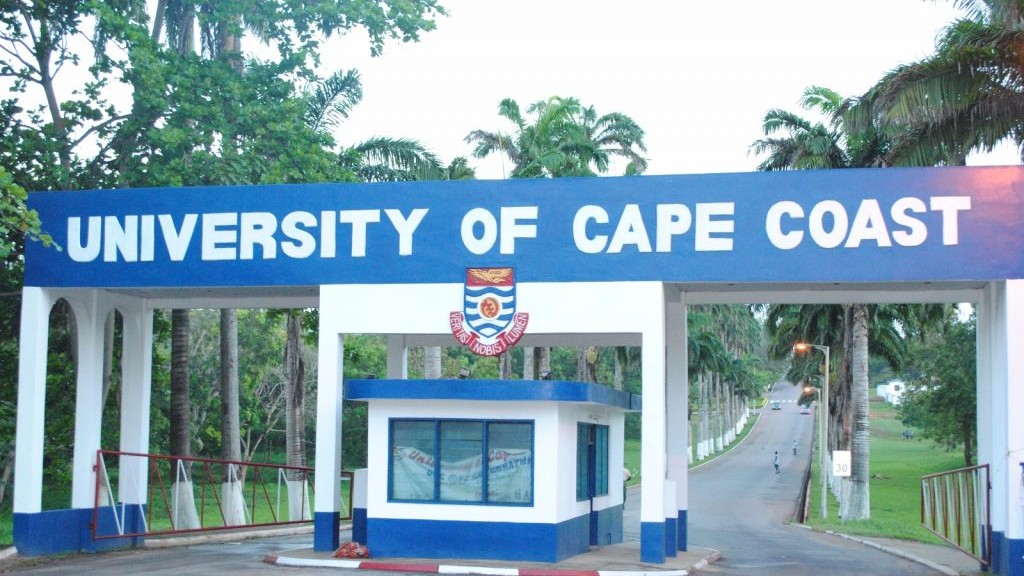
The University of Cape Coast (UCC) is a public university in Cape Coast, the capital of Ghana's Central Region on the Atlantic coast. It was established in October 1962 as a University College in special relationship with the University of Ghana, Legon, to train graduate professional teachers for Ghana's second cycle institutions and the Ministry of Education. Today its programmes also serve other ministries and industry. The motto is Veritas Nobis Lumen (Truth, Our Guide).
Academic work is organised in five colleges: the College of Agriculture and Natural Sciences, the College of Distance Education, the College of Education Studies, the College of Health and Allied Sciences, and the College of Humanities and Legal Studies. Faculties and schools include the Faculty of Arts, the Faculty of Educational Foundations, the Faculty of Humanities and Social Sciences Education, the Faculty of Law, the Faculty of Science and Technology Education, the Faculty of Social Sciences, the School for Development Studies, the School of Agriculture, the School of Allied Health Sciences, the School of Biological Sciences, the School of Business and the School of Economics. The School of Graduate Studies coordinates postgraduate training, with 272 master's and 92 doctoral programmes.
The undergraduate catalogue lists 158 programmes (139 degree, 6 diploma and 13 certificate), including many Bachelor of Education programmes alongside BA, BSc, BCom, BMus and professional degrees such as the Doctor of Optometry. The total student population is 74,720: 18,949 regular undergraduates, 1,445 sandwich undergraduates, 1,014 regular postgraduates, 2,773 sandwich postgraduates, 48,989 distance undergraduates and 1,540 distance postgraduates.
Student life centres on the traditional halls of residence, whose week-long hall celebrations are run by the Junior Common Room Committees, together with SRC Week, Ladies Week, departmental weeks, home-coming events, stage plays by the Department of Theatre and Film Studies, and sports including athletics, football, basketball, volleyball, handball and tennis. The Directorate of University Health Services and a University Hospital serve the campus community and the public.
International students apply through the Office of International Relations and do not need an application voucher. All freshly admitted undergraduates are provided campus accommodation in their first year, and continuing students are assisted to find private hostels. The Office also handles orientation, visas, resident permits and student welfare.
The Student Financial Support Office (STuFSO) runs the university's General Bursary and donor-funded scholarships behind a single application, assessed on verified need and decided by standing award committees. Calls are run per cycle and per mode of study (regular, sandwich, distance, part time), for example the General Bursary 2026/2027 main call, which closed on 1 September 2026. Awards are paid toward fees and upkeep. Donor schemes include the Secretariat Scholarship, Building Tomorrow, CoDE and GNPC. Applications are made through the STuFSO portal at stufso.ucc.edu.gh/calls.
Contact: [email protected], +233 (0)3321 32440, C. A. Ackah Lecture Theatre, Monday to Friday 8am to 4pm.
The School of Graduate Studies provides grants to postgraduate students with financial need to support quality and timely research.
The Office of International Relations (international.ucc.edu.gh/scholarships) lists external scholarships open to international applicants, including Commonwealth, Mandela Rhodes and Africa Scholarship Scheme awards.
UCC Student Financial Support Office (StuFSO) General Bursary and Donor Schemes →
Browse the scholarships listed for University of Cape Coast and check each award’s eligibility.
View scholarships for University of Cape Coast →To qualify for an offer, an applicant must have passes in six subjects with an overall aggregate of 36 or better for WASSCE and 24 or better for SSSCE. These are three core subjects (English Language, Core Mathematics, and Integrated Science or Social Studies) and three relevant elective subjects. All six subjects used for the aggregate must be C6 or better (WASSCE) or D or better (SSSCE).
WASSCE: A1=1, B2=2, B3=3, C4=4, C5=5, C6=6. SSSCE: A=1, B=2, C=3, D=4. A pass means A1 to C6 for WASSCE and A to D for SSSCE.
Each programme sets its own elective subject requirements and cut-off points, published in the admissions catalogue at admissions.ucc.edu.gh. Postgraduate programmes have their own entry conditions, for example MPhil for PhD admission and at least a second class (lower division) first degree for MSc programmes in the sciences.
Ghanaian applicants buy an application voucher from GCB Bank, ADB Bank, GTB Bank, Zenith Bank, Consolidated Bank, Prudential Bank, Republic Bank, Apex Bank or Ghana Post, then apply at the UCC application portal using the voucher serial number, choosing up to three programmes and uploading documents. Separate applications and vouchers are needed for undergraduate and postgraduate programmes. Regular applications typically close in July, sandwich in June and distance in October. Shortlisted applicants complete a medical examination before registration. Admissions enquiries: +233 33 213 2480, [email protected].
International applicants do not need a voucher and apply through the Office of International Relations (international.ucc.edu.gh). A visa is required unless the applicant's country is exempt; on arrival students must extend their permit to stay. Tuition varies by programme and is reviewed each academic year; the Office ([email protected]) gives current fees.
Old Site (Southern Campus), Cape Coast. Set on high ground in the Apewosika and Kokoado communities close to the Atlantic shore. It houses the Central Administration Block, the University Hospital, Adehye Hall (the female hall of residence), Atlantic Hall and Oguaa Hall.
New Site (Northern Campus, known as 'Science'), Cape Coast. About 1 km from the Old Site near Kwaprow and Amamoma. It houses the science building complex, the main library, Casley Hayford Hall, Kwame Nkrumah Hall, Valco Hall, the Campus Broadcasting Centre, the University garden and the University zoo.
Other facilities include an ICT centre, sports facilities, banking services, Wi-Fi hotspots across campus, and a library complex with a capacity of 750,000 volumes. The College of Distance Education serves distance learners, and the university maintains an Accra office.
Experiences shared by students of University of Cape Coast.
Studied here? Share your experience to help other applicants.

Book a free consultation with our expert counsellors and take the first step towards your dream university.
Copyrights © 2026 StudyMapped. All rights reserved.

Enter your credentials to continue.
Join us and start your study abroad journey.


