
University in United Kingdom
Cambridge, England, United Kingdom
University profile
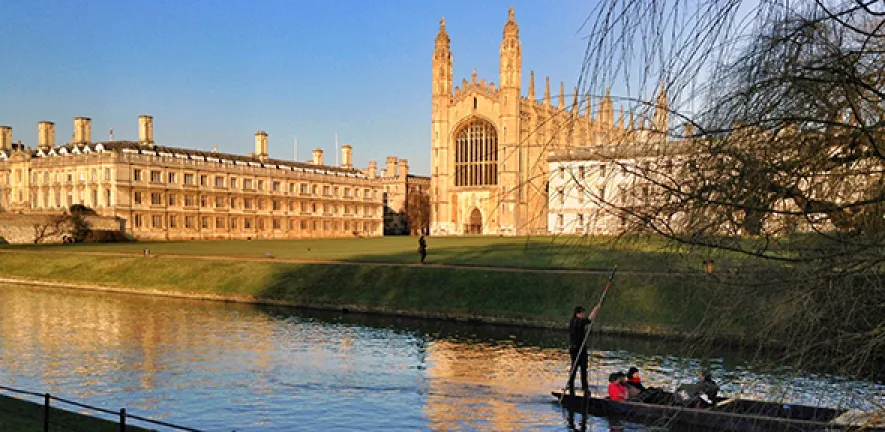
The University of Cambridge traces its origins to 1209, when groups of scholars gathered at the ancient Roman trading post of Cambridge to study. It is a confederation of Schools, Faculties, Departments and Colleges, with more than 24,000 students from 144 countries and 13,113 staff. Every student is a member of the University, of an academic Faculty or Department, and of one of the 31 self-governing Colleges.
Teaching and research are organised in six Schools: Arts and Humanities, Biological Sciences, Clinical Medicine, Humanities and Social Sciences, Physical Sciences and Technology, which together contain over 150 Faculties and Departments. More than 30 undergraduate courses cover over 65 subject areas, alongside a free one-year Foundation Year (CertHE) in the Arts, Humanities and Social Sciences for students who have experienced educational disadvantage. Beyond the Schools sit Cambridge University Press & Assessment, whose exam boards Cambridge English, Cambridge International Education and OCR serve more than 8 million learners a year, and the Institute of Continuing Education, founded in 1873, which runs over 250 courses for adults.
The 29 undergraduate Colleges house, feed and support students for at least three years; each has its own dining hall or cafeteria and library, and usually a gym and sports grounds. Undergraduates receive supervisions, small-group teaching sessions organised by their College, and each student has a Director of Studies and a pastoral Tutor. Three Colleges admit only mature students, and College welfare teams usually include a nurse, counsellor and chaplain.
The University's museums include the Fitzwilliam Museum, Kettle's Yard, the Museum of Archaeology and Anthropology, the Museum of Classical Archaeology, the Museum of Zoology, the Polar Museum, the Sedgwick Museum of Earth Sciences, the Whipple Museum of the History of Science and the Cambridge University Botanic Garden, which holds over 8,000 plant species. Cambridge University Library celebrated its 600th anniversary in 2016. Student life spans more than 70 sports clubs and societies and around 100 cultural and faith societies registered with the Students' Union.
Cambridge describes itself as a diverse international community, with over 9,000 international students. Among its alumni and affiliates are 126 Nobel Prize laureates, 47 heads of state and 217 Olympic medallists, and it had more than 333,629 living alumni as of December 2024. The Vice-Chancellor is Professor Deborah Prentice.
The Home tuition fee for students starting a first undergraduate degree in 2027 is £10,050 a year. International tuition fees for 2027 entry, fixed for the length of the course, are £30,798 (Group 1, e.g. Economics, English, History, Law), £34,356 (Mathematics), £40,296 (Architecture, Design, Geography, Music), £46,872 (e.g. Computer Science, Engineering, Natural Sciences) and £70,554 (Medicine and Veterinary Medicine). International students also pay an annual College fee. Estimated living costs for 2027-28 are £1,330 a month, around £11,970 for nine months.
UK students, and EU students with settled or pre-settled status, on a first full-time undergraduate degree with a household income under £62,215 can receive up to £3,500 a year, non-repayable. Higher amounts go to clinical medical students, independent students and students who were eligible for free school meals; care leavers could receive £8,350 a year. There is no separate application: students are assessed automatically when they apply to their regional student finance body. Cambridge Bursary Scheme.
The Stormzy Scholarship supports Black UK students from low-income or disadvantaged backgrounds on any course; the Formula 1 Engineering Scholarship supports UK students from backgrounds under-represented in Engineering; and the Gordon Edge Scholarship supports a science or technology student from counties in North West England and North Wales. Faculties and Colleges also offer grants, prizes and hardship support. Scholarships and bursaries.
Support for international undergraduates is limited and mostly partial and means-tested. It includes College awards, Cambridge Trust awards for overseas students accepted by a College, the International Disabled Students' Fund and the Prince Philip Scholarship for Hong Kong permanent residents. International financial support.
Most University funding is applied for by ticking the funding box in the Applicant Portal by the course funding deadline (8 December 2026 or 6 January 2027 for 2027-28). Gates Cambridge Scholarships support outstanding international postgraduates, with a 14 October 2026 deadline for US citizens; the Cambridge Trust and College funds also offer awards. Postgraduate funding.
Cambridge Trust International Scholarship →
Cambridge Trust Masters Studentship (International Fees) →
Cambridge Trust Masters Studentship (Home Fees) →
Cambridge Trust Global South Trailblazer Scholarship →
Browse the scholarships listed for University of Cambridge and check each award’s eligibility.
View scholarships for University of Cambridge →Applications are made through UCAS. The deadline for 2027 entry is 15 October 2026 (6pm UK time); UCAS applications can be started from 12 May 2026 and submitted from 1 September 2026. Applicants may choose a College or make an open application. Within 48 hours of submitting to UCAS, applicants receive a link to My Cambridge Application, due by 22 October 2026 (6pm UK time), together with any required transcript. The Foundation Year and some mature-student courses have a 13 January 2027 deadline.
Minimum offers are usually A*AA or A*A*A at A level depending on the course, normally based on three A levels taken together in Year 13; strong STEM applicants usually take Further Mathematics as a fourth subject. International Baccalaureate offers are 41-42 points out of 45 with 776 at Higher Level, and some Colleges ask for 777. Scottish applicants usually need A1, A2, A2 (A*AA courses) or A1, A1, A2 (A*A*A courses) in Advanced Highers. STEP Mathematics forms part of almost all conditional offers for Mathematics. Colleges may set higher offers where competition is strong or exams have been taken early.
Many courses require an assessment: TMUA for Computer Science, Economics and Mathematics; ESAT for Natural Sciences, Engineering and Veterinary Medicine; LNAT for Law; UCAT for Medicine; and College-set assessments for courses such as Architecture, Classics and Modern and Medieval Languages. Pre-registered tests have September registration deadlines. Everyone who receives an offer has been interviewed; the main interview period runs from 7 to 18 December 2026, and decisions are released in January.
Cambridge accepts a wide range of international qualifications, including International A levels, the European Baccalaureate and national school-leaving certificates assessed against A*AA or A*A*A requirements. US applicants usually need five AP Tests at score 5, with SAT (1,460-1,500 combined) or ACT (32-33) where required. Applicants with a combination of qualifications are assessed individually.
Applicants from non-majority English-speaking countries need English at a good CEFR C1 standard: normally IELTS Academic 7.5 overall with 7.0 in each element, Cambridge C2 Proficiency 200 (no element below 185), or C1 Advanced 193 (no element below 185) with other evidence. For interview, IELTS 6.5 overall with no element below 6.0 is recommended. Some visa routes require a SELT valid on the first day of the course.
The minimum requirement is a UK 2:1 Honours degree or international equivalent, though many courses require a high 2:1, a First or a Master's. Applications are made online through the Applicant Portal from each course page. Accepted English tests are IELTS Academic, TOEFL iBT and, for some courses, C1 Advanced or C2 Proficiency, with scores set per course and results dated no more than two years before the course starts. Main funding deadlines for 2027-28 entry are 8 December 2026 and 6 January 2027.
The University is woven through the city of Cambridge, with Colleges, Faculties and Departments spread across central and West Cambridge. During term, students must live within a 3-mile radius of Great St Mary's Church.
Study programmes offered at University of Cambridge.
Experiences shared by students of University of Cambridge.
Studied here? Share your experience to help other applicants.

Book a free consultation with our expert counsellors and take the first step towards your dream university.
Copyrights © 2026 StudyMapped. All rights reserved.

Enter your credentials to continue.
Join us and start your study abroad journey.


