

University in Canada · Featured
Vancouver, British Columbia, Canada
University profile
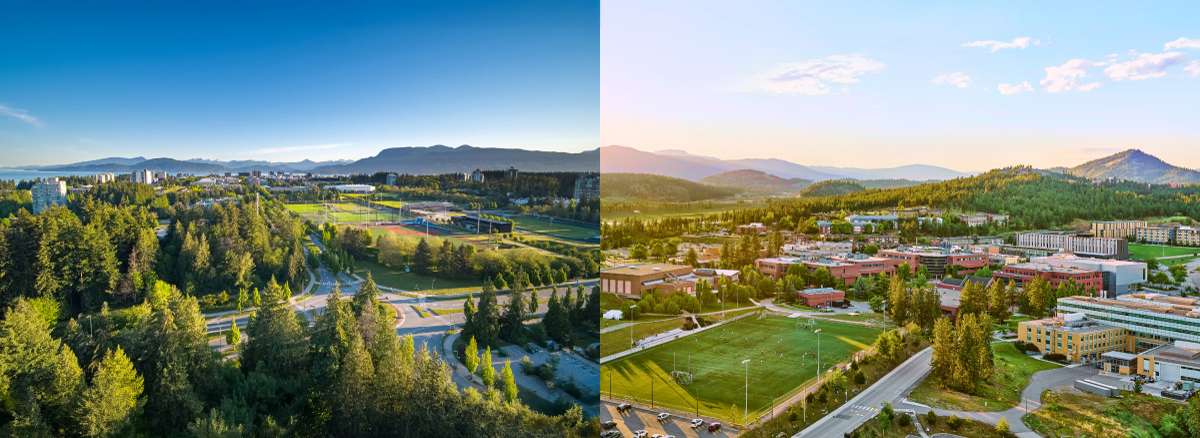
The University of British Columbia (UBC) is a public research university with two major campuses: Vancouver, at the western tip of the Point Grey peninsula, and the Okanagan campus in Kelowna. UBC has been educating students since 1915 and is led by President and Vice-Chancellor Benoit-Antoine Bacon. It enrols 72,100 students (59,688 undergraduate and 12,412 graduate), including 25.4% international students at Vancouver and 17.4% at the Okanagan campus, and employs 20,662 faculty and staff. Its alumni number over 435,000 in 145 countries.
The Vancouver campus (60,309 students; 49,165 undergraduate and 11,144 graduate) is about 30 minutes from downtown Vancouver, beside Pacific Spirit Park and the Pacific Ocean. Its faculties and schools include Applied Science, Arts, Land and Food Systems, Forestry, Science, Medicine, Dentistry, Law (Peter A. Allard School), Education, Kinesiology, Pharmaceutical Sciences, Music, the Sauder School of Business, the Vancouver School of Economics, the School of Public Policy and Global Affairs, the School of Architecture and Landscape Architecture, the School of Community and Regional Planning, the School of Journalism, Writing, and Media, the School of Nursing, the School of Social Work, the School of Information, the School of Population and Public Health, UBC Vantage College and the Faculty of Graduate and Postdoctoral Studies.
The Okanagan campus in Kelowna (11,791 students; 10,523 undergraduate and 1,268 graduate) has nine faculties and schools: the Irving K. Barber Faculty of Arts and Social Sciences, the Faculty of Creative and Critical Studies, the Okanagan School of Education, the School of Engineering, the Faculty of Health and Social Development, the Faculty of Management, the Irving K. Barber Faculty of Science, the Southern Medical Program of the Faculty of Medicine and the College of Graduate Studies. It offers 66 undergraduate and 61 graduate programs, and 83% of its students are domestic and 17% international.
On the Vancouver campus about 13,000 students live in 15 residences, and many first-year students qualify for a First Year Guarantee of Winter Session residence, mostly in Orchard Commons, Place Vanier or Totem Park. The Okanagan campus has ten residences with 2,120 beds, including the apartment-style Lower and Upper Cascades. 84% of undergraduates take part in enriched learning such as co-op, research or study abroad by the time they graduate (NSSE 2023).
UBC reports 2,661 Indigenous students, 6,485 students in UBC Extended Learning and 15,942 degrees granted in 2025. Both campuses are on the ancestral and unceded territories of the Musqueam people (Vancouver) and the Syilx Okanagan Nation (Okanagan). Undergraduate and graduate admission are open to international students, who need a Canadian study permit for in-person study; English-language academic pathways include UBC Vantage College and the English Language Institute.
UBC devotes more than $35 million a year to awards, scholarships and other financial support for international undergraduate students; recipients come from more than 111 countries. Applicants who apply by the admission deadline are automatically considered for the merit awards below; admission and award decisions are separate, and scholarship decisions are made between mid-February and the end of April.
Canadian citizens and permanent residents may apply for loans, bursaries and awards such as the Presidential Scholars Awards and the Beyond Tomorrow Scholars Award. Details: International student scholarships and awards; Dates and deadlines.
UBC Centennial Scholars Entrance Award →
International Major Entrance Scholarship (IMES) →
UBC International Scholars Program →
Browse the scholarships listed for University of British Columbia and check each award’s eligibility.
View scholarships for University of British Columbia →Requirements depend on where the applicant attended high school, the campus and the degree. Applicants must meet UBC's general admission requirements and the degree-specific requirements, and demonstrate English competency. Separate requirement pages exist for Canadian high schools, international high schools (including Ghana), International Baccalaureate Diploma students and Advanced Placement students; AP grades may be combined with an approved high school curriculum. Some degrees need a supplemental application, portfolio, interview or audition, for example Bachelor of Commerce (video interview in the personal profile), Computer Science, Nursing, Education, Music, Fine Arts and Pharmaceutical Sciences.
There are nine ways to meet the standard, including four or more consecutive years of full-time English-medium education immediately before UBC, six credits of first-year university English, IB English A grade 5 or higher, AP English grade 4 or higher, or an accepted test. Minimums, achieved in a single sitting: IELTS Academic overall 6.5 with no part below 6.0 (IELTS General, Indicator and One Skill Retake not accepted); TOEFL iBT overall 90 with Reading 22, Listening 22, Writing 21, Speaking 21 (institution code 0965); PTE Academic overall 65 with 60 in each skill; Duolingo English Test overall 125 with Reading 115, Listening 115, Writing 120, Speaking 120; CAEL overall 70; Cambridge English 180. Test scores must be from January 1, 2025 onwards for 2027/2028 Winter Session. Documents are due February 15. A waiver request process exists, and academic English pathways include UBC Vantage College and the UBC Conditional Admission Program.
Applicants must have completed high school, meet ELAS, hold an admission average of at least C (60%, where 50% is a pass) or 2.0 on a 4.0 scale, typically on the most recent 30 credits, and have credits: ideally 30 for second-year entry and 54 to 60 for third-year entry. Applicants with fewer than 24 credits are also assessed on final secondary grades.
Applicants must have been out of full-time education for at least four years and have no previous undergraduate degree, and may apply only to listed degrees at each campus (for example Arts, Fine Arts, Music, Kinesiology, Media Studies and Applied Biology at Vancouver, and Arts, Fine Arts, Management, Media Studies, Nursing, Science and Sustainability at Okanagan). Missing prerequisites must be completed by April 30.
The Faculty of Graduate and Postdoctoral Studies sets minimum requirements by country of prior study, and individual programs may add their own requirements and deadlines. Applications include official transcripts, a minimum of two references and, for most programs, a statement of interest. Applicants from universities outside Canada where English is not the primary language of instruction must provide a test taken within the last 24 months: TOEFL iBT 90 overall with minimum 22 (reading, listening) and 21 (writing, speaking) for tests taken before January 21, 2026, or 4.5 overall on the 1-6 scale (5 listening, 4.5 reading and writing, 4 speaking) for later tests; IELTS Academic 6.5 overall with 6.0 in each component; Duolingo 125 overall (115 reading, 115 listening, 120 writing, 120 speaking). Some programs require higher scores.
The online application opens in early October 2026 for Winter Session 2027/28 and Summer Session 2027. The application deadline is January 15, 2027 (11:59 p.m. PST). International applicants who want to be considered for the International Scholars Program must apply by November 15, 2026. Admission decisions for high school applicants are made on a continuous basis from November to June, and most students must accept their offer by May 1 or June 1, 2027. Applications are made through the EducationPlannerBC website. The non-refundable application fee is $78.50 for Canadian citizens and permanent residents and $173.25 for international students who require a study permit (Canadian dollars). Out-of-country high school applicants must submit documents by March 15, 2027, and post-secondary applicants from outside Canada and the United States by May 31, 2027. International applicants should apply for a study permit as soon as they accept their offer.
Reasons students choose University of British Columbia for their study abroad journey.
Study programmes offered at University of British Columbia.
Experiences shared by students of University of British Columbia.
Studied here? Share your experience to help other applicants.
A glimpse of campus life and the academic environment.



Book a free consultation with our expert counsellors and take the first step towards your dream university.
Copyrights © 2026 StudyMapped. All rights reserved.

Enter your credentials to continue.
Join us and start your study abroad journey.


