
University in United Kingdom
Bristol, England, United Kingdom
University profile
The University of Bristol is a research-intensive university in the city of Bristol in south-west England and a member of the Russell Group. It traces its origins to University College, Bristol, which opened in 1876 and was the first higher education institution in England to admit women on an equal basis to men, and it received its Royal Charter in 1909. In 2024/25 it had 31,132 students, 9,055 staff and 10,903 international students, and it offers more than 600 undergraduate and postgraduate degrees alongside foundation programmes, short courses and summer schools.
Teaching and research take place mainly on the Clifton campus, centred on Senate House and the Wills Memorial Building near the city centre, and at the new Temple Quarter Enterprise Campus beside Bristol Temple Meads station, home to the Business School, the Centre for Innovation and Entrepreneurship and the Bristol Dental School. Bristol Veterinary School occupies a 105-hectare estate at Langford, 14 miles south of the city, and the University also runs micro-campuses in Barton Hill and in Hartcliffe and Withywood.
Academic schools are grouped into three faculties:
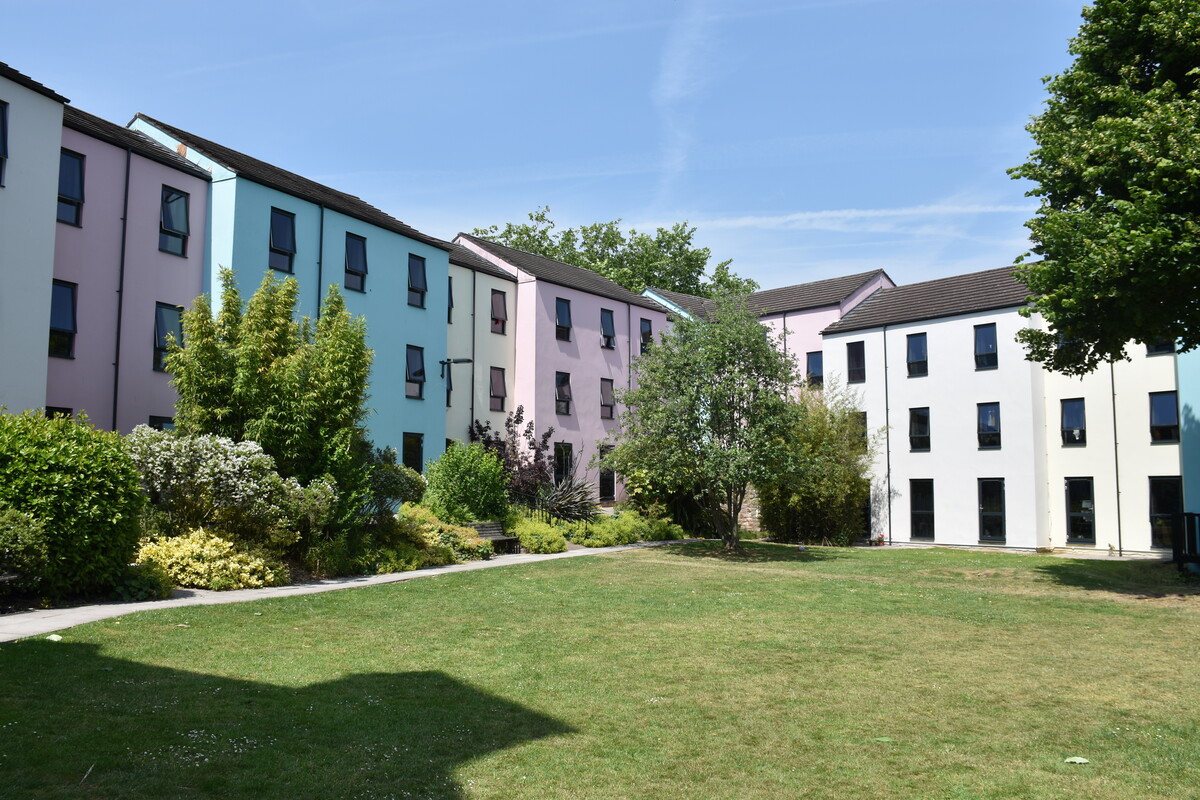
Thirteen Nobel Prize winners are linked to the University, among them William Ramsay, Paul Dirac, Cecil Powell, Nevill Mott and the current Chancellor, Sir Paul Nurse. Over 40 per cent of its teaching programmes are accredited by professional, statutory and regulatory bodies. Student life is organised around Bristol SU, which supports more than 300 student-run clubs and societies, and more than 40 University residences across the city, from Stoke Bishop halls such as Wills Hall, Churchill Hall and Hiatt Baker Hall to city-centre blocks near Temple Quarter.
Over 28 per cent of students are international, from more than 150 countries. International applicants can prepare for degree study through the one-year International Foundation Programme, and the Global Lounge hosts cultural events. The Students' Health Service provides a full NHS GP service to students and their families who live locally.
Home undergraduate tuition fees are £9,535 (2025/26), £9,790 (2026/27) and £10,050 (2027/28). International undergraduate fees depend on the course and generally increase by inflation each year of study, capped at 8% (not applied to clinical courses). Postgraduate fees are set per programme and listed on each programme page; increases for continuing students are capped at 8% per year. During full-year placements in 2026/27, home students pay 15% (study or work abroad) or 20% (industrial placement) of the fee, and international students 50% or 25%.
Home undergraduates with a household income of £50,000 or below who apply for a means-tested government maintenance loan receive a non-repayable bursary of up to £2,500 a year: £2,500 (income £10,000 or below), £2,000 (£10,001 to £20,000), £1,500 (£20,001 to £30,000), £1,000 (£30,001 to £40,000) and £500 (£40,001 to £50,000). No separate application is needed; students must consent to share household income with the University. University of Bristol Bursary
Think Big is the University's flagship scheme for applicants with overseas fee status. Undergraduate awards are £6,500 or £13,000 a year for up to four years (Dental School and Medical School courses are not eligible); postgraduate awards are £6,500, £13,000 or £26,000 for the first year of an eligible master's or MRes. Postgraduate applicants are also considered for the Think Big Career Accelerator, which includes a £3,000 scholarship. Subject-specific Think Big awards exist in areas including business, economics, policy studies, veterinary science, law, education, international relations and translation. One application form covers all schemes; applicants must first have applied to study. For 2026 entry, applications opened on 21 October 2025 and closed on 10 April 2026 at 10 am UK time. International scholarships
GREAT Scholarships of £13,000 (one each for India, Mexico and Thailand) support one-year postgraduate courses with the British Council. The R. Senathi Rajah Memorial Scholarship provides £26,000 plus a £3,000 living cost bursary for a Sri Lankan postgraduate, and the Michael Wong Pakshong bursary supports living costs for an international taught postgraduate in selected Arts, Law and Social Sciences schools. Queries about Commonwealth and Chevening scholarships go to [email protected].
University of Bristol graduates starting postgraduate study in 2025/26 or 2026/27 can receive a 25% alumni fee reduction. Bristol Master's Scholarships support home students from underrepresented backgrounds, and UK students can apply for government master's and doctoral loans. Bristol Postgraduate Research Scholarships cover full fees and a living-cost stipend, and 17 Doctoral Training Centres offer funded studentships. Postgraduate funding
Students in financial difficulty can apply to the Financial Assistance Fund (food vouchers or cash awards) and the Digital Support Fund, with seasonal help through a travel pass contribution scheme. The Money Advice and Funding team ([email protected]) advises on budgeting, bursaries and scholarships. Emergency financial support
Think Big Undergraduate Scholarships →
Think Big Postgraduate Scholarships →
Think Big for Researchers (Master's by Research) →
Think Big Career Accelerator →
Browse the scholarships listed for University of Bristol and check each award’s eligibility.
View scholarships for University of Bristol →Full-time undergraduate degrees are applied for through UCAS (institution code BRISL B78), with up to five choices. Applications for 2027 entry can be submitted from 1 September 2026. The deadline for medicine, dentistry and veterinary science is 15 October 2026 (6 pm UK time), and only four of the five UCAS choices may be used for these courses. The equal consideration deadline for all other courses is 13 January 2027 (6 pm UK time); some courses may close on that date. The final deadline for international undergraduate applications is 30 June. Part-time degrees, intercalated degrees and the two foundation years (Foundation in Arts and Social Sciences CertHE; Foundation Year in Science, Engineering and Mathematics CertHE) are applied for directly to the University. Most courses allow deferred entry, except the foundation years.
Each course page lists a typical offer in A-level and International Baccalaureate Diploma terms, and Scottish requirements in the form of two Advanced Highers and five Highers (three Advanced Highers are also considered). The standard requirement is three A-levels; there is no preference for four A-levels or for AS-levels, and General Studies, Global Perspectives and Critical Thinking are not accepted. BTEC, Access to HE, T Level and many other UK qualifications are considered as equivalents. Home applicants studying A-levels or the IB who apply via UCAS may receive a contextual offer of up to two grades below the standard requirement, for example if they attend an aspiring state school or college.
Applicants for medicine and dentistry must take the UCAT, and applicants for the Law LLB must take the LNAT.
A wide range of international qualifications is accepted, with country-specific guidance for each region. The one-year International Foundation Programme prepares international students for Bristol degrees; applicants outside mainland China apply through Kaplan International Pathways, while Medicine and Dentistry pathways are applied for through the Faculty of Health and Life Sciences. North American graduates can apply for Veterinary Science: Accelerated Graduate Entry through VMCAS (deadline 15 September 2026 for 2027 entry). Visa students on certain MEng or MSci courses may need an ATAS certificate before applying for a visa.
Each course specifies one of several English language profiles (A to H). IELTS Academic requirements range, for example, from 6.0 overall with no score below 6.0 (Profile F) and 6.5 overall with no score below 6.0 (Profile E) to 7.5 overall with 7.0 in all skills (Profile A). For Profile E, TOEFL iBT tests taken up to 20 January 2026 require 88 overall (R20, L19, S22, W22) and Pearson PTE Academic UKVI 67 overall with no lower than 64 in all skills. Tests must normally be taken within two years of the course start date, and scores cannot be combined across sittings. Applicants who have not yet reached the level receive a target grade in their offer, and pre-sessional courses are available.
The minimum requirement for a master's degree is typically an undergraduate degree equivalent to a UK upper second-class (2:1), with programme-specific requirements in each admissions statement. Applications are made through the University's online application portal; many programmes have fixed deadlines and some charge an application fee. Research applicants are advised to identify and contact a suitable supervisor before applying. Some self-funded international taught postgraduates pay a £2,000 deposit.
Residences: more than 40 University residences across Bristol, catered and self-catered, including Wills Hall, Churchill Hall, Badock Hall, Hiatt Baker Hall, Goldney Hall, Clifton Hill House and Manor Hall, with Print Hall, St Thomas Street, Timber Yard and Avon Point nearest Temple Quarter. The Bristol Unibus links the Stoke Bishop halls with Clifton and the city centre.
Sport and health: the Indoor Sports Centre and swimming pool, Coombe Dingle Sports Complex (cricket, football, hockey, lacrosse, netball, rugby, tennis), Hiatt Baker and Langford gyms and the Saltford Boathouse. The Students' Health Service offers NHS GP care, and the Mental Health Advisory Service and Disability Services support students.
Study programmes offered at University of Bristol.
Experiences shared by students of University of Bristol.
Studied here? Share your experience to help other applicants.

Book a free consultation with our expert counsellors and take the first step towards your dream university.
Copyrights © 2026 StudyMapped. All rights reserved.

Enter your credentials to continue.
Join us and start your study abroad journey.


