
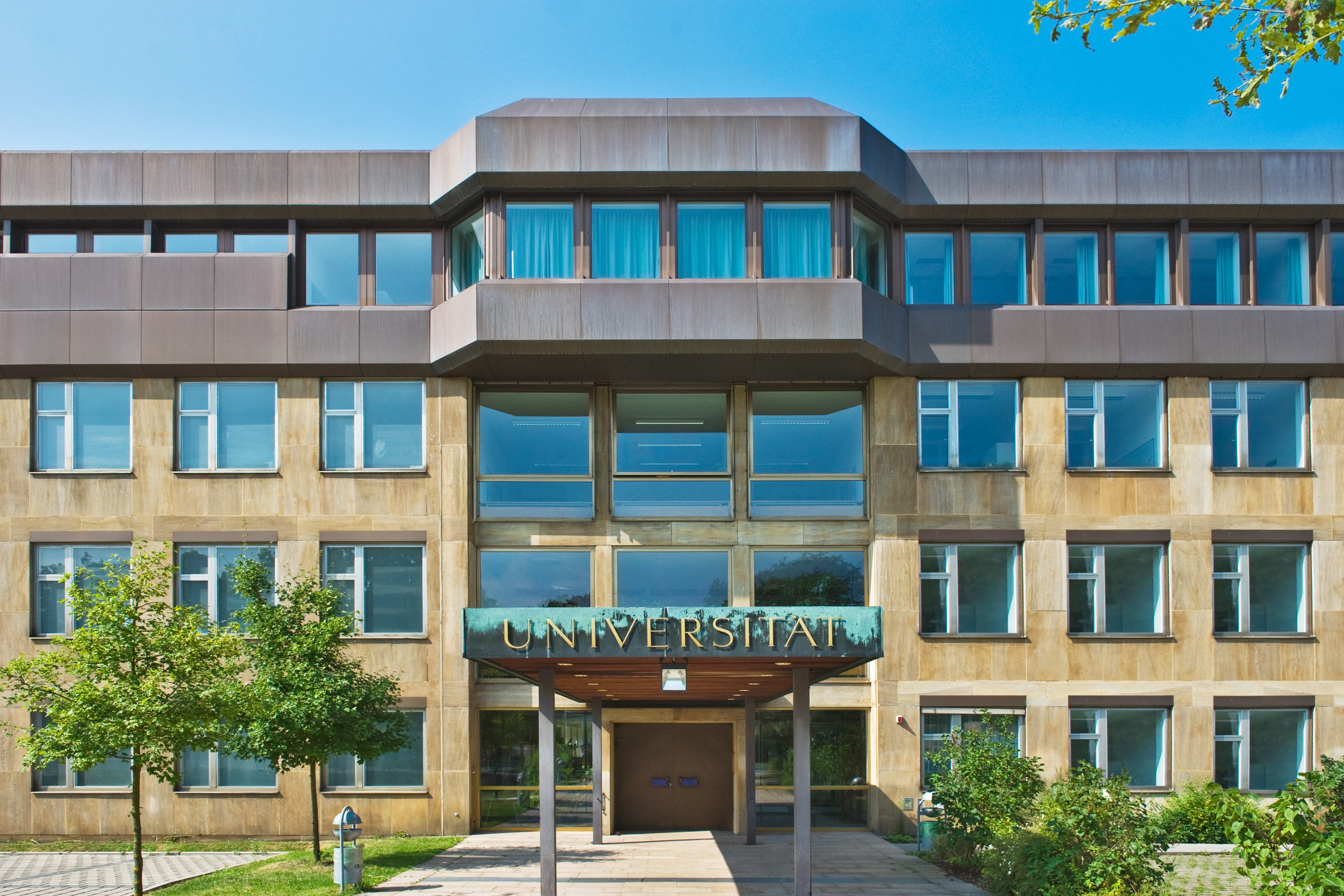

University in Germany
Bamberg, Bayern, Germany
University profile
The Otto-Friedrich-Universität Bamberg (University of Bamberg) is a public university in the Upper Franconian city of Bamberg, Bavaria, founded in 1647. It describes itself as a catalyst for a modern knowledge society, with about 10,400 students (January 2025) and 182 professorships. Its size allows close contact between lecturers and students, and the historic city, a UNESCO World Heritage Site, forms the setting for study.
Teaching and research are organised in four faculties: Humanities (GuK), Social Sciences, Economics and Business Administration (SoWi), Human Sciences and Education (Huwi), and Information Systems and Applied Computer Science (WIAI). More than 80 bachelor's, master's and teacher training programmes can be combined across subjects, studied module by module or taken part-time. Several programmes are taught in English or run as joint and double degrees with partner universities, and some include mandatory study abroad.
Four research fields shape the profile: Digital Humanities, Social and Human Sciences; Empirical Social Research on Education and Labour; Analysis and Preservation of Cultural Heritage; and Medieval Culture and Society. The university has expanded applied computer science and artificial intelligence, securing 30 new professorships through the Bavarian Hightech Agenda and the Bavarian AI competition. Two affiliated institutes, the Leibniz Institute for Educational Trajectories (LIfBi) and the State Institute for Family Research (ifb), work alongside the university, which also cooperates with the Institute for Employment Research (IAB) in Nuremberg.
The university has over 400 international partner universities in 70 countries, and international students make up 19% of the student body (January 2025). About 20% of Bamberg students take part in exchange programmes. A Welcome Center supports internationally mobile scholars and doctoral researchers, and the International Office handles applications from abroad.
The university does not run halls of residence of its own. Rooms are let by providers including the Studierendenwerk Würzburg (the largest local provider), Collegium Oecumenicum Bamberg, Joseph-Stiftung Bamberg, the Baugenossenschaft für den Stadt- und Landkreis Bamberg and Stadtbau GmbH Bamberg, and tutors in most halls help new arrivals. The student ID card works as a semester ticket for buses and trains in the city and district of Bamberg. The university is an EMAS-certified Fairtrade University and has held the family-friendly university distinction since 2005. It is a member of the TechnologieAllianzOberfranken (TAO) with the universities of Bayreuth, Hof and Coburg.
Degree study at the University of Bamberg is subject to a semester fee (Semesterbeitrag), which is a student contribution and not tuition; it includes the Studierendenwerk Würzburg basic fee and the city and district public transport semester ticket. Non-EU/EEA applicants pay a one-off application fee of EUR 60 per semester from winter semester 2026/27.
EUR 300 per month, financed half by the federal ministry and half by private donors. It is awarded first for two semesters and runs up to the standard period of study, and applies to bachelor, master and teacher training students of all nationalities enrolled or intending to start in the winter semester; doctoral students are excluded. Applicants submit an online form with enrolment certificate or admission letter, CV, one to two page motivation letter, entrance qualification and study records; there is no legal entitlement. Places are partly subject-specific.
A one-off grant of EUR 100 to EUR 500 for books or other learning materials, open to students entitled to BAföG who are in at least their second subject semester at Bamberg. Awards follow order of application, with a copy of the BAföG notice, enrolment certificate and a lecturer's confirmation required.
The Studierendenkanzlei advises on scholarships ([email protected], +49 951 863-1266) and lists programmes of the party-affiliated foundations, trade-union and employer-linked bodies, church-affiliated Studienwerke, Studienstiftung des deutschen Volkes, Max-Weber-Programm, Bayerische EliteAkademie and Aufstiegsstipendium. An Ausbildungsbeihilfe for Bamberg students is also offered. Details: uni-bamberg.de/stipendium.
Deutschlandstipendium at the University of Bamberg →
Oskar-Karl-Forster-Stipendium (learning materials grant) →
Browse the scholarships listed for University of Bamberg and check each award’s eligibility.
View scholarships for University of Bamberg →Applicants with foreign citizenship and a foreign school-leaving certificate apply through the university's online application portal. Certificates are evaluated by the International Office using the anabin database, with three outcomes: direct university entry qualification (possibly restricted to certain subjects), pre-university examination (Feststellungsprüfung) at a Studienkolleg, or no access. For the Lehramt an Gymnasien and Realschulen, direct access for all subjects is required. There is no Studienkolleg in Bamberg: applicants who need one attend Studienkolleg München, apply to a Bavarian university of their choice, and normally take two semesters to the Feststellungsprüfung. For Bamberg subjects, the W-course applies to Geographie, Politikwissenschaft and Wirtschaftsinformatik, and the G-course to Psychologie.
Application windows: winter semester mid-May to 15 July; summer semester mid-November to 15 January. EU/EEA citizens may apply to unrestricted bachelor and teacher training courses until the end of the enrolment period. Applicants from outside the EU/EEA pay an application fee of EUR 60 from the winter semester 2026/27, payable once per semester through ePayBayern by Visa, Mastercard or PayPal; it is waived for EU/EEA citizens including dual nationals, holders of a German Abitur or German bachelor's degree, students changing programme at Bamberg, doctoral students, exchange students, and joint or double degree and continuing education programmes.
Documents: CV, passport or ID, school-leaving certificate with grade list, university records where applicable, proof of German proficiency, Feststellungsprüfung certificate if taken, and name-change proof if needed; non-English or non-German documents need official translations. An APS certificate is required for certificates from China, India and Vietnam; TestAS only if the APS certificate shows it was taken.
German is required for all undergraduate programmes; A1 or A2 applications are not possible. Most programmes require B2: telc Deutsch B2, TestDaF level 3 in all four sections in one sitting, DSH-1, Goethe-Zertifikat B2, ÖSD B2 or DSD II. C1/C2 is required for Germanistik, Psychologie and German as a teaching subject: telc Deutsch C1 Hochschule, TestDaF level 4 in all four sections, DSH-2, Goethe-Zertifikat C2, ÖSD C2 or DSD II. The German Course for Study Purposes (minimum B1, direct entry qualification required) costs EUR 750 per semester plus semester fees and lasts up to two semesters. A short-term non-degree study programme of up to two semesters requires B2 (C1 for Germanistik and Psychologie).
Applications open mid-November for the summer semester and mid-May for the winter semester, and for most programmes run until the semester's registration deadline; deadlines and conditions are set per programme. Examples for 2027: Angewandte Informatik requires a final grade of 2.7 or better (German scale), with deadlines of 25 March (summer) and 1 October (winter); Betriebswirtschaftslehre uses an aptitude test with deadlines of 15 March and 15 September; Denkmalpflege has no minimum grade and a 15 July deadline for the winter semester only. Documents: tabular CV, school-leaving certificate and grades, university certificates and grade lists, proof of German skills (except for English-taught programmes), passport or ID, and, where relevant, a letter of motivation, internship references or scholarship proof (DAAD, BAYHOST). German-taught master's programmes generally need B2 (TestDaF level 3 in all sections, DSH-1, Goethe B2, telc B2 or ÖSD B2). Psychologie and Klinische Psychologie und Psychotherapie require DSH-2 level, and Deutsche Sprachwissenschaft, Germanistik and Neuere deutsche Literatur require DSH-3 level or C2 (Deutsche Sprachwissenschaft accepts C1 with conditional admission). English-taught programmes require an IELTS, TOEFL, UNIcert or Cambridge certificate; English proficiency letters are not accepted. Applicants to the International Software Systems Science master's with a qualifying degree from outside the Lisbon Convention area and a final mark below 1.5 need a GRE General Test or GATE score. An APS certificate is required from China, India, Mongolia and Vietnam. Master applicants should contact the welcome center for international master students ([email protected]) about accommodation, visa and first steps.
Admitted students enrol through the university portal and send printed enrolment documents to the Studierendenkanzlei, Kapuzinerstraße 25, 96047 Bamberg. For the winter semester 2026/27, enrolment is possible from 22 June to 2 October 2026, with documents recommended by 14 September 2026. Proof of adequate health insurance is mandatory for enrolment.
Doctoral candidates enrol in doctoral studies and are supported by the Bamberg Graduate Schools and the Welcome Center for Internationally Mobile Scholars.
The university is spread across the old town and nearby sites of Bamberg rather than a single campus. Key locations include:
Libraries: the Main Library plus Departmental Libraries 1 (Theology and Philosophy), 2 (Human Sciences), 3 (Social Sciences and Business Administration), 4 (Language and Literature Sciences), 5 (History and Geography) and a departmental library at the ERBA facilities (Applied Informatics). Canteens and cafeterias, a sports centre and the digital teaching and learning labs (DigiLLabs) serve students. Halls of residence are run by external providers, chiefly the Studierendenwerk Würzburg.
Experiences shared by students of University of Bamberg.
Studied here? Share your experience to help other applicants.

Book a free consultation with our expert counsellors and take the first step towards your dream university.
Copyrights © 2026 StudyMapped. All rights reserved.

Enter your credentials to continue.
Join us and start your study abroad journey.


