
University in United Kingdom
Aberdeen, Scotland, United Kingdom
University profile
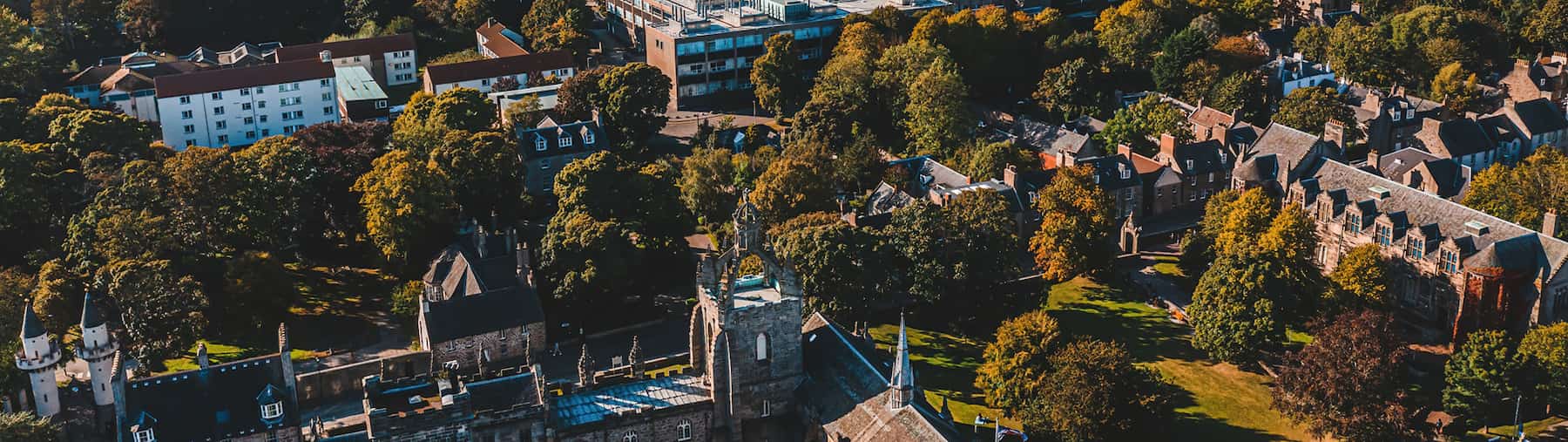
The University of Aberdeen, founded in 1495, is Scotland's third oldest university and the fifth oldest in the UK. It was established by William Elphinstone, Bishop of Aberdeen, with the aim of founding a university "open to all and dedicated to the pursuit of truth in the service of others". Today it is a research-led university of around 15,000 students and 3,500 staff, drawn from more than 130 nationalities.
Teaching and research are based mainly at two campuses in the city of Aberdeen in north-east Scotland: the historic King's College campus in Old Aberdeen, home to the arts, social sciences, physical sciences and the main library, and the Foresterhill health campus, shared with NHS Grampian, where most life sciences and medicine are based. The University also runs AFG College with the University of Aberdeen in Doha, Qatar, and a branch campus in Mumbai, India, which has received University Grants Commission approval.
The academic structure has four faculties, each containing three schools:
Notable institutes include the Rowett Institute of Nutrition and Health, the Institute of Medical Sciences and the Institute of Applied Health Sciences at Foresterhill, the National Decommissioning Centre at Newburgh and the Lighthouse Field Station at Cromarty. The University received the Queen's Anniversary Prize in 2017 for its Health Services Research Unit and again in 2021 for research and teaching in soil science. Gaelic has been taught as a subject since the eighteenth century, and the Business School holds EQUIS accreditation.
Most first-year students live at Hillhead Student Village, the principal residence, which houses around 2,000 students each year, and new students who apply by the deadline are guaranteed a place in halls. Student life centres on the Students' Union (AUSA), with more than 300 sports clubs and societies, and the Aberdeen Sports Village and Aquatics Centre with its 50-metre Olympic-standard pool. International applicants are supported through country-specific entry guidance, a Language Centre with pre-sessional English programmes and foundation routes through the International Study Centre.
The University advises budgeting for annual fee increases. Its recommended living-cost budget is £1,171 per month, and Student visa holders also pay the NHS immigration health surcharge of £776 per year.
New self-funded, full-time, on-campus international students starting in 2026/27 or 2027/28 automatically receive a partial tuition fee waiver: £6,000 for every year of an undergraduate or PGDE programme (excluding Medicine, Dentistry and the DPLP), and £8,000 for taught or research Masters students (excluding the DPLP, PGDE and Dentistry). No application is needed; the award appears on the CAS. Undergraduate details | Postgraduate details
New undergraduates from England, Northern Ireland, Wales, the Republic of Ireland, the Channel Islands and the Isle of Man paying the Rest of UK fee rate automatically receive a £2,000 discount on University accommodation and a £50 weekly catering allowance for 27 weeks in their first year. Scholarship details
Schemes for Scottish students include the Undergraduate Entrance Scholarships, the Cowrie Foundation Scholarship for Black British students from disadvantaged backgrounds, the Robertson Trust Journey to Success Scholarships, the Cormack Gateway 2 Medicine Scholarship and the ICAS Foundation programme for accounting and finance students (2026 applications closed on 31 May 2026). New undergraduates from SIMD20 (Quintile 1) postcodes starting in September 2026 are offered a year of free accommodation in University halls. Scottish student funding
The Alumni Postgraduate Scholarship reduces the tuition fee to £7,000 for most full-time, on-campus taught Masters programmes, and the Aberdeen Alumni Discount gives University of Aberdeen graduates 20% off self-funded postgraduate fees. Scottish-domiciled students can apply to SAAS for a postgraduate tuition fee loan of up to £7,000 and a living-cost loan of up to £6,900; students from England can apply for a Postgraduate Loan through Student Finance England. Graduates with first-class honours can apply for a Carnegie Scholarship. Postgraduate scholarships
The University of Aberdeen Development Trust Sports Bursary Scheme supports up to 20 students a year who compete at or close to national level. Search the funding database
Aberdeen Global Scholarship - Undergraduate and PGDE →
Aberdeen Global Scholarship - Postgraduate →
Canadian Master's Excellence Scholarship →
Browse the scholarships listed for University of Aberdeen and check each award’s eligibility.
View scholarships for University of Aberdeen →Full-time undergraduate applications are made through UCAS; part-time, non-graduating and visiting students apply directly to the University. The deadline for Medicine and Dentistry is 6pm (UK time) on 15 October. For all other degrees, applications submitted by 6pm (UK time) on 14 January are guaranteed equal consideration. Applicants to Education, Medicine and Music programmes may be called for interview, and any interview precedes an offer. Offer holders are invited to an Offer Holder Day, usually in early spring.
Some degrees have additional subject requirements. A Foundation Apprenticeship counts as one Higher at grade A but cannot replace a required subject.
Under its Contextualised Admissions Policy the University makes adjusted or access threshold offers to applicants who meet widening access criteria, including SIMD20 (Quintile 1) postcodes in Scotland, POLAR4 Quintile 1 postcodes elsewhere in the UK, care experience, receipt of free school meals and attendance at a listed priority school. Typical adjusted offers are BBC at Higher or CCC at A Level for MA and BSc programmes, and BBB at Higher or BBC at A Level for Biomedical Sciences and Law. Entry to MSci and MEng is not discounted.
Highly qualified applicants with Advanced Highers, A Levels or the IB can apply through UCAS for second-year entry ("Point of Entry: Year 2") to many MA, BSc, MChem, MSci and BEng degrees, completing an honours degree in three years instead of four. Typical advanced entry offers are ABB at A Level or 34 IB points for MA and BSc programmes, and AAB or 36 for Biomedical Sciences. Advanced entry is not available for Law, Medicine or Primary Education.
Country-specific entry requirements are set out for each country and territory; applicants from some countries complete a foundation year at the International Study Centre before progressing to a degree. Students from outside the UK who need a Student visa receive a Certificate of Acceptance for Studies (CAS) to support their visa application.
Nationals of recognised English-speaking countries, and holders of approved school qualifications, three A Levels or the IB taught in English, or an English-medium degree from an approved university may be exempt. Test scores must normally be from within two years of the course start.
Applications for taught Masters programmes are made through the Direct Applicant portal, with September and January intakes and separate deadlines for applicants who need a Student visa. PGDE teaching programmes are applied for through UCAS.
PhD entry typically requires a Masters degree or a first or upper-second class (2:1) honours degree in an appropriate area, or an equivalent qualification. Unless applying for an advertised studentship, most research degrees can start at any time, and applications are accepted up to 18 months before the preferred start date.
Study programmes offered at University of Aberdeen.
Experiences shared by students of University of Aberdeen.
Studied here? Share your experience to help other applicants.

Book a free consultation with our expert counsellors and take the first step towards your dream university.
Copyrights © 2026 StudyMapped. All rights reserved.

Enter your credentials to continue.
Join us and start your study abroad journey.


