
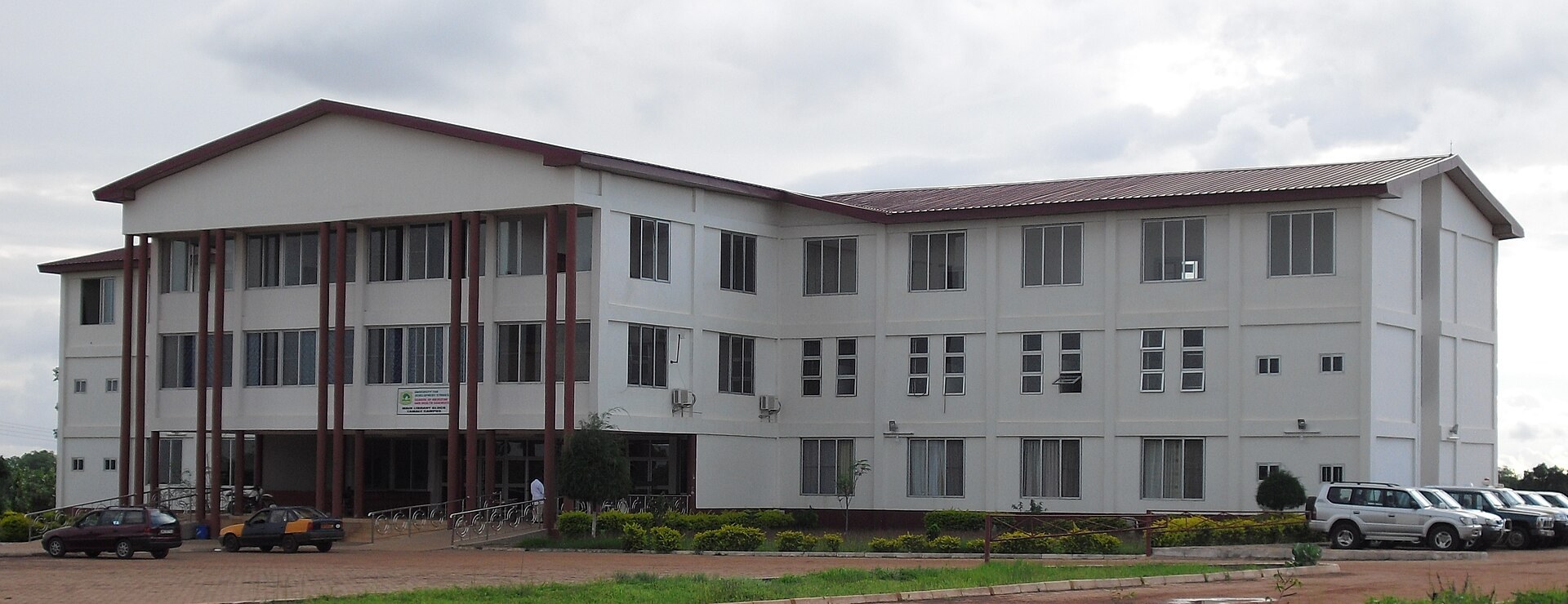

University in Ghana
Tamale, Ghana
University profile
The University for Development Studies (UDS) is Ghana's first public university in the North. It was established by the Government of Ghana under PNDC Law 279 and gazetted on 15 May 1992, with the aims of providing higher education to all suitably qualified persons, undertaking research applied to the needs of the people of Ghana, and blending the academic world with the community for the development of northern Ghana in particular. Its motto is Knowledge for Service and its stated vision is to be a Home of World Class Pro-Poor Scholarship.
UDS has a pro-poor mandate that shapes its teaching, research and outreach, with an emphasis on practically oriented, field-based training. Its community-technical-interface programme combines coursework with the Third Trimester Field Practical Programme (TTFPP) and Community Based Education and Service (COBES). The Directorate of Community Relations and Outreach Programmes runs these along with teaching practice and a homestay programme for international students.
The University operates a multi-campus system in and around Tamale, with a further campus at Yendi: Tamale (Central Administration and the health schools), Nyankpala, Tamale City, Tamale North and Eastern Campus, Yendi. Schools and faculties include the Faculties of Agriculture, Food and Consumer Sciences; Bioscience; Communication and Media Studies; Education; Industrial Arts and Technology; Law; Natural Resources and Environment; Physical Sciences; Social Sciences; and Sustainable Development Studies; and the Schools of Allied Health Sciences, Business, Dentistry, Economics, Engineering, Medicine, Nursing and Midwifery, Pharmacy and Pharmaceutical Sciences, Public Health and Veterinary Sciences, together with the Graduate School.
The oldest faculty is Agriculture, Food and Consumer Sciences, which admitted the first 40 students in September 1993. The School of Medicine and Health Sciences uses problem-based learning and sends students to rural communities for four-week placements. The University runs diploma, undergraduate and graduate programmes, including regular and sandwich graduate programmes, a Graduate Entry Medical Programme and professional health degrees such as the six-year MBChB and Doctor of Pharmacy.
Students live in university halls and hostels or in private hostels around the campuses. On-campus halls include GUSSS Hostel and Sagnarigu Hall in Tamale and Union, Jeddah, Nyankpala and Graduate Halls at Nyankpala, and rooms are booked through an online accommodation portal. The Dungu and Nyankpala campuses have University Clinics, and the University Counselling Directorate provides psychological support and career services.
International students are admitted at undergraduate, postgraduate and short-stay levels. The Directorate of International Relations and Advancement (DIRA), in the Central Administration building on the Dungu campus, handles international admissions, orientation, visa and residence-permit support and welfare. Applicants from non-English-speaking countries can take an English Proficiency Course run by the Department of Languages in the Faculty of Communication and Media Studies.
UDS does not offer routine scholarships to international students, but may facilitate nominations for bilateral, Commonwealth or partner-funded schemes. Information on the University's own bursaries for Ghanaian students is handled through Student Affairs and the Dean of Students' Affairs. Official links: International fees and financial aid.
DAAD MPhil/PhD Economic Development Policy Scholarships (WAC-SRT, UDS) →
Browse the scholarships listed for University for Development Studies and check each award’s eligibility.
View scholarships for University for Development Studies →Applicants need at least C6 in all three core subjects (English Language, Core Mathematics, Integrated Science or Social Studies) and three relevant elective subjects. A grade of D7, E8 or F9 in any one of these subjects means the candidate is advised not to apply for a degree. The aggregate of the best six subjects (three core, three electives) must not exceed 36, although admission is competitive and programme cut-off points are much lower. Social Studies is not an elective. For candidates who read Arts or Business subjects, Social Studies may replace Integrated Science in the aggregate if the grade is better and the candidate has at least a pass in Integrated Science; it does not replace Integrated Science for Science students.
Diploma entry requires three credit passes in elective subjects in the area of specialisation and at least a pass (D7 or better) in English Language and Mathematics. Candidates who meet degree requirements but whose aggregates are not competitive may be offered diploma places.
HND and other diploma holders with Second Class Lower or better in a related programme are considered for Level 200. Holders with Third Class or Pass are considered for Level 100. A selection interview is required.
MBChB (6 years): WASSCE candidates with an aggregate of 9 or better (three core subjects plus three electives from Chemistry, Biology, Physics or Elective Mathematics) are shortlisted for an entrance examination and interview; the examination and interview fee is GHC 350. GCE A-Level applicants need science A-levels with a maximum aggregate of 9 plus O-Level credits (Grade 6 or better) in five subjects including English Language, Mathematics, Additional Mathematics and General Science. All enter at Level 100.
Graduate Entry Medical Programme (GEMP): an integrated 4.5-year full-time MBChB for holders of at least a Second Class Lower science-based first degree (for example biological sciences, biochemistry, chemistry, physician assistantship, pharmacy, nursing or midwifery, nutrition, dietetics, food science, biomedical engineering, laboratory sciences, physiotherapy, radiography). Applicants need credit WASSCE/SSSCE grades in three core and three elective science subjects including Biology and Chemistry, and evidence of National Service where applicable. Shortlisted applicants take a four-week access course (fee GH¢ 2,000), a written examination and an oral interview. The 2026 application deadline was 2 April 2026.
BSc Physician Assistant Anaesthesia (2 years, Level 300 entry): open to national and international applicants with a diploma in Registered General Nursing, Psychiatry Nursing or Nurse Anaesthesia, or a BSc in Nursing, Psychiatry Nursing or Midwifery, plus post-registration experience in an accredited facility. Direct entry from WASSCE is not accepted.
Nursing and nurse anaesthesia: the BSc Nurse Practitioner and 2/3-year BSc Nursing programmes require registered nurses with a diploma or State Registered Nurse certificate and at least three years' work experience. BSc Nurse Anaesthesia requires an RGN diploma with three years' post-registration experience, an RGN BSc with two years, or an Advanced Diploma in Nurse Anaesthesia with two years.
The BSc Community Nutrition programme requires credit passes (A1-C6) in the three core subjects and three electives.
Regular and sandwich graduate programmes are run through the Graduate School. MSc applicants need at least a Second Class Lower first degree in a relevant field; MPhil applicants need at least Second Class Upper and a research proposal; PhD applicants need an MPhil or research MSc, a proposal and an interview. Two or three referee reports are usually required, and interviews are held by the host department. Public Health Nutrition applicants from non-English-speaking countries need TOEFL iBT 79 (no section below 17) or IELTS 6.5 (no component below 6.0).
Qualifications must be equivalent to Ghanaian standards, for example WASSCE, SSCE or NECO with passes in six subjects including English and Mathematics, GCE A-Level with three relevant passes, the Kenyan KCSE with at least C+, the International Baccalaureate, the US High School Diploma with SAT or ACT scores, and national baccalaureates with 12-14/20. Undergraduate applicants from non-English-speaking countries need IELTS 6.0 or TOEFL 70. Postgraduate applicants need a bachelor's degree of at least Second Class Lower (or equivalent) and IELTS 6.5 or TOEFL 80. Non-English documents need certified translations. A study visa, a valid passport (six months' validity), a Yellow Fever certificate and health insurance (NHIS or an approved international policy) are required, and students staying longer than a trimester obtain a residence permit from the Ghana Immigration Service. Approved international tuition is quoted in US dollars; for example, non-AU nationals pay $8,750 for MBChB or Dentistry, $2,500 for BSc Nursing, $2,000 for other BSc programmes and $1,750 for BA/BEd programmes per year as quoted for the programme, with lower rates for AU and Caribbean nationals. On-campus rooms cost $1,200 (single) or $650 (double).
Ghanaian applicants buy an e-voucher (GH¢ 200 undergraduate, GH¢ 250 postgraduate) at designated banks or through the UDS online payment portal, then complete the online form at the admissions portal, uploading a passport photograph on a white background and certificates. After submission, undergraduate and postgraduate applicants print the application summary and send copies with certificates to the Head (Academic and Students' Affairs) at P.O. Box TL 1350, Tamale, and scan the documents to the admissions email. Forms for the 2026/2027 year opened on 16 January 2026. International applicants register on the portal as International Applicants, do not buy an e-voucher, and are encouraged to apply by 31 July for September entry; applications are reviewed continuously.
MBChB aggregate 9; Doctor of Pharmacy 12 (18 fee-paying); BSc Nursing and Midwifery 9 (male) and 10 (female) for science students, 7 and 8 for non-science students; BSc Health Information Management 18; Doctor of Medical Laboratory Sciences 12; BSc Medical Imaging Technology 11; BSc Community Nutrition 18; BSc Dietetics 16.
The University has an e-learning platform and a library portal. Students may also use the Tamale West Hospital, Tamale Central Hospital and Tamale Teaching Hospital for advanced care.
Study programmes offered at University for Development Studies.
Experiences shared by students of University for Development Studies.
Studied here? Share your experience to help other applicants.

Book a free consultation with our expert counsellors and take the first step towards your dream university.
Copyrights © 2026 StudyMapped. All rights reserved.

Enter your credentials to continue.
Join us and start your study abroad journey.


