

University in Canada
Pointe-de-l'Église, Nova Scotia, Canada
University profile
Université Sainte-Anne is the only French-language post-secondary institution in Nova Scotia. It offers university and college programmes as well as French-as-a-second-language immersion and customised training. The language of instruction and administration is French, except for English courses and some continuing-education courses, and the language of use on campus is French. It serves Acadians and students of all backgrounds who wish to study in a francophone setting.
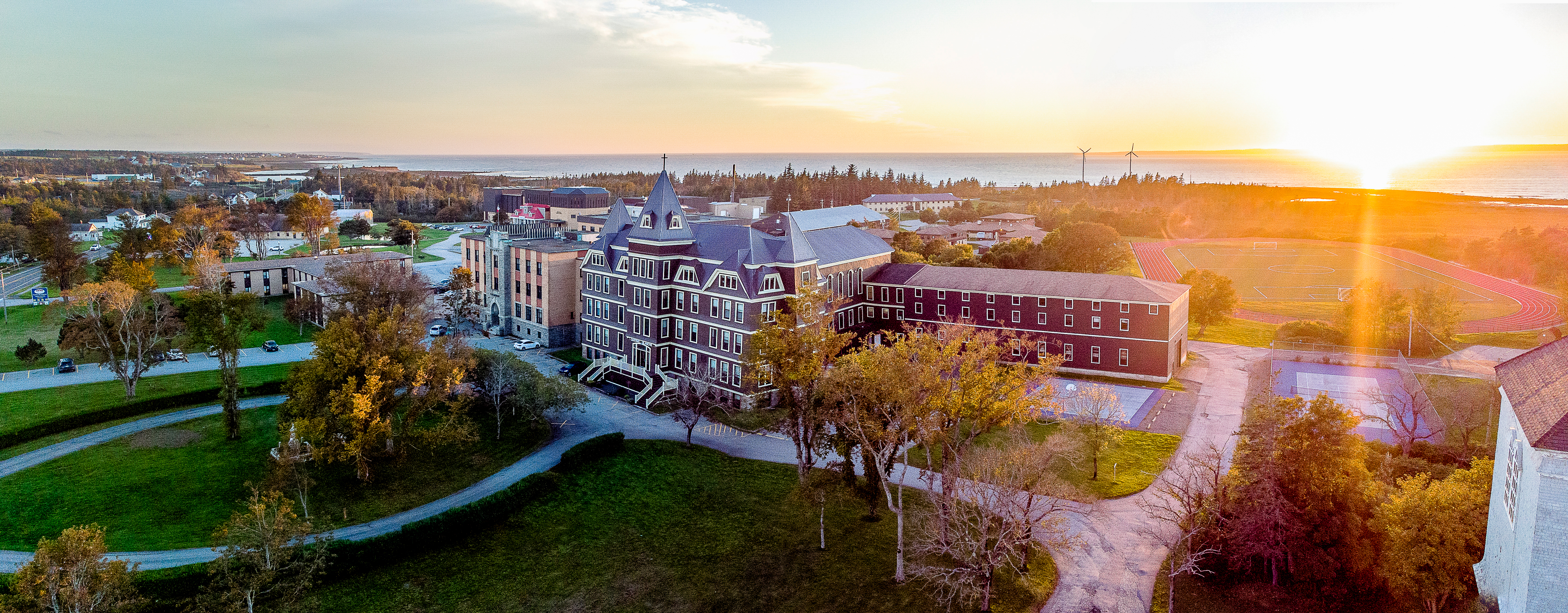
The main campus is at Pointe-de-l'Église (Church Point) on Baie Sainte-Marie, in the largest Acadian region of Nova Scotia, about 260 kilometres from Halifax. Teaching is also delivered at four other campuses: Halifax, Tusket, Petit-de-Grat on Isle Madame, and Saint-Joseph-du-Moine on Cape Breton Island. Some programmes are also offered online.
University programmes are grouped in two faculties. The Faculty of Arts and Sciences comprises the departments of French Studies, English Studies, Humanities and Sciences. The Faculty of Professional Programs comprises the departments of Administrative Sciences and Education. Degrees include the Bachelor of Business Administration (including a co-operative option), Bachelor of Arts (majors in Acadian Studies, Canadian Studies, English, French, History, Commerce, double major or no major), Bachelor of Science (including a Biology major with co-op option), Bachelor of Education and combined BA/BEd and BSc/BEd routes, and a Bachelor of Social Work. Preparatory diplomas in health sciences (including a route towards the Atlantic Veterinary College) and an English-as-a-second-language certificate are also offered. Graduate programmes are the MA in Francophone Cultures and Spaces, the Master of Science in Biological Sciences and the Master of Education.
Research is organised around units such as the Marine Research Centre, the Lobster Quality Centre, the Louis-E.-Deveau Entrepreneurship Centre, the Science and Industry Innovation Laboratory and the Observatoire Nord/Sud, together with a Canada Research Chair on women, democracy and power in the Francophonie.
On the Pointe-de-l'Église campus, nearly 300 residence places are available, along with a cafeteria, the Louis-R.-Comeau Library and the Marcel-R.-Comeau Sports Centre (pool, ice rink, track and soccer field, gym, cardio and weight rooms). Only this campus has student residences and a cafeteria. Student life includes the Dragons varsity teams, student associations and a buddy programme. International students arrive from around the world and need a Canadian study permit; they can apply through the provincial attestation letter route or the Francophone minority communities student pilot.
Many Canadian students coming directly from high school receive an automatic Excellence Scholarship of up to $5,000, renewable, based on their average. The Merit Scholarship by Excellence (approximately $10,000, renewable) covers full tuition for exceptional applicants at the discretion of the scholarship committee, in limited numbers. The Out-of-Province Scholarship ($1,000, renewable) goes to students from outside Nova Scotia who do not qualify for an excellence award. For these, completing the admission application and meeting the 28 February deadline places the applicant in the first allocation round.
Nova Scotia students receive $128.30 off each 3-credit course through the provincial bursary, and international students receive an automatic international reduction of $125.40 per 3-credit course.
Provincial and federal student loans and aid programmes are available; the university's financial services officer advises on loans (902-260-5030). The university also lists numerous external awards, such as the Nova Scotia French monitor programme and Explore.
Details and application forms: scholarships page, tuition and fees.
Bourses d'excellence (Entrance Excellence Scholarships) →
Bourse de mérite par excellence (Excellence Merit Scholarship) →
Bourse pour les jeunes pris en charge (Youth in Care Scholarship) →
Browse the scholarships listed for Université Sainte-Anne and check each award’s eligibility.
View scholarships for Université Sainte-Anne →Requirements vary by programme and province. For the BSc with a Biology major, applicants from Nova Scotia need five academic or advanced Grade 12 courses including French 12, advanced mathematics, pre-calculus or calculus, and two sciences among Biology 12, Chemistry 12 and Physics 12, with an average of 60% or more across the five courses. Equivalent course lists are set for New Brunswick, Prince Edward Island, Quebec (Secondary V), Ontario (e.g. FRAN 4U or 3M, MHF4U or MCV4U, and two of BIO 4U, CHI 4U, PHY 4U) and Newfoundland and Labrador, each also with a 60% average. Applicants from other provinces or countries need a secondary diploma or equivalent with the courses required for the chosen programme. Most programmes have no fixed quota of places, so one application naming the preferred programme is enough.
All students beginning a university programme sit a French placement test (September 2026 sitting on 8 September at the main campus). An English placement test is compulsory for students whose first language is not English, unless they completed English 12 academic in Nova Scotia or an equivalent course elsewhere in Canada; it is a placement tool and cannot be failed.
Up to 30 credits of transfer credit are granted for IB courses (higher level and some standard level courses passed with at least 4/7, plus Theory of Knowledge) and up to 30 credits for AP courses passed with at least 3/5, provided the course fits the student's programme.
Applications from international students are accepted for the fall session until 1 May of the same year and for the winter session until 1 August of the previous year. The non-refundable application fee is $150. Applicants from April onwards face shorter deadlines for the required advance payment. A study permit is required and can be sought through a provincial attestation letter or the Francophone minority communities student pilot (PPECFSM), which must be indicated at the time of application. After the study permit is obtained, a mandatory advance of $10,000 for university studies ($13,000 for master's programmes) or $4,000 for college studies must be paid within 30 days; it is non-refundable and counts towards fees. A $250 housing fee is separate.
Applicants create an account on the online admission portal (Omnivox) and upload transcripts; official copies must be sent by the previous institutions. A birth certificate or government-issued ID showing date of birth is also required. Nova Scotia students may consent to electronic transfer of their transcript through the provincial MyTranscripts system. The application fee for Canadian students is $55 ($60 for the Bachelor of Education and master's programmes), paid online by Visa or MasterCard; international students unable to use cards can pay through PayMyTuition or GlobalPay. An eligibility letter appears in the portal once the file is processed.
Canadian students pay $894 per 3-credit course (without lab) in BA, BSc, BBA and BSW programmes and $941 in BEd and combined BA/BEd or BSc/BEd programmes; international students pay $1,619 per 3-credit course. Master's tuition per term is $2,682 (MA) and $3,003 (MSc Biological Sciences) for Canadians, and $4,857 for international students in both; the MEd is $1,188 per 3 credits (Canadian) or $1,619 (international). Lab fee is $132 per course. Nova Scotia students receive a $128.30 reduction per 3-credit course and international students a $125.40 reduction. People aged 60 and over receive a 50% tuition reduction. Residence rates range from $2,509 to $3,659 per term depending on the building, and meal plans are $3,388 per term (cafeteria plan) or $498 per term (FLEX40).
Study programmes offered at Université Sainte-Anne.
Experiences shared by students of Université Sainte-Anne.
Studied here? Share your experience to help other applicants.

Book a free consultation with our expert counsellors and take the first step towards your dream university.
Copyrights © 2026 StudyMapped. All rights reserved.

Enter your credentials to continue.
Join us and start your study abroad journey.


