
University in France
Paris, Île-de-France, France
University profile
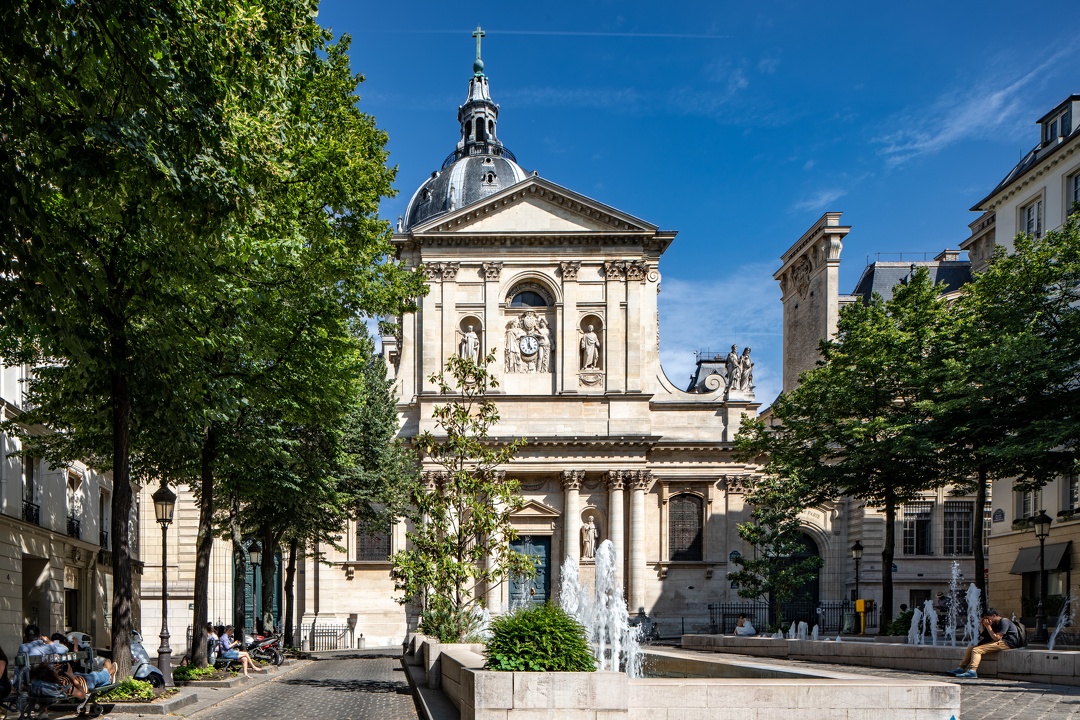
Université Paris 1 Panthéon-Sorbonne is a public university in Paris and, in its own words, the leading French university in the humanities and social sciences. It traces its heritage to the college founded by Robert de Sorbon in the thirteenth century and was created by decree in 1971 after the break-up of the former University of Paris. It combines rigorous scientific training with research in law, economics, management, history, philosophy, the arts and mathematics.
The university is spread across 26 sites in Paris and the Île-de-France region and welcomes nearly 46,000 students each year, supported by about 1,500 teachers and teacher-researchers (48% women). It has an annual budget of 250 million euros and 322 partner institutions in 73 countries, and it belongs to the Una Europa alliance of eleven European universities.
Teaching is organised in three poles. The humanities and arts pole covers history, geography, philosophy, art history, archaeology, visual arts and the science of art, with some programmes unique in France such as aesthetics and the restoration of works of art. The law and political science pole is built around the École de droit de la Sorbonne (EDS) and groups law, public administration, business law, international and European studies, political science and labour and social studies. The economics and management pole brings together economics, management and business economics, and mathematics and computer science.
Its components include the École d'économie de la Sorbonne, École d'histoire de l'art et d'archéologie de la Sorbonne, École d'histoire de la Sorbonne, École de droit de la Sorbonne, École de management de la Sorbonne, École de Science politique de la Sorbonne and École des arts de la Sorbonne, the UFRs of geography, mathematics and computer science, and philosophy, and institutes such as IAES, IEDES, IEJ, IDUP, IREST, the Institut des assurances de Paris and ISST, alongside the Formation continue Panthéon-Sorbonne and the associated IAE. The offer includes 22 licences, 18 double licences, 418 master tracks and 71 university diplomas.
International students make up more than 20% of the student body (2025-2026). The university holds the three-star 'Bienvenue en France' label awarded by Campus France, runs two integration weeks a year, and offers programmes taught entirely in English in law, economics, art history, management, mathematics and tourism. Student life includes active associations, cultural and sports activities, a student health service (SSE) with centres at Pierre Mendès France and Saint-Charles, and a library network of seven integrated and 25 associated libraries.
Registration fees are set annually by ministerial order. Licence: 178 euros (2,902 euros for non-EU students); second diploma licence: 118 euros (1,934 euros non-EU); double licence: 296 euros (4,836 euros non-EU); Master 1 and 2: 255 euros (3,950 euros non-EU); second diploma master: 167 euros (2,633 euros non-EU); doctorate: 398 euros; magistère: 600 euros; auditeur libre: 350 euros. University diplomas (DU) may carry additional fees. Payment by card or cheque, or in three instalments online until 15 October.
Paris 1 applies differentiated registration fees only partially in 2026-2027. Besides the national exemptions (doctorate and HDR, exchange students, French government scholarship holders, apprentices, refugees, long-term residents, students attached to a tax household in France for two years, and others), the university exempts asylum seekers and stateless persons, beneficiaries of temporary protection, holders of the DU Passerelle, students under an international agreement with a partner university, students re-enrolling in the same cycle, students taking a gap year, and nationals of the 44 least developed countries on the UN list. Students enrolled in 2025-2026 stay exempt until the end of their cycle. Official page.
The Contribution vie étudiante et de campus (CVEC) is a separate national levy paid to Crous before registration, with exemptions for scholarship holders and asylum seekers among others. The university uses its share for the FSDIE, preventive medicine, sport, culture and campus life; FSDIE project funding for student associations goes up to 10,000 euros.
Browse the scholarships listed for Université Paris 1 Panthéon-Sorbonne and check each award’s eligibility.
View scholarships for Université Paris 1 Panthéon-Sorbonne →Application and registration are annual and individual, in five steps: choose a programme, apply, wait for authorisation, complete administrative registration online, then pedagogical registration. First-year licence applicants who are French, nationals of the European Economic Area, Andorra, Monaco or Switzerland, or holders of a French baccalauréat or European Baccalaureate apply through Parcoursup. Applicants with a foreign secondary-school diploma who are not EEA nationals use the Demande d'Admission Préalable (DAP): the dematerialised 'Études en France' platform from 15 October to 15 December 2026 if they live in a Campus France country, the paper 'dossier vert' if they live in France (1 October to 15 December 2026), or the 'dossier blanc' if they live abroad in a non-Campus France country (1 October to 15 December 2026). All licence degrees are taught in French and a B2 level of French is required at the time of application; the university organises TCF test sessions. Diplomas and transcripts must be translated into French by a professional translator.
Applicants to the second or third year of licence or to the second year of master apply through eCandidat if they are French, EEA, Andorran, Monegasque or Swiss nationals, or hold a residence permit valid for the whole academic year. Other non-EEA applicants living in a Campus France country apply through the 'Études en France' platform from 15 October 2026, with the deadline set by their Campus France office; those living elsewhere apply through eCandidat. First-year master applicants use Mon Master (French and EEA nationals, and non-EEA applicants living in France or the EEA or in countries outside the Études en France scheme), or Études en France from 15 October 2026 for Campus France countries. The Demande d'admission adaptée (DAA) through eCandidat is open to refugees, beneficiaries of subsidiary or temporary protection, stateless persons and children of diplomats posted in France, with applications opening between February and March 2027.
Typical documents: CV and motivation letter, identity document, secondary and university diplomas and transcripts with professional translations, a language certificate, a 2-3 page research project for Master 2 Recherche, and an optional recommendation letter. Lists vary by programme and are managed by each department.
For programmes taught in French, a B2 level (Licence 1 and 2) or C1 level (Licence 3, Master 1 and Master 2) is required, shown by DELF/DALF or TCF. For programmes taught in English, IELTS, TOEFL, TOEIC or Cambridge certificates are accepted at the same levels. Certificates are required only from nationals of countries where French (or English) is not an official language.
International doctoral candidates may come through a joint-supervision agreement (cotutelle de thèse) with a foreign university, a doctoral research stay, or individually. In a cotutelle the candidate has two supervisors, spends at least one semester in each institution, normally completes the thesis in three years (one-year extension possible), is exempt from registration fees at one of the two universities, and receives both doctoral diplomas after a single defence.
Non-European students need a long-stay student visa valid as a residence permit (VLS-TS 'étudiant') or the temporary long-stay student visa, requested through France-Visas before arrival in France.
The university operates 26 sites and centres in Paris and the Île-de-France region. Named sites include:
The Service commun de la documentation groups 7 integrated and 25 associated libraries, with 352,102 documents and 109,393 books and journals accessible online. Student services include the Student Health Service shared with Paris Cité and Sorbonne Nouvelle (general medicine, nutrition, vaccination, psychological support and more), housing partnerships with Hénéo, Crous and the Cité internationale universitaire de Paris, and an Atelier des 130 creative workshop at the Odéon.
Study programmes offered at Université Paris 1 Panthéon-Sorbonne.
Experiences shared by students of Université Paris 1 Panthéon-Sorbonne.
Studied here? Share your experience to help other applicants.

Book a free consultation with our expert counsellors and take the first step towards your dream university.
Copyrights © 2026 StudyMapped. All rights reserved.

Enter your credentials to continue.
Join us and start your study abroad journey.


