
University in France
Orléans, Centre-Val de Loire, France
University profile
The Université d'Orléans (UO) is a multidisciplinary public university in the Centre-Val de Loire region of France. It was founded in 1306 by Pope Clement V, making it one of the oldest universities in Europe, and was re-established in the mid-1960s on a campus south of the city of Orléans. It is a public scientific, cultural and professional institution (EPSCP) covering initial and continuing education, research, professional integration and international cooperation. It has 20,213 enrolled students (January 2026) and 1,227 teaching and research staff alongside 857 administrative and technical staff.
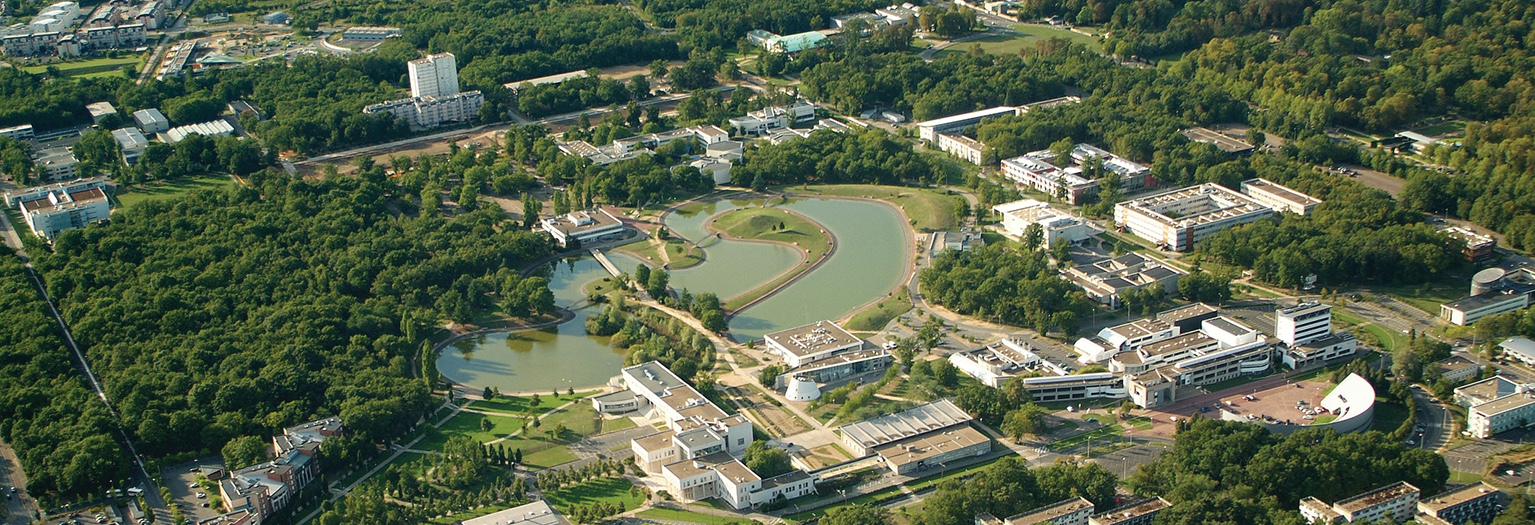
The main campus, Orléans-La Source, extends over about one hundred hectares, 100 km from Paris in the Loire Valley, a UNESCO World Heritage landscape. With its lake, woods and lawns, it hosts most of the university; the other sites (Bourges, Chartres, Châteauroux, Issoudun, Blois and Tours-Fondettes) are described as sites de proximité. The university counts 14 geographic sites in 7 towns and 233,663 m2 of floor space, and is preparing a new city-centre site, Campus Madeleine, due to open in Orléans from the start of the 2027 academic year.
Teaching is organised through the UFR Droit, Économie, Gestion; the UFR Lettres, Langues et Sciences Humaines; the UFR Sciences et Techniques; a health faculty (UFR Santé, with a medicine department in Orléans and the École Universitaire de Kinésithérapie); four IUTs (Orléans, Bourges, Indre and Chartres); Polytech Orléans, the university engineering school; the INSPÉ Centre Val de Loire for teacher education; the IAE Orléans school of management; and the Observatoire des Sciences de l'Univers en région Centre-Val de Loire (OSUC). The university lists 206 programmes across five fields: Arts, Letters and Languages; Humanities and Social Sciences; Law, Economics and Management; Science, Technology and Health; and sport sciences (STAPS).
Research is carried out in 26 research units (9 joint research units, 14 university research teams and 3 CNRS units), 9 research federations and five doctoral schools within the Collège Doctoral Centre-Val de Loire, co-accredited with the Université de Tours. The university holds the European HRS4R (Human Resources Excellence in Research) label and belongs to the ATHENA European university alliance of ten partners. It is also a member of the Pôle Universitaire Centre-Val de Loire with the Université de Tours and INSA Centre Val de Loire, and of AUREF, the EUA, the AUF and France Universités.
Student life at La Source includes the Maison de l'Étudiant, the Guichet de l'AIDE (individual student support), a university health service, the Passerelle Handicap, a university gymnasium and sports hall, the Le Bouillon cultural centre and a library network of 23 libraries. More than 100 student associations operate on the campuses, and the sports service offers over 50 activities. Student housing and catering are provided by CROUS Orléans-Tours. More than 2,000 international students, about 14 per cent of enrolment from nearly 90 countries, study at the university; the Guichet Unique, a buddy system and an Institut de Français support new arrivals.
Registration fees are set annually by the Ministry. National rates (principal registration): BUT, Licence, Licence professionnelle, CPGE, Capacité en droit and DFGSM, 178 EUR; Master and DFASM, 255 EUR; doctorate and HDR, 398 EUR; engineering degree (Polytech Orléans), 630 EUR; auditeur libre, 178 EUR. Students on international mobility (article 8 of the arrêté of 19 April 2019) pay 2,902 EUR in Licence-level cursus and 3,950 EUR in Master-level cursus; doctoral fees are the same as the national rate. A second (complementary) registration costs 118 EUR, 167 EUR and 265 EUR at national rates (Licence, Master, doctorate), 420 EUR for engineering, and 1,934 EUR or 2,633 EUR for international mobility students in Licence or Master. Some components add a specific complementary fee. Students holding a grant on social criteria are exempt from registration fees.
Payment is by card or bank transfer, and in cash up to 400 EUR as an exception. Payment in three instalments is available online for fees above 600 EUR, and in five instalments for students subject to differentiated fees who hold a French bank card. Fee schedule.
The CVEC is a separate mandatory contribution of 105 EUR, paid or exempted (for students holding grants) at cvec.etudiant.gouv.fr before enrolment; it is paid once, even for multiple registrations. It funds health, sport, culture and social support, and access to those actions is free for all students. Students in continuing education, lycée-based courses or international exchange in France do not pay it. CVEC page.
Students whose grant status could not be shown at enrolment, students who transfer to another university or who cancel before 15 October 2026 are refunded (minus a 23 EUR transfer fee). Students under 28 whose quota is at most 975 EUR may be refunded by decision of the President; students over 975 EUR with a changed situation, foreign students whose family income is not taxed in France, unfunded doctoral students and students over 28 are considered by a refund commission. Applications are due by 31 January 2027.
The university nominates candidates for the France Excellence Eiffel scholarship of the French Ministry for Europe and Foreign Affairs, for Master (applicants born after 31 March 1997) and doctorate (born after 31 March 1991). Applications must pass through the university's international relations office ([email protected]) and must not be sent directly to Campus France; internal selection for the 2027-2028 campaign closes on Friday 13 November 2026 at 23:59 (UTC+1). The main criterion is academic excellence. For a doctorate, a supervisor must be found before 4 December 2026. Eiffel procedure.
Students of the double Licence in Languages with Siegen (UFA grant) and the double degree in law with Macerata (UFI grant) receive mobility grants during their year in France. International student grants.
An ad hoc specific aid (ASAP) is decided monthly by a local commission at CROUS, after a file prepared with a social worker; the university's social service can be contacted at [email protected] or 02 38 41 71 79. The CVEC fund also finances the Coup de Pouce scheme (food vouchers, emergency parcels and school supplies). Exchange students can pay 65 EUR per semester for French courses at the Institut de Français.
France Excellence Eiffel Scholarship at Université d'Orléans (Master and Doctorate) →
Browse the scholarships listed for Université d'Orléans and check each award’s eligibility.
View scholarships for Université d'Orléans →Applicants who hold or are about to obtain the French baccalauréat apply through Parcoursup (January to March). Holders of a foreign baccalauréat living abroad submit a demande d'admission préalable (DAP) between 1 October and 15 December: through the cultural service of the French embassy (dossier blanc), or, in countries with a Centre pour les Études en France, exclusively online through the Études en France application (1 October to 15 December; the deadline may be earlier in some countries). Foreign baccalauréat holders residing permanently in France send a dossier vert by email to [email protected] between 1 October and 15 December. Stateless persons, refugees and beneficiaries of subsidiary protection are exempt from the DAP and may request an application file by email before 15 June. For BUT, candidates in an Études en France country apply through that application between 1 October and 31 December. Some programmes are not open to first-year Licence applicants.
At least three years of higher education abroad are recommended for entry to the third year of the Licence through this procedure. Applicants in Études en France countries apply through that application (1 October to 31 December). Others request a file between 1 February and 15 March, stating the level and programme, nationality, place of residence and last diploma; completed files are due at each UFR by 31 March.
Applicants in Études en France countries apply only through that application (1 October to 31 December). Others apply on eCandidat between February and June, depending on each programme's campaign dates.
Candidates holding or preparing a national Licence or equivalent apply on the MonMaster platform (2026 calendar: application phase 17 February to 16 March; admission proposals from 3 June; complementary phase 19 to 25 June). The file includes a CV, post-baccalauréat record, transcripts for at least the last five semesters (translated into French with ECTS for candidates from outside French universities), internships and work experience. Non-European candidates residing in an Études en France country apply through that application instead. Programmes taught at least 50% in a foreign language, or recruiting at least 50% international candidates, may use their own channels.
Non-francophone applicants must take the French language level verification test, and the file must include a certificate showing at least level B2. Programmes taught in English are offered in engineering at Polytech, law and economics at undergraduate level, and masters in International Economics, Languages, Business and International Management, Sport Performance Training and Optimisation (Sport Psychology), Fundamental and Applied Physics in Space Sciences and Applications (PhyFA) and Automotive Engineering for Sustainable Mobility (AESM).
Polytech Orléans offers an integrated preparatory course (PeiP) and seven engineering specialities, five as students and three through apprenticeship. First-year entry runs through Parcoursup; administrative enrolment opens on 20 August 2026 and teaching begins on 1 September.
Students in the first or second year of a CPGE must enrol in parallel at the university (16 September to 15 October 2026) under the dual-enrolment scheme.
Registration and annual re-registration are made through the ADUM application, following the procedures of the Collège Doctoral Centre-Val de Loire and the doctoral school managers ([email protected]). International joint supervision (cotutelle de thèse) leading to a double doctorate is available.
Before enrolling, pay or be exempted from the CVEC and obtain the attestation number. Create a MoveOn account and complete the pre-enrolment file, available from 4 July, before arrival, once you hold your visa. Students admitted to Orléans-La Source must attend the Guichet Unique between 24 August and 11 September 2026, 9:00 to 16:00 (Amphithéâtres des Sciences, rue de Saint-Amand, tram stop Parc Floral). Students admitted to Bourges, Chartres, Châteauroux or Issoudun return the file by email to the relevant scolarité office. The university does not issue late-arrival certificates.
Central enrolment office: [email protected]; enrolment helpline 02 38 41 70 86 or [email protected]. Full details: international applicants.
The Service Commun de la Documentation groups 23 libraries: four university libraries, seven INSPÉ documentation centres, six component libraries at remote sites, two laboratory libraries and associated libraries. A preventive medicine service operates on campus, and CROUS Orléans-Tours runs the university restaurants and student housing.
Study programmes offered at Université d'Orléans.
Experiences shared by students of Université d'Orléans.
Studied here? Share your experience to help other applicants.

Book a free consultation with our expert counsellors and take the first step towards your dream university.
Copyrights © 2026 StudyMapped. All rights reserved.

Enter your credentials to continue.
Join us and start your study abroad journey.


