

University in France
Pointe-à-Pitre, Outre-mer, France
University profile
The Université des Antilles (UA) is a public institution of a scientific, cultural and professional character (établissement public à caractère scientifique, culturel et professionnel) spread across two territories, Martinique and Guadeloupe, and five campuses. It describes itself as the only Francophone university rooted in a multilingual Caribbean environment, and as the only French university in the Americas. Its community comprises more than 12,000 students and close to a thousand staff members.
Teaching is organised around 12 components (composantes): Unités de Formation et de Recherche (UFR), two Instituts Universitaires de Technologie (IUT de Martinique and IUT de Guadeloupe) and two Instituts nationaux supérieurs du professorat et de l'éducation (INSPÉ). The faculties include the Faculté de droit et d'économie (FDE) in Martinique, the Faculté Jean Bernabé (Lettres et Sciences Humaines), the UFR Sciences, Technologies et Environnement (STE), the UFR Santé (present on both poles), the UFR des Sciences Exactes et Naturelles (SEN), the UFR de Sciences Juridiques et Économiques (SJE), the UFR STAPS and the Faculté Roger Toumson (UFR des humanités caribéennes). Programmes run from Bac+2 to Bac+8 in four domains: Arts, Lettres, Langues; Droit, Économie, Gestion; Sciences Humaines et Sociales; and Sciences, Technologies, Santé. The 67 diploma mentions cover BUT, Licence, Licence professionnelle, Master, engineering-track programmes habilitated by the CTI, and the doctorate.
Research is organised in 26 research units around four priorities: tropical biodiversity and ecosystems, the One Health approach, climate and energy transitions, and Caribbean societies, cultures and institutions. Doctoral training is run by the École doctorale ED 636 DEECA, with 320 doctoral students, 41 international co-supervised theses and 44 doctoral specialities. In 2023 the university entered the Shanghai (ARWU) ranking for its research in ecology, and appeared again in 2024 and 2025.
Student life is supported by seven university libraries holding 260,000 printed books and 185,000 e-books, with a Caribbean collection that carries the national CollEx label. The CROUS Antilles-Guyane provides catering, housing in university residences, grants and social action on the campuses. Other services include a student health service (SSE), sports and cultural activities through the SUAPS, a disability support unit (Relais handicap), the FSDIE fund for student initiatives and the CASE specific-aid committee.
International activity includes about 180 active partnership agreements in some fifteen countries, membership of the European university alliance EUNICoast, and six mobility programmes (Horizons UA, Itinéraires UA, Tremplin Monde, Archipel UA, Empreinte UA and Passerelle UA). More than 700 international students are welcomed each year, about 450 of them in degree programmes, and the university is pursuing the Campus France 'Bienvenue en France' label.
Registration fees (droits d'inscription) are set nationally by the arrêté of 19 April 2019 and vary by national diploma and by nationality, with differentiated fees for non-EU students. Fees can be paid by online card payment or bank transfer, and payment in three instalments is allowed if administrative registration is completed before 31 August and the amount due is EUR 400 or more. Withdrawal before the start of the academic year gives a refund, less EUR 23 retained for administrative costs.
Holders of a state scholarship and pupilles de la nation preparing a national diploma are exempt by right (article R719-49), as are students covered by a reciprocal agreement with a foreign institution (R719-49-1). The president may grant total or partial exemption on individual request, in particular on resources grounds, for no more than 20% of students (R719-50). Requests are made through Exoweb between 7 July and 31 August 2026, with supporting documents sent within 8 days.
The contribution de vie étudiante et de campus (CVEC), a separate annual contribution collected by the CROUS and payable before registration, is EUR 105 for 2026-2027. Scholarship holders and asylum seekers are exempt. Payment is made at cvec.etudiant.gouv.fr.
The university runs the Fonds de solidarité et de développement des initiatives étudiantes (FSDIE), the Comité d'Aide Spécifique aux Étudiants (CASE) for financial hardship, and the Relais handicap. The CROUS Antilles-Guyane handles grants, housing and social action, and operates solidarity grocery stores on the campuses. For mobility, Erasmus+ funds European destinations and the Aide à la Mobilité Internationale (AMI) supports scholarship students; Erasmus+ KA171 Caribbean funding of EUR 872,000 supports more than 150 mobilities with partner universities in the region. Doctoral funding options include the contrat doctoral d'établissement (a three-year public-law contract awarded by competition), CIFRE agreements, regional allocations and project funding.
Applications and registration | Student aid | International mobility
FSDIE Social Aid (Aide sociale), Université des Antilles →
CASE Emergency Student Aid (Comité d'Aide Spécifique aux Étudiants), Université des Antilles →
Browse the scholarships listed for Université des Antilles and check each award’s eligibility.
View scholarships for Université des Antilles →Future baccalauréat holders and first-time applicants to the first year of the first cycle submit their wishes on Parcoursup. For 2026 the main phase ran from 19 January to 1 April 2026 and the complementary phase from 11 June to 10 September 2026. Administrative registration then ran from 7 July to 31 August 2026; admissions accepted from 24 August had to be finalised by 11 September 2026 on IAWEB. Pedagogical registration runs on IPWEB from 7 July to 31 October 2026 for semester 1 and from 1 December 2026 to 15 January 2027 for semester 2.
Foreign students applying for a first registration in the first year of a Licence in a French university, whether abroad or already in France, follow the demande d'admission préalable (DAP) procedure, which includes an assessment of French-language comprehension. Students resident in one of the 67 countries covered by the 'Études en France' procedure must make a specific application through that procedure.
Applications are made on the eCandidat platform following each programme's calendar. Administrative registration runs from 7 July to 31 August 2026, with a late-arrival deadline of 15 September 2026.
Entry to the first year of Master is through the national Mon Master platform. Administrative registration runs from 7 July to 31 August 2026: offers accepted before 19 July must be finalised by 24 July, and offers accepted from 20 July by 31 August.
Students of CPGE conventionnées with the university are registered through the head of their public lycée via IAWEB (dual registration) until 15 January.
Admission requires a national Master's degree or a diploma conferring the grade of master, the agreement of a thesis supervisor and the favourable opinion of the École doctorale ED 636 DEECA. Applicants contact the doctoral registration office before applying. For 2026 the application calendar runs from 22 May to 15 September 2026 on the online platform. Applicants without a Master's may request a derogatory admission, with translated diplomas, publications, a research dissertation, a CV, a thesis project and a letter from the research supervisor. Each year the doctoral student signs an individual training agreement and the thesis charter; annual re-registration depends on the favourable opinion of the comité de suivi individuel. International co-supervised theses (cotutelle) are governed by an agreement between the two institutions and must be requested before first-year registration.
Scanned documents are uploaded on PJ Web within 48 hours: identity document or passport, a recent ID photograph (3.5 x 4.5 cm, JPEG), the CVEC certificate, proof of payment of registration fees, and the baccalauréat transcript or equivalent for a first registration. Further documents depend on the situation (employment contract, parental authorisation for minors, last transcript from a previous institution, scholarship notice, disability accommodation notice).
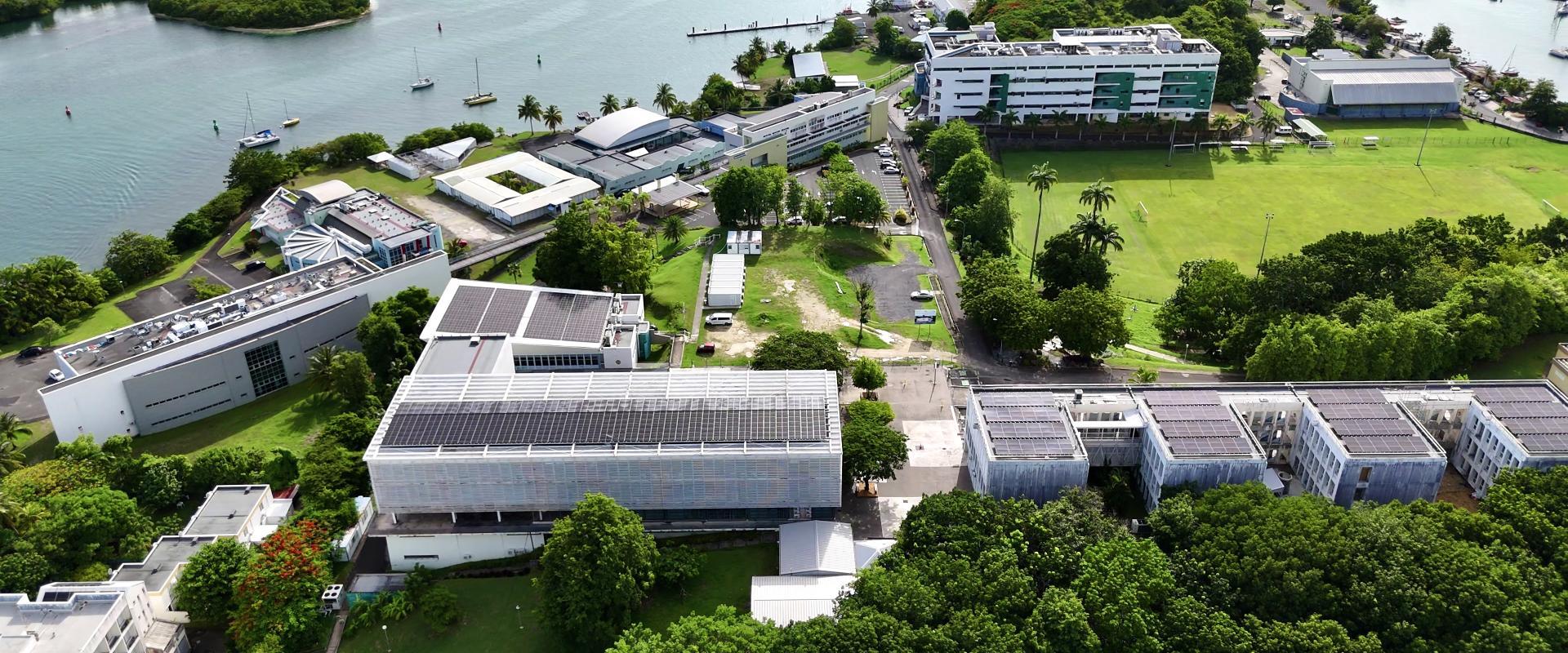
The five campuses total more than 91,000 m² of buildings. Seven university libraries serve the campuses with more than 1,000 seats, 260,000 printed books and 185,000 e-books. CROUS restaurants and solidarity grocery stores operate on the campuses, and public transport (KARU'LIS in Guadeloupe, RTM in Martinique) serves Fouillole, Morne Ferret, Schoelcher and Fort-de-France.
Study programmes offered at Université des Antilles.
Experiences shared by students of Université des Antilles.
Studied here? Share your experience to help other applicants.

Book a free consultation with our expert counsellors and take the first step towards your dream university.
Copyrights © 2026 StudyMapped. All rights reserved.

Enter your credentials to continue.
Join us and start your study abroad journey.


