

University in France
Mont-Saint-Aignan, Normandie, France
University profile
The Université de Rouen Normandie (URN) is a multidisciplinary public university with a health faculty, founded in 1966 as one of the 'universités nouvelles' created in France in the 1960s. It is a major actor in teaching and research in Normandy, with about 35,000 students and 2,511 staff, a budget of 277 million euros and an ambition to become the 'Université des transitions', placing environmental and societal transitions at the centre of its strategy. It gives particular attention to opening higher education to as many people as possible and to the economic and social development of its region.
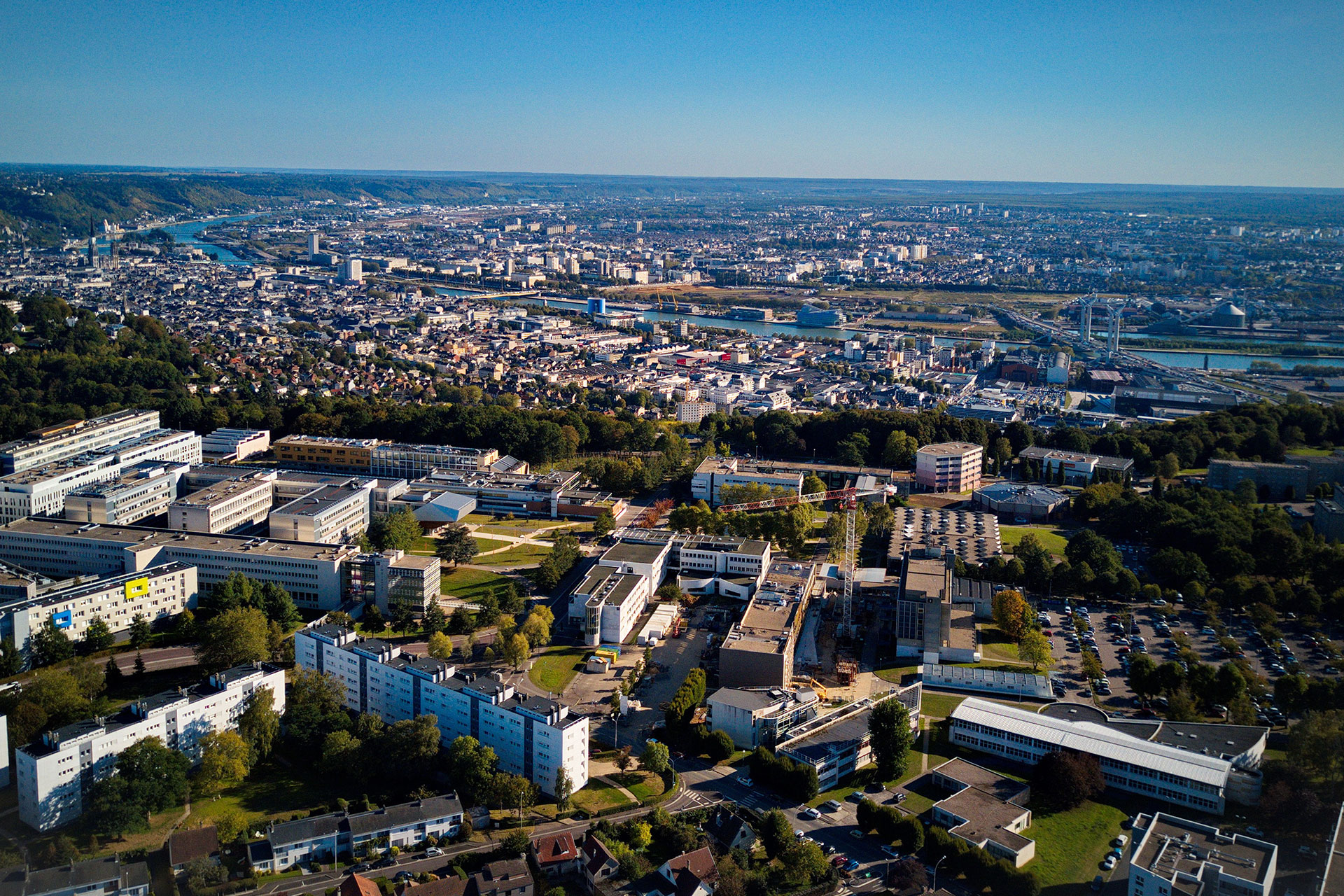
The university is organised around six main campuses in and around Rouen and across Normandy. Mont-Saint-Aignan is the historic and administrative centre; Campus Pasteur, Campus Santé (Martainville) and the Sciences et Ingénierie campus at Le Madrillet (Saint-Étienne-du-Rouvray) are in or beside Rouen; and Évreux and Elbeuf host further institutes and branches, with teaching outposts at Le Havre run in partnership with Le Havre Normandie university. Rouen is about an hour from the coast and an hour and a half from Paris by train.
Teaching is delivered through six UFR (faculties): Lettres et Sciences humaines; Sciences de l'Homme et de la Société; Droit, économie et science politique; Santé; Sciences et Techniques; and Sciences et Techniques des Activités physiques et sportives (STAPS). Alongside them are the Institut universitaire de Technologie de Rouen and of Évreux, the Institut de Préparation à l'Administration générale (IPAG), the Institut d'Administration des Entreprises (IAE), the Institut national supérieur du professorat et de l'éducation (INSPE), the engineering school ESITech (Génie Physique and Technologie du Vivant) and a continuing and work-based education centre. More than 400 courses are offered.
Research is organised in 38 research units across three thematic poles (Matériaux, Énergie, Numérique, Environnement; Chimie, Biologie, Santé; Humanités, Culture, Sociétés), with around 1,600 academic staff and researchers and 800 doctoral students. Campus life includes around 60 approved student associations, the SUAPS sports service with more than 90 physical activities, a student health service with five centres, six university libraries and a Maison de l'Université hosting conferences, concerts and theatre on the Mont-Saint-Aignan campus.
Internationally, URN works with partners in over 40 countries, belongs to the 10-university European alliance INGENIUM, holds the Erasmus+ charter 2021-2027, and offers double and joint degrees and delocalised degrees abroad. French-as-a-foreign-language courses and DELF/DALF certification are provided by the Maison des langues. The university is a founding member of the ComUE Normandie Université and of the Rouen higher-education association CESAR, and received the 'HR Excellence in Research' label on 24 July 2023.
Registration fees (droits d'inscription) cover tuition and the university library contribution; additional courses incur additional fees. Payment is by card online, with an option to pay in three monthly instalments; no refund is possible before the last instalment is collected. Since the 2026-2027 academic year, non-EU international students not covered by an exemption category pay differentiated registration fees under the decree of 19 May 2026. Not affected: French nationals; nationals of the EU, EEA, Monaco, Andorra, Quebec or Switzerland; doctoral students; refugees and beneficiaries of subsidiary protection; long-term residents; people fiscally domiciled in France for over two years; CPGE students; and apprentices. Non-EU students admitted before 19 May 2026 for a first enrolment in 2026-2027, with an exemption notice, keep their exemption until the end of their cycle in the same programme.
The university may grant total or partial individual exemptions on request, within a cap of 30% of concerned students for 2026-2027 (25% in 2027-2028, 20% from 2028-2029), with priority to social and economic situations. Requests are made on exoweb.univ-rouen.fr; the deadline is 31 October 2026, a first payment of fees is required, and the commission meets on 19 November 2026. Details: differentiated fees FAQ.
The CVEC is a separate annual contribution paid to the CROUS; the amount collected for 2025-2026 is 105 euros, of which the university receives 45 euros per student in initial education plus a supplementary payment. It funds student initiatives, social support and the student health service. See CVEC.
The Eiffel programme of the French Ministry for Europe and Foreign Affairs is for foreign students in Master (monthly allowance of 1,200 euros) and Doctorate (2,000 euros) with additional direct support such as international transport and insurance; tuition fees are not covered. Master candidates must be 29 or under and not already studying in France; doctoral candidates must be 35 or under. Master scholarships last 12 to 24 months (up to 36 for an engineering diploma), doctoral ones 12, 18 or 36 months. The call for 2027-2028 runs from 2 October 2026 to 6 January 2027; URN internal deadlines are 13 November 2026 (Master) and 4 December 2026 (Doctorate), and the university transmits selected files to Campus France, with results from 12 April 2027. Doctoral applications go to [email protected]. Required documents include ID, CV, diplomas, transcripts for the last three years, a career project and a signed charter; doctoral files add a thesis project, an external expert opinion and a funding plan. See Eiffel programme.
Student social workers support students in difficulty, including material aid after approval by the FSDIE commission. University restaurants offer meals at the national rate of 1 euro through the CROUS.
Bourse France Excellence Eiffel (candidatures via l'Université de Rouen Normandie) →
Browse the scholarships listed for Université de Rouen Normandie and check each award’s eligibility.
View scholarships for Université de Rouen Normandie →First-year applicants apply through the national Parcoursup platform: they consult programme sheets, formulate and confirm their wishes, and answer admission offers as they arrive. The complementary phase opens in mid-June. Selective programmes (B.U.T. and integrated preparatory classes) answer 'yes', 'no' or 'waiting list'; non-selective programmes (Licence, PASS) may answer 'yes', 'yes-if' (with support such as tutoring or additional courses) or 'waiting list'. If capacity is limited, priority goes to applicants whose background, motivation and plan best match the programme. Applicants repeating a year re-enrol directly rather than through Parcoursup.
Applications to the second or third year of a Licence, B.U.T. 2 and 3, Licence professionnelle, Master 2, the agrégation preparation, the engineering diploma (ESITech), paramedical state diplomas and university diplomas go through the eCandidat platform: create an account, complete the file and upload all supporting documents (the application can only be sent once complete), follow the progress by email, then confirm wishes after the pedagogical commission's decision. Applicants without a French student number (INE) must register directly with the relevant registrar's office.
International students are supported by the Direction des relations internationales et de la coopération (DRIC). Exchange students (Erasmus+, ICM, INGENIUM or bilateral agreements) are handled by the Mobilité et Promotion unit; students without an exchange agreement who are admitted through Campus France are handled by the Espace Monde unit as 'candidats libres'. Contact: [email protected] or [email protected]. The Mes démarches site, partly in English, covers registration steps.
Entry to the first year of Master is through the national Mon Master platform for holders (or candidates) of a national Licence or equivalent who are French or nationals of the EEA, Andorra, Switzerland or Monaco. Up to 15 applications for standard programmes and 15 for work-study programmes can be submitted, with up to 10 of each in the complementary phase. Admission is not automatic and may depend on file review, interview or competitive exam; the file includes CV, transcripts for the last five semesters and, where requested, motivation letter, research or internship project, and language or digital test results. Applicants of other nationalities residing in a country covered by the 'Études en France' procedure apply through that procedure instead. Validation of prior studies (VES) and Master repeat requests are handled outside Mon Master.
The Maison des langues offers the Diplôme universitaire d'études françaises (DUEF, intensive French from A1 to C1), the Diplôme universitaire passerelle pour étudiants en exil (DUPEX), evening courses and courses for exchange students. It is an approved centre for DELF and DALF certification. Contact: [email protected], +33 (0)2 32 76 93 83.
The doctorate is a three-year research degree prepared in one of eight doctoral schools. Registration is authorised by the university president after the opinion of the doctoral school director, on the proposal of the thesis supervisor. Contact: [email protected] or [email protected].
Facilities: six university libraries (Pasteur, Évreux, teacher training, Mont-Saint-Aignan, Santé, Sciences et ingénierie) open Monday to Saturday; a student health service with five centres (Mont-Saint-Aignan, Évreux, Le Madrillet, Elbeuf, Pasteur); the SUAPS sports service; and CROUS university restaurants and housing near the campuses.
Study programmes offered at Université de Rouen Normandie.
Experiences shared by students of Université de Rouen Normandie.
Studied here? Share your experience to help other applicants.

Book a free consultation with our expert counsellors and take the first step towards your dream university.
Copyrights © 2026 StudyMapped. All rights reserved.

Enter your credentials to continue.
Join us and start your study abroad journey.


