

University in Germany
Dortmund, Nordrhein-Westfalen, Germany
University profile
TU Dortmund University (Technische Universität Dortmund) is a public research university in Dortmund, in the Ruhr region of North Rhine-Westphalia. Its profile rests on the combination of natural and engineering sciences with social sciences and cultural studies. It has about 29,500 students and 6,598 employees, among them 325 professors, and offers around 80 Bachelor's and Master's degree programmes plus teacher training in 30 subjects for all school types.
Teaching and research are organised in 17 departments: Mathematics; Physics; Chemistry and Chemical Biology; Computer Science; Statistics; Biochemical and Chemical Engineering; Mechanical Engineering; Electrical Engineering and Information Technology; Spatial Planning; Architecture and Civil Engineering; Business and Economics; Educational Sciences and Psychology; Rehabilitation Sciences; Humanities and Theology; Cultural Studies; Arts and Sport Sciences; and Social Sciences. Mechanical engineering with its emphasis on production and logistics, physics, biochemical and chemical engineering, statistics, computer science and education research are among its internationally recognised fields. TU Dortmund is also one of the few German universities to train teachers for all types of schools, supported by the Dortmund Competence Center for Teacher Training and Teaching/Learning Research (DoKoLL).
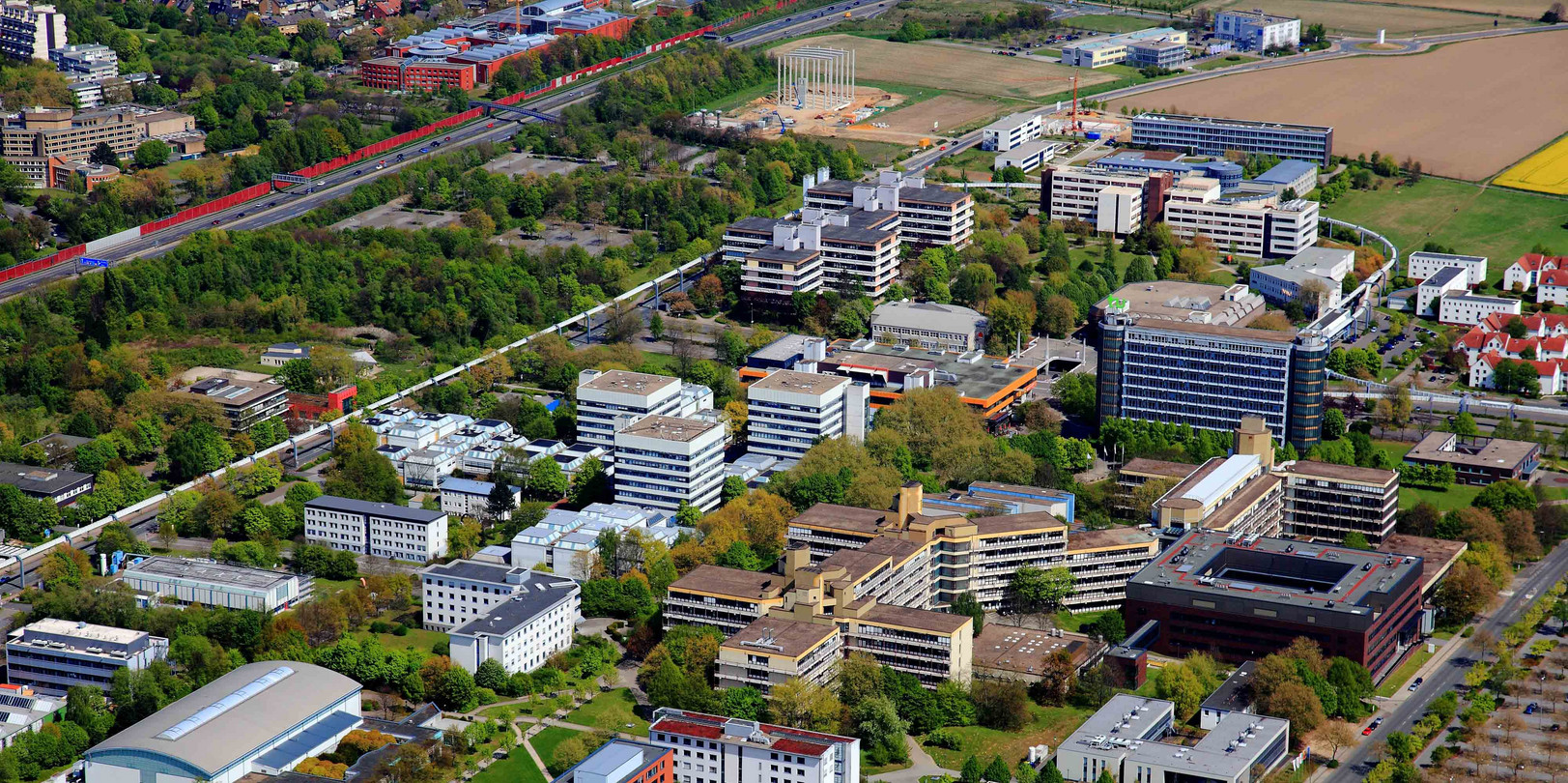
The campus is split into North Campus and South Campus, linked by the H-Bahn, a suspended monorail that runs every five minutes between the two. The university has its own S-Bahn station (Dortmund Universität), and the neighbouring TechnologieZentrumDortmund is described as the largest technology park in Europe. Further sites in the city include a city learning location, the university floor at the Dortmunder U and the Center for Higher Education (zhb) on Hohe Straße.
Student life includes two cafeterias and seven restaurants, cafes and bistros on campus, a university sports programme of over 80 sports with a fitness studio on campus (the German University Sports Association named TU Dortmund University of the Year 2021), and university music with an orchestra, a gospel choir and other ensembles. The Studierendenwerk Dortmund allocates over 2,400 dormitory places in ten residential complexes in Dortmund and four in the region, including barrier-free rooms. The Center for Higher Education runs the Division of Disability and Studies (DoBuS), which received a Zero Project award in 2016.
One in five students comes from abroad: more than 5,800 students from around 120 countries make up about 19.5 percent of the student body, and about 230 exchange students arrive each year. The International Office handles applications from applicants with foreign qualifications, and several Master's programmes are taught entirely in English. TU Dortmund is a member of the University Alliance Ruhr with Ruhr University Bochum and the University of Duisburg-Essen, in place since 2007.
Most programmes charge no tuition. Every enrolled student pays the semester contribution (Semesterbeitrag), which is not tuition and is the same for all applicant groups: EUR 321 for summer semester 2026 and EUR 339.70 for winter semester 2026/27, with the amount for summer semester 2027 to be announced in January 2027. It includes the Germany Semester Ticket among other services, is due within 14 days of the payment request, and is refundable in full on withdrawal by the Friday before lectures begin. A few programmes charge tuition: Advanced Methods in Particle Physics costs approximately EUR 1,940 in total (about EUR 970 per semester, as of 2026), and Mechanics of Sustainable Materials and Structures has fees that differ for EU/EEA and non-EU/EEA applicants. International students must hold German student health insurance. Non-EU/EEA applicants applying through uni-assist pay a processing fee per programme.
TU Dortmund has offered the Deutschlandstipendium since winter semester 2011/12 for high-achieving, talented students of all subjects, including first-semester and international students. The grant is EUR 300 per month, half from private sponsors and half from the federal Ministry of Education and Research, is independent of other income, does not count towards BAföG and is not repaid. It is generally awarded from October for at least two semesters and at most to the end of the standard period of study. Selection considers academic performance together with social engagement, internships, professional experience and personal or family circumstances. Applications are made online each year from 15 August to 15 September. Deutschlandstipendium application.
TU Dortmund awards the DAAD scholarship for more equal opportunities throughout the year, DAAD graduation scholarships for international students and doctoral candidates in financial need through no fault of their own during the final study phase, and DAAD scholarships for special commitment to international activity in the degree programme or at the university. The Martin Schmeisser Foundation offers scholarships for final theses, and study scholarships for refugees (NRWege ins Studium) are available. International students' scholarship overview.
The university runs a scholarship advisory service ([email protected]) and lists scholarships for students of computer science, for studying abroad, for doctoral financing and prizes for very good academic performance. Scholarships of up to EUR 300 per month do not count towards BAföG eligibility. The university also points students to foundations such as the Konrad Adenauer, Friedrich Ebert, Heinrich Boell, Hans Boeckler, Friedrich Naumann and Rosa Luxemburg foundations, Avicenna, Cusanuswerk, Villigst and the German Academic Scholarship Foundation, several of which also fund international students and doctoral research. Students can also use BAföG through the Studierendenwerk Dortmund and educational loans. Scholarships at TU Dortmund University.
Browse the scholarships listed for TU Dortmund University and check each award’s eligibility.
View scholarships for TU Dortmund University →Applicants need a Higher Education Entrance Qualification (Hochschulzugangsberechtigung, HZB), usually the Abitur. A subject-related qualification entitles holders to certain programmes only, and the Fachhochschulreife does not qualify for admission. Depending on the foreign qualification, either all programmes (general HZB) or only some (subject-specific HZB) can be studied, and a preparatory college (Studienkolleg) may be required; TU Dortmund does not offer a Studienkolleg. A Feststellungsprüfung certificate is accepted where acquired. First-semester entry in Bachelor programmes is generally for the winter semester only; Computer Science also admits in the summer semester. Some programmes require an aptitude test, language test or internship as an enrolment requirement. Programmes are either open admission or restricted admission (NC).
Non-EU/EEA applicants (non-EU/EEA citizens whose HZB was obtained outside the EU/EEA) apply through uni-assist, which charges a processing fee per programme; a preliminary review document (VPD) is not required. Application period for the summer semester: about early November to 15 January for all programmes. Winter semester: about mid-March to 15 July for German-taught programmes and about early January to 15 May for English-taught programmes. The deadline is the date uni-assist receives the complete application and the fee. Documents cannot normally be submitted after the deadline, except recognised German-language proof for programmes without admission restrictions. Applicants from China, India and Vietnam must add an APS certificate issued specifically for TU Dortmund, and applicants from Pakistan an HEC attestation stamp on transcripts and degree certificate. All documents need sworn translations into German or English.
EU/EEA applicants (EU/EEA nationals, or those with an HZB from the EU/EEA) apply through the online application or the application form sent by e-mail; no postal documents are required. For open-admission programmes the application runs from early November (summer semester) or about 26 March (winter semester) to the Friday before lectures begin. For restricted-admission programmes the winter semester period runs from about mid-June to 15 July. Applications are free for EU/EEA citizens. Applicants with German certificates apply or enrol through the campus portal. The postmark of TU Dortmund University is valid for timely receipt of mailed documents.
German proof accepted: DSH level 2 or 3, TestDaF with at least TDN 16 in total, DSD II, Goethe-Zertifikat C2 (GDS), the Goethe-Institut ZOP, KDS or GDS, or telc Deutsch C1 Hochschule with an overall grade of sufficient or better. A few programmes also require English at B2 level (Applied Literature and Cultural Studies, Applied Linguistics, English teacher education). English-taught Master's programmes include Advanced Methods in Particle Physics, Biopharmaceutical Engineering, Chemical Biology, Chemistry, Data Science, Data Science in Sports and Health, Econometrics, Industrial Mathematics, Manufacturing Technology, Mechanics of Sustainable Materials and Structures, Medical Physics and Physics of Living Systems, Physics, Political Conflict Studies, Process Systems Engineering, Spatial Planning, Religion, Ethics and Politics, and SPRING; the English level required depends on the programme. Proof of English must be valid at application and submitted by the deadline. Applicants without sufficient German can also apply for a German language course route.
A Master's entrance qualification (Masterzugangsberechtigung) is needed, normally a Bachelor's degree or equivalent first university degree. A subject-specific review by the relevant department follows the application, and some departments state a minimum grade or number of ECTS credits in a subject area. Applicants may apply before finishing the degree by uploading a university certificate with the expected graduation date; the final degree is usually due within the application deadline. Non-EU/EEA applicants apply via uni-assist with the same general periods as for Bachelor's programmes (summer semester about early November to 15 January; winter semester about mid-March to 15 July for German-taught and early January to 15 May for English-taught programmes), with different periods for some programmes, for example Raumplanung (German-taught): early November to 15 December and mid-March to 15 May. EU/EEA applicants apply online, with deadlines varying by department and programme (for example Mechanics of Sustainable Materials and Structures: early January to 15 October; Industrial Mathematics: early January to 15 December; Advanced Methods in Particle Physics: early January to 31 December). Many Master's programmes admit in both semesters, and teacher education Master's applicants from other universities have their prior achievements reviewed. For applicants with German degrees, enrolment is through the campus portal.
Admission to doctoral studies is granted by the doctoral committee of the relevant department. Enrolment, possible at any time, requires the committee's admission certificate, a valid identification document, Bachelor's and Master's degree certificates, transcripts of records and sworn translations into German or English; applicants from China, Vietnam or India add the APS certificate. The Graduate Center supports doctoral researchers with advice, transferable-skills training and networking, and a Welcome Service helps international researchers.
Enrolment documents are uploaded digitally in the campus portal. They include the entrance qualification or degree, the health insurance notification and any proof of enrolment requirements; non-EU applicants who applied through uni-assist for winter semester 2026/27 or later enrol directly in the campus portal. Winter semester 2026/27 runs from 1 October 2026 to 31 March 2027, with lectures from 12 October 2026 to 5 February 2027; summer semester 2027 follows.
The University Library holds about 1 million books plus e-books and e-journals. Other facilities include the IT and Media Center (ITMC), the Center for Entrepreneurship and Transfer (CET), scientific workshops, the DELTA electron storage ring for synchrotron radiation, a campus fitness studio and the International Meeting Center (IBZ).
Study programmes offered at TU Dortmund University.
Experiences shared by students of TU Dortmund University.
Studied here? Share your experience to help other applicants.

Book a free consultation with our expert counsellors and take the first step towards your dream university.
Copyrights © 2026 StudyMapped. All rights reserved.

Enter your credentials to continue.
Join us and start your study abroad journey.


