
University in United States
Stanford, CA, United States
University profile
Stanford University (legally Leland Stanford Junior University) is a private research university in Stanford, California, founded in 1885 by Leland Stanford, a former California governor and U.S. senator, and his wife Jane Lathrop Stanford, as a memorial to their only child. It opened on October 1, 1891, on the Stanford family's Palo Alto stock farm, and was conceived as nonsectarian, coeducational and affordable, combining a liberal arts education with training in science and engineering.
The campus covers 8,353 acres with 630 buildings, and its seven schools are located together on a single campus. The seven schools are Business, the Doerr School of Sustainability, Education, Engineering, Humanities and Sciences, Law and Medicine. Academic programs span the arts and humanities, natural and social sciences, engineering, sustainability, medicine, law, education and business. In autumn 2025 the university enrolled 7,289 undergraduates and 10,025 graduate students, with 2,402 faculty members.
Research is organized across the schools and 15 independent laboratories, centers and institutes, including the SLAC National Accelerator Laboratory, managed under license from the U.S. Department of Energy, and the Hoover Institution Library & Archives. Stanford Libraries hold hundreds of thousands of rare and unique items in Special Collections and University Archives.
Student life centres on the residential campus. Residential & Dining Enterprises (R&DE) offers housing options for undergraduate and graduate students and their dependents. The athletics program fields 36 varsity programs with more than 800 student-athletes, and the campus hosts arts venues such as the Bing Concert Hall. Students begin classes in the autumn quarter, and the academic year runs in autumn, winter and spring quarters.
International students are part of the student body, and the admission requirements are the same for all applicants regardless of citizenship. Stanford meets the full demonstrated need of admitted students regardless of citizenship, and the ACT or SAT is required of first-year applicants. The graduate community numbers about 9,700 students (Graduate Admissions), and graduate degrees are offered across all seven schools.
Stanford's aid is need-based; it does not offer merit scholarships outside a limited number of athletic scholarships. The university commits to meeting the full demonstrated need of all admitted students regardless of citizenship and does not expect students to borrow. Almost half of undergraduates receive need-based aid. Families earning less than $150,000 with typical assets pay no tuition, and families earning less than $100,000 pay no tuition or room and board. The average need-based scholarship in the current freshman class is more than $70,000.
International citizens who request aid have that request considered in the admission evaluation; aid resources for them are limited. Applicants who do not request aid at application cannot apply for aid later during their four years unless their citizenship status changes. International applicants submit the CSS Profile or, if unable to, the ISAFA.
Knight-Hennessy Scholars provides up to three years of tuition fellowship, a living stipend and a travel stipend for graduate students in any of the seven schools. See the Knight-Hennessy Scholars website and the Financial Aid Office.
Stanford University Scholarship (need-based undergraduate aid) →
Browse the scholarships listed for Stanford University and check each award’s eligibility.
View scholarships for Stanford University →Required components: the Common Application, the $100 nonrefundable application fee or fee waiver request, ACT or SAT scores, the School Report form and counselor letter of recommendation, official transcripts or academic results, a midyear transcript (due by February 15), and letters of recommendation from two academic teachers. ACT or SAT scores are required, with no minimum score and no preferred exam; for the Class of 2029 the middle 50 percent scored 34-36 on the ACT and 1520-1570 on the SAT. AP exams are not mandatory, but all AP scores taken must be self-reported. Applicants in IB programs outside the U.S. provide predicted IB marks, and British-system applicants provide GCSE results and predicted A-Level marks. Optional arts portfolios are accepted.
Students who have completed college-credit coursework since high school apply as transfers; coursework must be from an accredited degree-granting institution. Required: Common Application, application fee or waiver, official transcripts from every college attended, College Report and two academic instructor recommendations. Deadline: March 15; decision by mid-May; reply date June 1. All students start in the autumn quarter. Applicants who already hold a bachelor's degree are not eligible for undergraduate admission.
Requirements are the same as for domestic applicants. Marks need not be converted to a U.S. GPA; the secondary school diploma (or equivalent) must be held by enrollment in the fall. School documents must be sent directly from the school and translated into English by a school official. English proficiency exams are not required; scores from any such exam may be self-reported, and an English test cannot substitute for the ACT/SAT. Admitted international students receive visa information after admission. International citizens applying for financial aid face a more selective process (see financial aid).
Stanford's Graduate Admissions handles MA, MS, PhD and other non-professional programs in the Graduate School of Education, School of Engineering, School of Humanities & Sciences, School of Medicine and Doerr School of Sustainability. The Graduate School of Business (MBA, MSx, PhD), the School of Law (JD, advanced degrees) and the School of Medicine (MD, MS in Physician Assistant Studies) run separate admissions offices and applications.
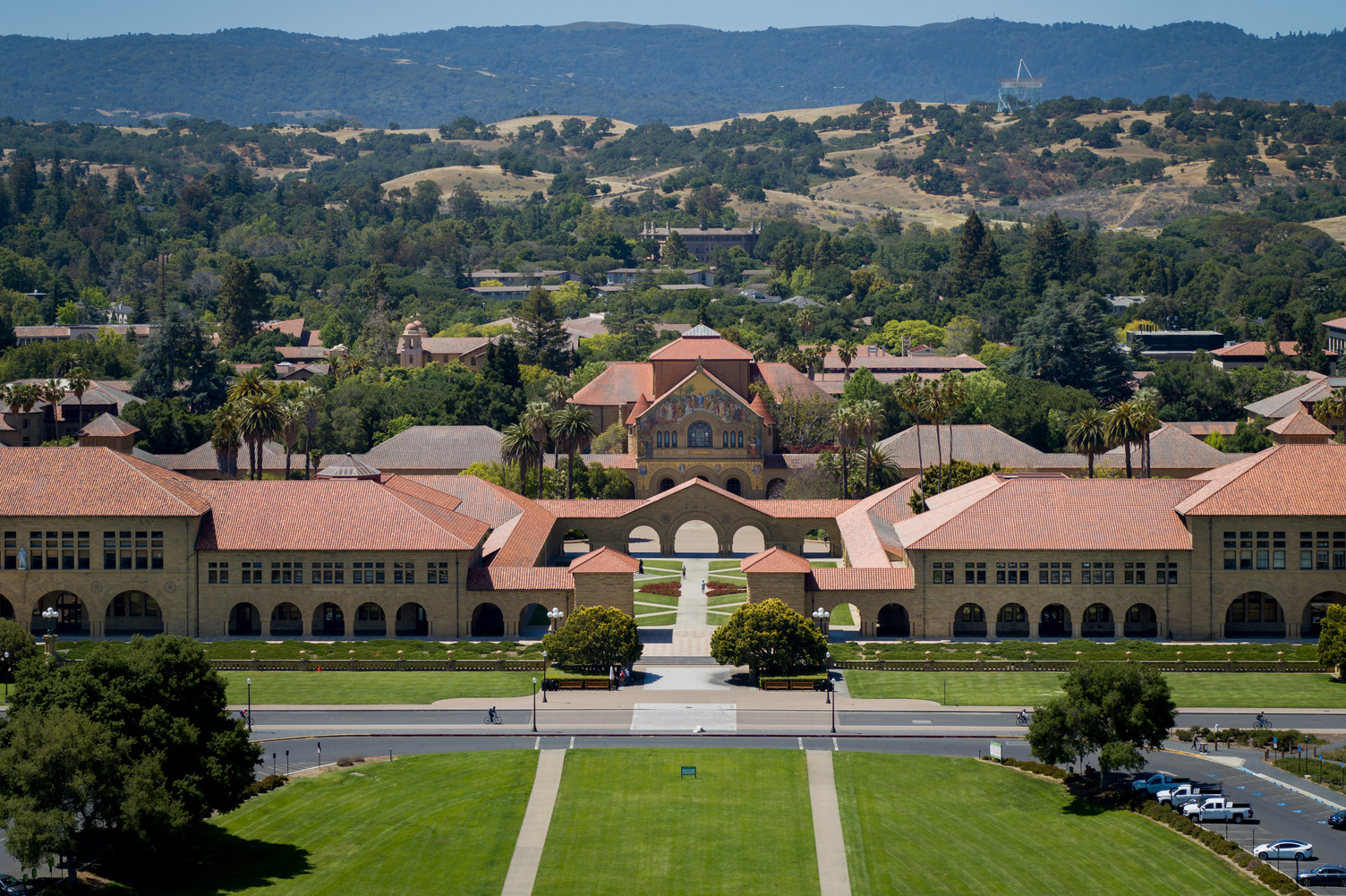
The Stanford campus covers 8,353 acres in the center of the San Francisco Peninsula, California. The land lies across seven governmental jurisdictions, including 3,994 acres in unincorporated Santa Clara County, 2,603 acres in unincorporated San Mateo County and 1,292 acres in Palo Alto.
The campus has roughly 630 buildings with about 17.9 million square feet, 26,000 trees and over 1,000 plant species, and about 14,000 undergraduate and graduate student beds. Campus land also includes a historic equestrian barn, a biological preserve, a center for automotive research and an educational farm.
Stanford's land also hosts the 70-acre Stanford Shopping Center and the 700-acre Stanford Research Park. The 35-acre Redwood City campus, opened in 2019, is about 5 miles from the main campus and houses over 1,500 Stanford staff.
Study programmes offered at Stanford University.
Experiences shared by students of Stanford University.
Studied here? Share your experience to help other applicants.

Book a free consultation with our expert counsellors and take the first step towards your dream university.
Copyrights © 2026 StudyMapped. All rights reserved.

Enter your credentials to continue.
Join us and start your study abroad journey.


