

University in Germany
Karlsruhe, Baden-Württemberg, Germany
University profile
The Staatliche Hochschule für Gestaltung (HfG) Karlsruhe is a state art and design university in Karlsruhe, Baden-Württemberg. It opened on 15 April 1992 as a reform university and was founded together with the ZKM | Zentrum für Kunst und Medien by Heinrich Klotz. Its stated aim is to relate the traditional arts to media technology and electronic production methods, and it draws on the ideas of the Bauhaus tradition.
The HfG is one of the few German universities that still awards the Diplom and the Magister Artium (M.A.), instead of Bachelor and Master degrees. Both are equivalent to a Master qualification. Studies are not modularised and are organised around cross-disciplinary project work in small groups. Every programme combines a major subject with two minor subjects, always including one theory and one practice subject. The standard period of study is nine semesters.
Five programmes are offered: Medienkunst, Ausstellungsdesign und Szenografie, Kommunikationsdesign, Produktdesign (all Diplom) and Kunstwissenschaft und Medienphilosophie (Magister). A doctoral programme in Kunstwissenschaft und Medienphilosophie leads to the Dr. phil., as the HfG holds full doctoral rights.
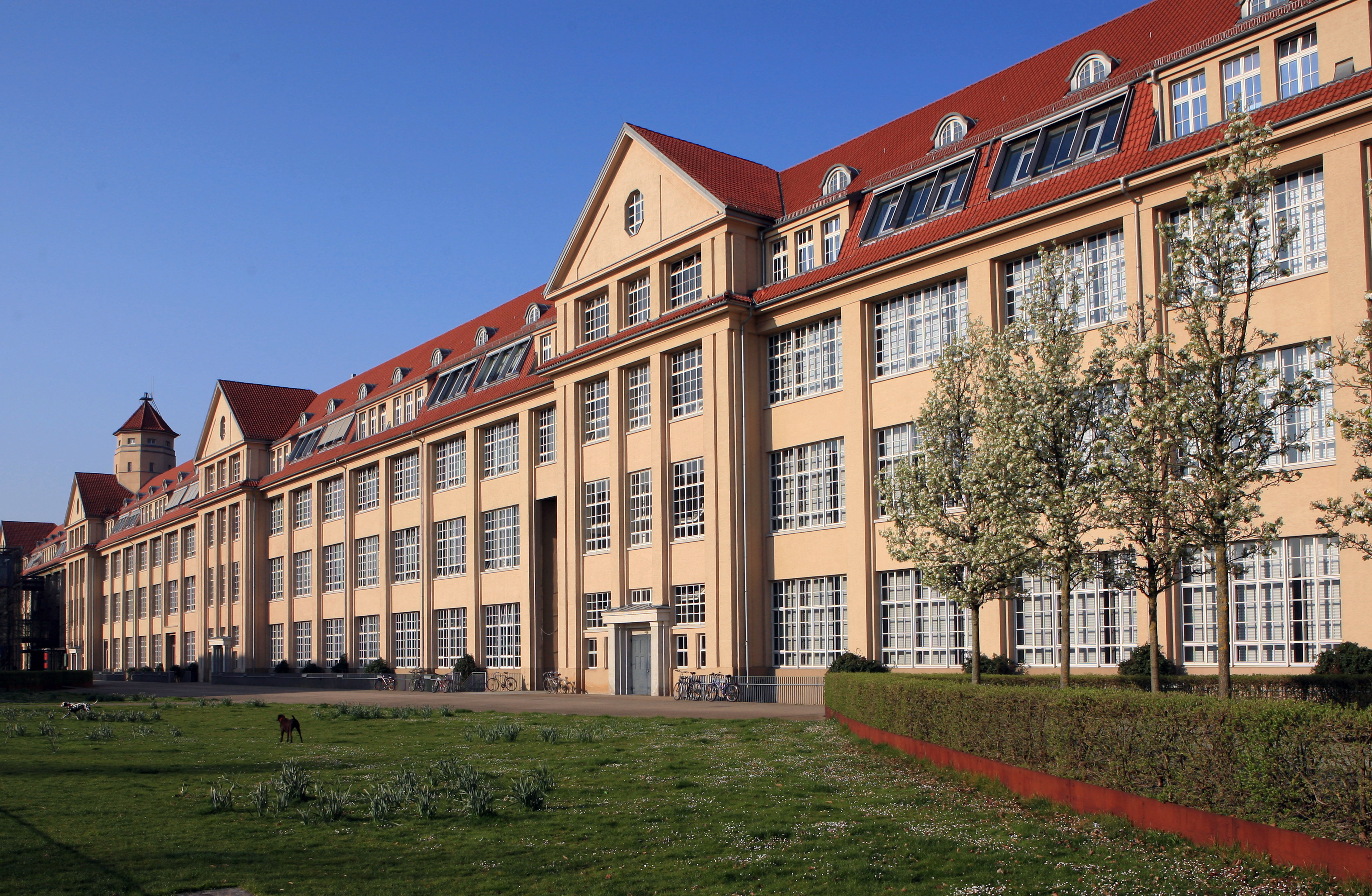
The HfG shares a single 320-metre-long former industrial hall in the Südweststadt, built for the Industriewerke Karlsruhe-Augsburg, with the ZKM. Facilities include workshops for wood, metal, model making, electronics, 3D printing, screen printing and book binding, studios for photography, sound and film, the multifunctional Großes Studio, the 45-seat cinema Blauer Salon, and a library run jointly with the ZKM that holds around 90,000 books and other media. The HfG has no halls of residence of its own.
About 400 students study at the HfG, with around 20 students per professor. German is the regular language of instruction, and international professors often teach in English. International students are supported by an International Office, Erasmus+ and partnerships with universities worldwide. In 2008 the Wissenschaftsrat evaluated the HfG and attested an excellent educational concept.
As a Baden-Württemberg state university, the HfG charges international students who do not hold EU/EEA citizenship and are studying for a degree a tuition fee of EUR 1,500 per semester (since winter semester 2017/18). EU/EEA students pay no tuition. Exchange students are exempt. All students pay the semester contribution (Semesterbeitrag), which is not tuition: EUR 202.50 per semester according to the matriculation page. The HfG's information for international students lists its components as Studierendenwerk contribution, administrative cost contribution and student body contribution; exchange students pay only the Studierendenwerk contribution.
The HfG points international students to the DAAD scholarship database and to foundations such as the Rosa-Luxemburg-, Friedrich-Ebert-, Hans-Böckler-, Konrad-Adenauer-, Heinrich-Böll- and Friedrich-Naumann-Stiftung and the Evangelisches Studienwerk. Its International Office advises on Erasmus+, PROMOS and other mobility funding (International Office). Details of the prizes and scholarships are on the Preise und Stipendien page. A monthly budget of at least EUR 700-800 is suggested for living costs in Karlsruhe.
Landesgraduiertenförderung (LGFG) Doctoral Scholarship at HfG Karlsruhe →
Riemschneider-Stiftung Diploma Film Scholarship →
Browse the scholarships listed for Staatliche Hochschule für Gestaltung Karlsruhe (HfG) and check each award’s eligibility.
View scholarships for Staatliche Hochschule für Gestaltung Karlsruhe (HfG) →The HfG awards the Diplom (Medienkunst, Ausstellungsdesign und Szenografie, Kommunikationsdesign, Produktdesign) and the Magister Artium (Kunstwissenschaft und Medienphilosophie). Both are equivalent to a Master degree and carry the same entitlements. There are no Bachelor or Master programmes and no intermediate Bachelor-equivalent degree. Study begins in the winter semester only. Applicants with a suitable Bachelor degree can, depending on individual aptitude, be admitted to a higher semester.
Applicants need the general or subject-restricted Hochschulreife or an equivalent prior qualification under section 58(2) of the Landeshochschulgesetz Baden-Württemberg. The Fachhochschulreife is not sufficient. Applicants with a subject-restricted qualification can only be admitted to the matching programme. For Kunstwissenschaft und Medienphilosophie either Latin (Latinum) or knowledge of two foreign languages is required, and English is desirable for all subjects. Applicants must also pass an entrance examination proving artistic-professional or academic aptitude.
For the practice programmes the examination consists of a pre-selection based on the motivation letter and a portfolio of up to 20 work samples, followed by a selection interview. The admissions committee may set a practical task, to be presented at the interview. For Kunstwissenschaft und Medienphilosophie the pre-selection is based on the motivation letter, and a portfolio is optional, followed by an interview.
Applications are made online only, through the HfG's own application portal (not uni-assist). Applications for the following winter semester are submitted from 1 March to 30 April (exclusion deadline). For 2026 the deadline for Kunstwissenschaft und Medienphilosophie was extended to 20 July. Documents to upload: a one-to-two-page motivation letter, a copy of the Hochschulreife certificate (or a current school certificate and half-year report), a Bachelor certificate if applicable, a CV, and the portfolio (one PDF, maximum 20 samples, 50 MB). Minors need parental consent. A complete application is required for each subject applied for. Online matriculation follows by 15 August, with the semester fee paid by that date, and the final matriculation takes place in person at the Studienbüro from 15 September, with certified copy of the entrance qualification, proof of health insurance and a signed house and fire safety declaration.
Foreign school and degree certificates must be recognised as equivalent to the German Hochschulreife, and the HfG decides on recognition during the admissions procedure. Certified English or German translations are needed unless the documents are issued in those languages. Applicants from South Korea may be asked for the College Scholastic Ability Test result, and applicants from China, India and Vietnam for a valid APS certificate. Proof of a passed German language test is required at matriculation. Accepted: DSH with overall result DSH-1; TestDaF with at least TDN 3 in all four parts; the German part of the Feststellungsprüfung at a Studienkolleg; DSD II; Goethe-Zertifikat C2 (GDS), C1 or B2; ÖSD C2, C1 or B2; telc Deutsch C1 Hochschule, C1 or B2. German is the regular language of instruction, although international professors often teach in English.
The doctoral programme in Kunstwissenschaft und Medienphilosophie (Dr. phil., under the Promotionsordnung 2015) admits, as a rule, candidates with a Master or Magister degree in a theory programme in art, cultural, humanities, media or social sciences with an overall grade of at least 'good' (2.0 or better). Applicants submit a CV, copies of degree certificates and a dissertation outline of about 5-7 pages through the online portal; the Promotionsausschuss decides on admission after a doctoral agreement is concluded. Admission is as a rule not linked to funding.
Karlsruhe (Lorenzstraße 15, Südweststadt): the single site of the HfG, in a former industrial hall shared with the ZKM. All five programmes, the administration, the Studienbüro and the International Office are located here.
Study programmes offered at Staatliche Hochschule für Gestaltung Karlsruhe (HfG).
Experiences shared by students of Staatliche Hochschule für Gestaltung Karlsruhe (HfG).
Studied here? Share your experience to help other applicants.

Book a free consultation with our expert counsellors and take the first step towards your dream university.
Copyrights © 2026 StudyMapped. All rights reserved.

Enter your credentials to continue.
Join us and start your study abroad journey.


