
University in Canada
Fredericton, New Brunswick, Canada
University profile
St. Thomas University (STU) is a primarily undergraduate liberal arts university in Fredericton, New Brunswick, at 51 Dineen Drive. Its mission is built around teaching and learning, a humanistic approach and experiential education, and its institutional roots go back to 1910. It is a Catholic-founded institution and holds memberships in bodies such as Universities Canada, the Association of Atlantic Universities and the Association of Catholic Colleges and Universities of Canada.
Under a 1963 federation agreement St. Thomas relocated to the campus of the University of New Brunswick in 1964, while continuing to grant its own degrees in arts and education and to control its admission regulations and curriculum. Teaching is organised around the four-year Bachelor of Arts, in which students declare a major at the end of second year and may add minors or an honours programme. Subjects span the social sciences (including Anthropology, Business and Social Entrepreneurship, Criminology and Criminal Justice, Economics, Gerontology, International Relations, Law, Politics and Society, Political Science, Psychology, Sociology) and the humanities (including Catholic Studies, Communications and Public Policy, English, Fine Arts, French, Great Books, History, Human Rights, Journalism, Native Studies, Philosophy, Religious Studies and Spanish and Latin American Studies).
Professional programmes sit in two schools. The School of Social Work offers the Bachelor of Social Work, the Master of Social Work and the Mi'kmaq Wolastoqey BSW, and the School of Education runs a 10-month post-degree Bachelor of Education with two field placements in New Brunswick. Other offerings include the Bachelor of Arts (Aviation Stream) delivered with MFC Training, Bachelor of Applied Arts programmes offered with the New Brunswick Community College, an Accelerated Bachelor of Arts, an English as a Second Language programme and certificates in Experiential Learning and in Digital and Media Literacy.
Student life centres on three on-campus residences, Harrington Hall, Vanier Hall and Holy Cross House, each with shared kitchens, lounges and study spaces. Clubs and societies include the Students' Union (STUSU), the International Students' Association (STUISA), Enactus, and a theatre programme; Indigenous Student Services runs events and ceremonies from the Wabanaki Centre; varsity teams compete as the Tommies in Atlantic University Sport and U SPORTS.
International applicants apply through the Common Application and are assessed against country-specific entry standards, including West African (WASSCE), Kenyan, Indian, Nepalese and GCE qualifications. The university was chartered by the New Brunswick legislature in 1934.
Incoming Bachelor of Arts students are considered for entrance scholarships (academic achievement and involvement), application-based entrance awards and need-based bursaries. Applicants with an admissions average of 80% or higher are automatically considered for the St. Thomas University Scholarship (Renewable), valued at up to $20,000 and renewable for up to four years, when they apply for admission.
Application-based entrance awards range from $500 to $100,000 over four years, and one application covers most of them. They are open to candidates for full-time first-year admission to the Bachelor of Arts on the basis of high school records; international applicants with the equivalent of an 80% average or higher are also eligible. The committee reviews the admission average and Grade 12 courses, and may weigh leadership, involvement, location and community engagement.
Need-based one-time bursaries of $500 to $3,000 for full-time Bachelor of Arts candidates, assessed on family financial capacity, employment situation and special needs.
Applicants who have an offer of admission and have submitted current transcripts apply by March 1 through the Scholarship and Bursary Application under the Next Steps tab of the applicant portal. Transfer students are considered for scholarships-in-course after 30 credit hours at STU. A two-year tuition and residence waiver pilot (from 2022-23, up to ten students a year) has supported undergraduate applicants from countries in conflict who meet Canadian emergency-status criteria.
Links: Incoming student awards, Entrance scholarships list, Financial aid.
STU Entrance Scholarships, Awards and Bursaries →
Browse the scholarships listed for St. Thomas University and check each award’s eligibility.
View scholarships for St. Thomas University →High school graduation with a minimum average of 70% on five successfully completed Grade 12 academic courses, including Grade 12 academic English (or French for Francophone school applicants), plus four Grade 12 academic electives from an approved list that includes Biology, Chemistry, Mathematics, Computer Science, Economics, French, Geography, Geology, History, Physics, Political Science, Sociology, Spanish, Literature, Law, Media Studies, Native Studies and the arts. Meeting the minimum does not guarantee admission.
Applicants must show academic strength in a university-preparatory high school programme comparable to Canadian standards; achievement and rank in class are considered. Applications and documents are encouraged by June 1 for September entry and October 1 for January entry, as embassy processing can take up to three months. International students apply through the Common Application. Official transcripts from all secondary and post-secondary institutions must be sent directly by the issuing institution to [email protected]; permanent residents also supply a copy of their permanent resident card.
AP grades of 4 or 5, individual IB higher-level grades of 5, 6 or 7, or GCE A-Level grades of C or higher earn transfer credit: up to 18 credit hours for AP and up to 30 credit hours for IB diploma and A-Level students, on a 120-credit-hour degree.
Applicants whose primary language is not English submit TOEFL, IELTS, MELAB, CAEL, Cambridge English, Duolingo English Test or PTE scores directly from the testing centre (STU ETS code 0803). Minimums for entry with the ESL programme: TOEFL iBT 61 (paper 500), IELTS 5.0, MELAB 69, CAEL 40-50, Cambridge B2 First, Duolingo 90, PTE 50-61. Scores for a regular five-course load: TOEFL iBT 89 (paper 573), IELTS 6.5, MELAB 80, CAEL 60, Cambridge C1 Advanced or C2 Proficiency, Duolingo 115, PTE 62+. The requirement may be waived for applicants graduating from a New Brunswick high school with 70% or higher in English 122 or 121.
Transfer applicants send official post-secondary transcripts to the Admissions Office; credits earned outside Canada need a course-by-course WES evaluation. January transfer applicants apply by early December. Conditional acceptance usually follows within about a week of a complete file, and credit evaluations take about 7 to 10 days. Adult learners must be 21 or older and submit a 1-2 page letter on education, work experience and plans plus any transcripts. Applicants aged 60 or over may receive a 50% tuition rebate, and those 65 or over may audit undergraduate courses free.
Create an account on the STU applicant portal, start a new application and pay the non-refundable $55 application fee ($40 for New Brunswick applicants); Canadian high school transcripts are uploaded to the portal. Residence reservations are confirmed through the portal by April 15.
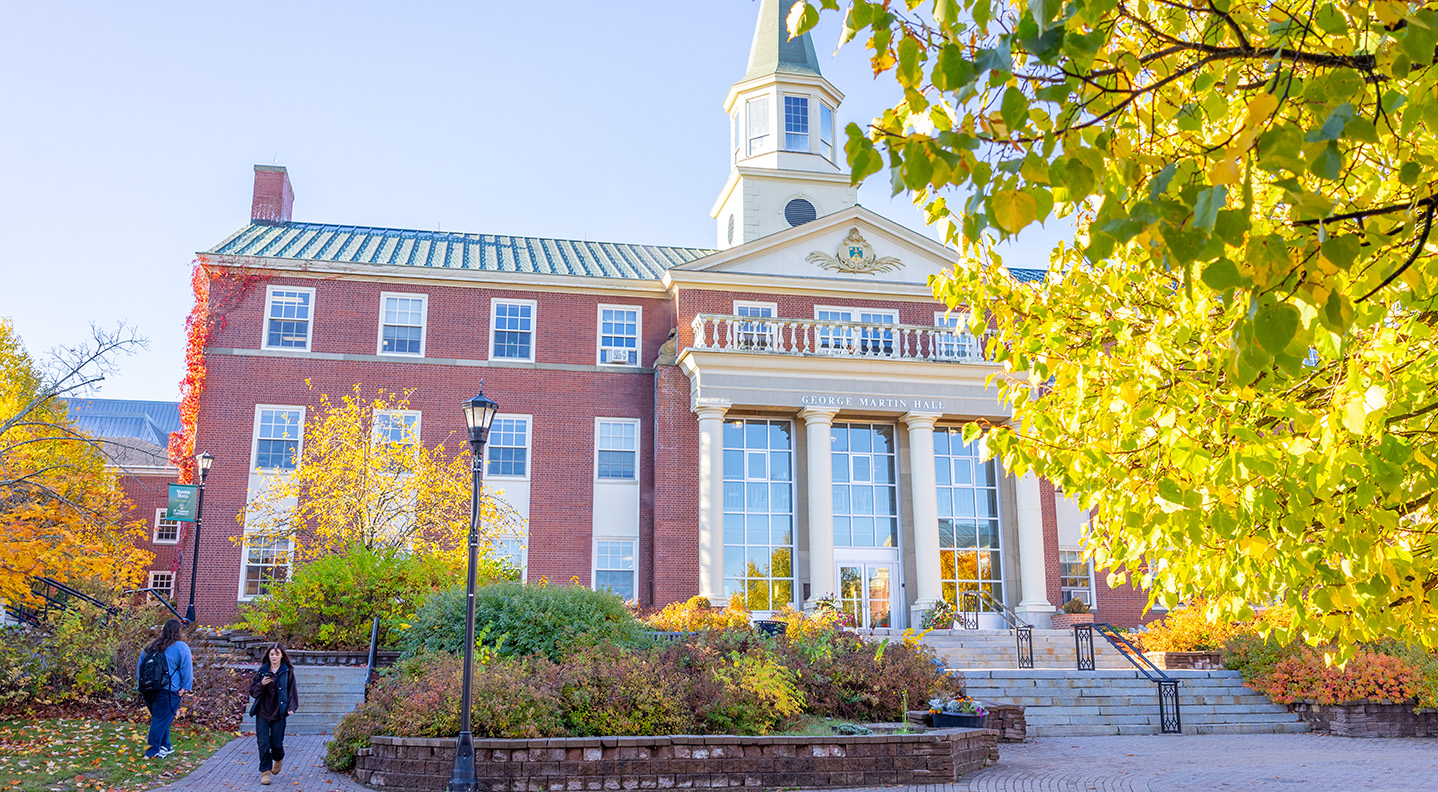
Fredericton campus, 51 Dineen Drive, Fredericton, NB: the university's single campus, on the grounds of the University of New Brunswick under the 1963 federation agreement. Teaching takes place in buildings including George Martin Hall (administration), Edmund Casey Hall, Sir James Dunn Hall, Brian Mulroney Hall, Margaret Norrie McCain Hall (auditorium, study hall and seminar rooms) and Donald C. Duffie Hall (Admissions), alongside the J.B. O'Keefe Fitness Centre. Journalism also uses leased classroom space in a CBC broadcast facility.
Study programmes offered at St. Thomas University.
Experiences shared by students of St. Thomas University.
Studied here? Share your experience to help other applicants.

Book a free consultation with our expert counsellors and take the first step towards your dream university.
Copyrights © 2026 StudyMapped. All rights reserved.

Enter your credentials to continue.
Join us and start your study abroad journey.


