
University in France · Featured · Top university
Paris, Île-de-France, France
University profile
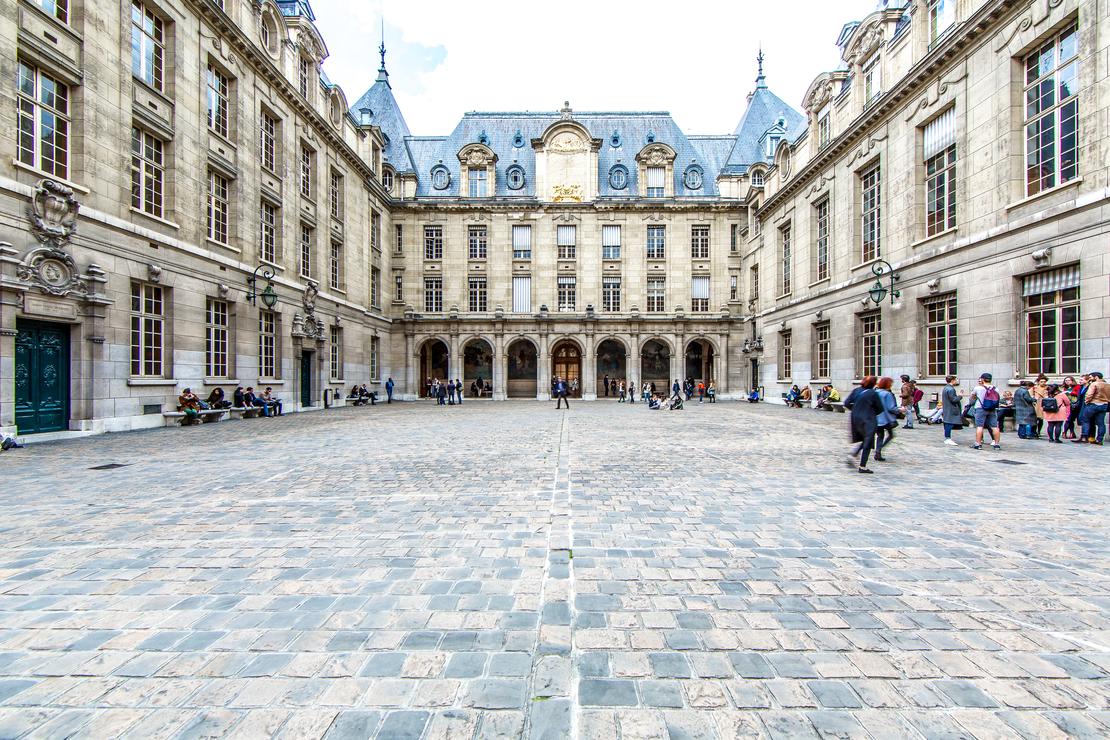
Sorbonne University (Sorbonne Université) is a multidisciplinary, research-intensive university in the heart of Paris, with a regional presence. It was created on 1 January 2018 through the merger of Paris-Sorbonne University (Paris IV) and Pierre and Marie Curie University (UPMC, Paris VI), and brings together the arts and humanities, health sciences, and science and engineering. It has more than 53,000 students, of whom 11,500 are international, and a community of 3,300 university professors, 3,800 national research partners and 3,100 administrative and technical staff.
Teaching is organised in three faculties: the Faculty of Arts and Humanities (Lettres), the Faculty of Health Sciences (Santé) and the Faculty of Science and Engineering (Sciences et Ingénierie). Arts and Humanities covers literature, languages, foreign literatures and civilisations, linguistics, philosophy, sociology, history, geography, history of art and archaeology, and musicology, and includes the CELSA school of information and communication sciences and the INSPÉ teacher-training institute. Health Sciences, associated with the AP-HP Sorbonne University Hospital Group and the Quinze-Vingts National Ophthalmology Hospital, trains doctors, midwives and paramedical professionals. Science and Engineering has six departments (UFRs) in biology, chemistry, engineering, mathematics, physics, and earth sciences, environment and biodiversity, plus Polytech Sorbonne, the Paris Institute of Astrophysics, the Henri Poincaré Institute and three marine stations.
The university offers 37 bachelor's degrees with 45 bi-disciplinary options (major-minor and double-major paths), 240 master's programmes and doctoral training in 23 doctoral schools, with about 3,900 doctoral candidates. It reports 750 international programmes, more than 1,500 Erasmus+ exchange agreements, membership of the 4EU+ European university alliance, 12 international strategic partners and an overseas branch, Sorbonne University Abu Dhabi. Bachelor's programmes are taught in French; selected master's programmes are taught in English.
Student life includes more than 150 student associations, more than 750 student jobs and library capacity for 4,000 people. Housing support includes an online accommodation platform, CROUS social housing applications, the Cité internationale universitaire de Paris (for students from master's level) and national aid such as APL and the Visale deposit guarantee. An International Welcome Desk online platform guides international students from arrival preparation to departure.
Sorbonne University is a French public institution; its degrees are national French degrees, and it is the lead member of the Sorbonne University Alliance (six members and four national research centres).
Fees are set nationally by the Ministries of Higher Education and of Economy and Finance: bachelor's €178, master's €255, doctoral €398, engineering programmes €630 per year. Doctoral, third-cycle health and HDR students are not subject to differentiated fees.
Since 2019 non-EU students enrolling for a national degree are subject to differentiated fees, with exceptions including EU/EEA, Monaco, Andorra, Quebec and Swiss nationals, refugees, long-term residence permit holders, students resident in France for at least two years, CPGE students and those re-enrolling in the same cycle. Students receiving a state-funded grant (including French Government grants) or enrolling under an exemption agreement or exchange programme are automatically exempt. Others may apply to the Exemption Committee, which considers personal financial resources, health, distance from family, family difficulties or isolation, and disability. For 2026-2027 the Governing Board approved an exemption policy that allows every non-EU student who applies and meets the criteria to be exempted from the differentiated fees. Applications are submitted on the student life support platform.
All students in initial higher education must pay the annual CVEC to CROUS before enrolling.
Sorbonne University submits excellent Master's and PhD applications (average of at least 15/20 over the last three academic years) to Campus France for the Eiffel programme in seven fields: biology and health; ecological transition; mathematics and digital science; engineering; French history, language and civilisation; law and political science; economics and management. Master's awards fund 12 to 24 months for students new to France; PhD awards fund 12 to 18 months under cotutelle, with 36 months for new students in France enrolled in the first year of a doctorate. For the 2026/2027 round, internal deadlines were 28 November 2025 (Master's) and 24 November 2025 (PhD). See the Eiffel programme page.
The Fonds de solidarité et de développement des initiatives étudiantes (FSDIE) funds student projects and aid, and faculties can grant one-off assistance, fee exemptions and refunds; social workers examine emergency aid applications (grants and financial assistance). The Fondation Sorbonne Université runs four scholarship programmes for its students: Passeport pour le master, Passeport pour la mobilité, Passeport pour les JO and Passeport pour les sciences Pluri'Elles. CROUS accommodation requests are made through the DSE between 15 January and 31 May of the year before entry.
France Excellence Eiffel Scholarship (Sorbonne University nomination, 2027/2028 call) →
China Scholarship Council (CSC) Doctoral Scholarships at Sorbonne University →
Browse the scholarships listed for Sorbonne University and check each award’s eligibility.
View scholarships for Sorbonne University →Bachelor's programmes are taught in French. Applicants holding a French or European Baccalaureate apply through Parcoursup, as do candidates from France, the EU, the EEA, Switzerland, Monaco and Andorra. Applicants from other countries apply for the first year through the Demande d'inscription préalable (DAP); in countries covered by the Études en France procedure this is done through the Campus France centre (CEF) of the country of residence. For the second or third year of a bachelor's degree, applicants in Études en France countries apply through that procedure; those in France or in other countries apply on eCandidat. Applicants for the second year are advised to apply for the first year at the same time, since a pedagogical commission may admit them only to the first year.
For the 2026-2027 cycle the Campus France DAP calendar ran from 1 October 2025, with the application deadline at Espace Campus France on 15 December 2025, interviews and consular notification by 15 March 2026, university decisions by 30 April 2026 and student decisions by 31 May 2026.
Applicants not from francophone countries need a certificate of French such as TCF, TEF or DELF; the level required ranges from B2 to C1 depending on the programme, and applicants should check with the faculty. The university's SELFEE service offers its own French certifications as well as DELF and DALF. Master's programmes taught in English are listed on the university's Programs in English page; no bachelor's programmes are taught in English.
Applicants in Études en France countries apply for the first year of a master's through that procedure. EU/EEA/Swiss applicants living in other countries apply on Mon Master. Second-year master's applicants in France or non-Études en France countries apply on eCandidat. Those repeating the first year, applying by validation of studies (VES) or professional experience (VAP), or enrolled in programmes with automatic master's admission such as the cursus master en ingénierie (CMI) contact their institution directly.
Doctoral applicants hold a master's degree, an engineering degree or an equivalent qualification and apply through the relevant doctoral school; admission follows the Order of 25 May 2016 on the national doctoral framework. Applicants who need a visa receive a talent passport 'chercheur' for doctoral study rather than a student visa.
After admission, students pay the CVEC to CROUS, register and pay fees online, activate their student account, upload supporting documents and receive a student card; course registration is completed each semester. New arrivals in France must apply for a residence permit online within two months of arrival.
Facilities across the university include libraries with a capacity of 4,000 people, 125 technology platforms, two Fab Labs (Science and Engineering; Arts and Humanities) and four incubators.
Reasons students choose Sorbonne University for their study abroad journey.
Study programmes offered at Sorbonne University.
Experiences shared by students of Sorbonne University.
Studied here? Share your experience to help other applicants.
A glimpse of campus life and the academic environment.




Book a free consultation with our expert counsellors and take the first step towards your dream university.
Copyrights © 2026 StudyMapped. All rights reserved.

Enter your credentials to continue.
Join us and start your study abroad journey.


