

University in France
Paris, Île-de-France, France
University profile
Sciences Po (Paris Institute of Political Studies) is an international research university in the humanities and social sciences, founded in Paris in 1872 as the École Libre des Sciences Politiques. It combines principles of public and private law: the Institut d'études politiques de Paris (IEP) is a public higher-education institution responsible for teaching, research and library services, while the Fondation nationale des sciences politiques (FNSP), a private foundation, handles strategic direction and administrative and financial management. It has held the status of Grand Établissement since 1985.
Teaching is organised in the Undergraduate College, eight graduate schools and a School of Research. The College delivers a three-year Bachelor's degree (equivalent to a French licence) on seven campuses in Dijon, Le Havre, Menton, Nancy, Paris, Poitiers and Reims, each with its own geographic minor. Master's programmes are taught in Paris through the School of Public Affairs, the Paris School of International Affairs (PSIA), the Law School, the Urban School, the School of Management and Impact, the School of Journalism, the School of Research and the Paris Climate School. There are about 30 two-year Master's programmes, one-year Master's programmes for young professionals taught in English, competitive-exam preparation, Executive Education and international short programmes.
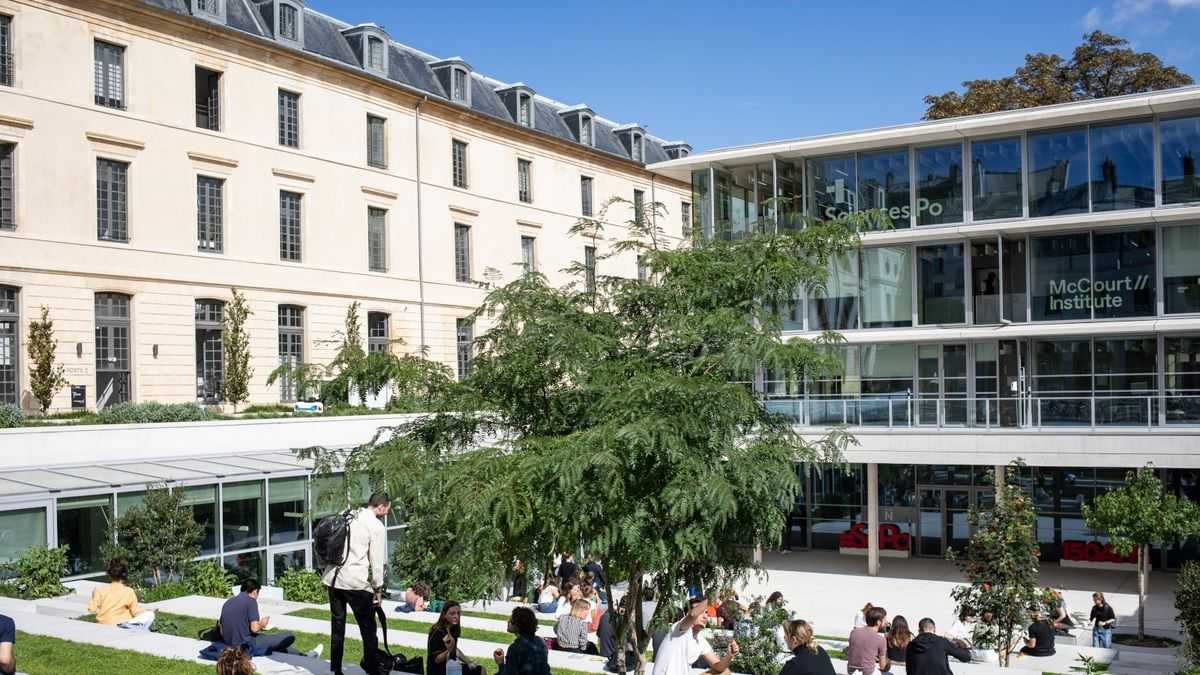
The historic Paris campus is centred on 27 rue Saint-Guillaume in Saint-Germain-des-Prés, with a group of buildings around Boulevard Saint-Germain forming an urban campus of nearly 20,000 square metres, and the 22,000 square-metre Saint-Thomas Campus opened in 2022. Students on the Paris campus can join more than eighty associations, and sports offer covers some 200 activities in over 40 disciplines. The Sciences Po Health Centre operates on all campuses with doctors, nurses and psychologists, and appointments are free and confidential.
Sciences Po reports about 13,500 students, 40% of them international, from 150 nationalities, together with 300 permanent faculty, 445 university partnerships, 64 dual degrees and 90,000 alumni. Most students spend a year abroad in the third year of the Bachelor's degree. Dual degrees are run with partners including Columbia University and University College London, and the second year of Master's study includes a semester of internship or study away.
Housing is arranged through partnerships with CROUS and private student residences near each campus, plus an online rental platform reserved for registered students. Sciences Po cites the QS World University Rankings by Subject 2025, where it is placed 4th worldwide in Politics and first in France and in the European Union in that subject.
Students whose parents' tax residence is in France or the European Economic Area pay fees scaled to household income: from 0 to 14,900 euros per year at undergraduate level and from 0 to 20,640 euros at graduate level. Students whose parents' tax residence is outside the EEA pay, for first-time entry in September 2026, 14,900 euros at undergraduate level and 20,640 euros at graduate level. Fee waivers are granted to all students receiving the CROUS scholarship and to non-scholarship holders from low-income families. One in three students on average pays no tuition fees.
The Sciences Po excellence scholarship for first-time applicants from outside the European Union whose household does not file taxes in the EU and who have been admitted to the Undergraduate College or a two-year Master's programme. It is awarded on merit and profile as part of admission. At Bachelor's level it gives a total exemption or an exemption of 9,500 euros from tuition fees; at Master's level it gives an exemption of 18,500 euros for each of the two years, and it renews automatically for Bachelor's holders who continue to a Master's. Around 300 students receive it each year. It cannot be combined with other Sciences Po or partner scholarships such as Mastercard Foundation, but can be combined with external awards such as Eiffel. PhD, one-year Master's, exchange students, French-procedure Master's applicants and most dual-degree candidates are not eligible. Applicants tick the scholarship in the 'Financial information' section of the application (French-school applicants contact the Admission Office after validating on Parcoursup). The 2027 deadlines are 13 January 2027 for the undergraduate international pathway, 1 April 2027 for French-school applicants, and 18 October 2026 or 29 November 2026 for the Master's committees. Apply: Émile Boutmy Scholarship.
Merit-based scholarships for students from sub-Saharan Africa who face financial and other barriers, open to applicants to the graduate schools and the Summer School. Sciences Po aims to support 1,450 scholars in the programme's second phase (2024 to 2033). Details: Mastercard Foundation Scholars Program.
All CROUS scholarship recipients receive a Sciences Po top-up grant worth 75% of their original scholarship. Country-specific awards include the Geneviève McMillan-Reba Stewart Foundation Scholarship (sub-Saharan African students admitted to the undergraduate Europe-Africa programme) and agreements with COLFUTURO and others giving 10% to 20% reductions for Latin American students. Sciences Po will not submit Eiffel Excellence applications for the 2027-2028 year. International mobility grants help students on the year abroad. Overview: Scholarships and financial aid; scholarships for non-European students. Financial aid enquiries: [email protected].
Mastercard Foundation Scholars Program at Sciences Po (Master's) →
Geneviève McMillan-Reba Stewart Foundation Scholarship →
CARE Scholarship (Canadian students, PSIA) →
Browse the scholarships listed for Sciences Po and check each award’s eligibility.
View scholarships for Sciences Po →Applicants must be preparing a French Baccalauréat or an equivalent foreign secondary diploma for the first time in the current year. Applicants who obtained it in the previous 12 months may apply as an exception on conditions, notably without enrolment in another higher-education institution. Only one application to the Undergraduate College is allowed. Candidates preparing the French Baccalauréat (including Abibac, Bachibac and Esabac in a French school) apply via Parcoursup on the Parcoursup calendar. Candidates preparing a non-French diploma (IB, A-levels, Abitur, Maturité suisse, US high-school diploma and others) apply through the Sciences Po admissions website, whatever their nationality. The Paris-campus Bachelor and dual degrees are reserved for the French pathway.
The international pathway has a non-refundable application fee of 150 euros (waived only for proven refugee status). Applicants choose two minors of the Bachelor of Arts, or a dual degree and a minor, and submit two academic references, transcripts and written texts (motivations in 1,500 to 2,000 characters each). The file is marked out of 50 (final-exam results, academic performance and progress, academic project and motivations), followed by a remote interview of about 25 minutes (self-presentation, commentary on an image, discussion of motivations) marked out of 50, for a total out of 100. For the 2027 intake, applications run on a rolling basis to 1 March 2027: complete applications by 4 November 2026 receive results in mid-January 2027, by 13 January 2027 in early April 2027, and by 1 March 2027 in early May 2027. Interviews take place from 8 to 18 December 2026, 8 to 19 March 2027 and 13 to 23 April 2027. The Sciences Po application is separate from the Campus France (CEF) procedure.
Working languages are French and English. Language test certificates are optional at undergraduate application; proficiency is assessed through the written texts and interview. Le Havre, Menton (English track) and the Reims English track require English at CEFR C1. Dijon, Nancy and Poitiers require French at C1, or French at least B1 together with English at C1 (intensive French in the first semester). Paris, Menton (French track) and Reims Africa (French track) require French at C1.
Applicants with a French undergraduate degree (or 180 ECTS credits) use the domestic procedure; applicants with a non-French undergraduate degree (or 180 ECTS credits or bachelor's equivalent, or a master's-level degree where universities do not award undergraduate qualifications) use the international procedure. Applications are made online and include academic transcripts with the undergraduate average grade (a minimum average applies for admissibility), mandatory references, a motivation letter in the language of the programme and, where required, a language test. The application fee is 150 euros, with limited exemptions. For the 2027 intake, the international procedure closes on 21 February 2027 (3 January 2027 for the Joint Master in Journalism and International Affairs and the Master in Journalism), with decisions released on a rolling basis according to the date a complete file was received (applications by 18 October 2026 are decided before 17 December 2026; by 29 November 2026, before 11 February 2027; by 3 January 2027, before 1 April 2027; by 31 January 2027, before 6 May 2027; by 21 February 2027, before 3 June 2027). Dual degrees have their own deadlines. Applicants cannot apply through several procedures in one campaign. Language tests are valid for two years (for the 2027 intake, taken on or after 1 January 2025), while Cambridge, DELF, DALF, Goethe and similar certificates have lifetime validity; exemptions apply to applicants who studied at least two consecutive years in a degree fully taught in the relevant language or hold a secondary diploma taught in it. Master's students must prove English at C1 level by the end of the two years even where no English level is required for admission.
Applicants must hold a Master's degree (or equivalent) with a research dissertation graded "Very good" or equivalent, a logical link between their previous studies and the chosen discipline (law, economics, history, political science or sociology) and meet financial pre-conditions. Applications are made on the Sciences Po admissions portal, reviewed by the doctoral thesis committee and recommended to the executive committee of the School of Research, and final admission is granted by the President of Sciences Po. Two admission sessions are held each year.
Facilities include libraries, a virtual campus tour, the Sciences Po Health Centre on every campus (general practitioners, nurses, psychologists and psychiatrists), around 200 sports activities in over 40 disciplines, and housing partnerships with CROUS and private residences near each campus.
Experiences shared by students of Sciences Po.
Studied here? Share your experience to help other applicants.

Book a free consultation with our expert counsellors and take the first step towards your dream university.
Copyrights © 2026 StudyMapped. All rights reserved.

Enter your credentials to continue.
Join us and start your study abroad journey.


