
University in France
Strasbourg, Grand Est, France
University profile
Sciences Po Strasbourg is the Institut d'études politiques (IEP) of Strasbourg, a grande école of the Université de Strasbourg and the oldest Institut d'études politiques in France. It sits in the heart of Europe, in a city that hosts major European institutions, and it trains students through a demanding multidisciplinary curriculum that combines law, economics, management, contemporary history, political science, geopolitics and languages.
Since 2020 the school has been based at the Cardo, 7 rue de l'Ecarlate, a building close to Strasbourg's historic centre. The school is fully integrated into the University of Strasbourg, as is Sciences Po Saint-Germain-en-Laye in its own university, which gives students access to the university's language teaching, library network and teaching staff from other components.
The flagship programme is the five-year Diplôme de Sciences Po Strasbourg (300 ECTS, RNCP39136, grade de master). The first two years (1A and 2A) form a common core, the third year (3A) is spent abroad, and the final two years (4A and 5A) are specialised in one of five tracks: Droit et politiques publiques, Économie et finances, Études européennes, Études des relations internationales et du global (ERIG), and Politiques et sociétés. The school also runs a Master in Political Science (M1 and M2), 19 Master 2 pathways in public policy, European law, finance, European and international studies, international relations and political science, and a Licence professionnelle in the administration and territorial authorities field.
Exclusive partnerships link the school with the grandes écoles of the public service (INSP, INET and others), the Banque de France, the Commissariat des armées and local authorities, and with companies through the Club des partenaires. Close to 30% of students receive state grants, and the Programme d'études intégrées (PEI) prepares pupils from less advantaged areas for the entrance competition.
Student life is organised around about twenty student associations covering the arts, sport, debate, journalism, European affairs, environment and equality, plus associations for individual master programmes. The Cardo library is part of the University of Strasbourg library network.
International opportunities include double-master programmes with eight partner universities, a five-year Franco-German double curriculum with Saarland University labelled by the Franco-German University, and the EPICUR triple master in European Geopolitics, International Security and Law, taught in English.
Registration fees for the Diplôme de Sciences Po Strasbourg are modulated according to the household's taxable income (revenu brut global divided by number of shares), in every year of the diploma, under a scheme adopted by the boards of Sciences Po Strasbourg and the University of Strasbourg to widen access. The exact amount is notified by email. Students entering the fifth year also register for the Master 2 and pay its fees in the relevant component. Fees for other programmes follow the University of Strasbourg's schedule. See registration fees.
The school helps manage a donors' scholarship (bourse des donateurs) to support the least advantaged students, and runs the Programme d'études intégrées (PEI) to prepare pupils from less advantaged areas for the entrance competition. The entrance-competition fee is reduced for grant-holding students. See social diversity and democratisation.
Bourse des donateurs "Objectif Réussite" (Sciences Po Strasbourg) →
Browse the scholarships listed for Sciences Po Strasbourg and check each award’s eligibility.
View scholarships for Sciences Po Strasbourg →Admission to the first year is through the common entrance competition of the Réseau ScPo (Aix, Lille, Lyon, Rennes, Saint-Germain-en-Laye, Strasbourg, Toulouse), or on file ('sur titre') for 2026 baccalauréat holders with an overall average of at least 17/20. Candidates are pupils in the final year of secondary school or the previous year's baccalauréat holders; baccalauréat equivalents are accepted. Candidates must register on Parcoursup (the 'Réseau ScPo' wish) and sit the competition, which is also held at centres abroad. The 2027 competition takes place on Saturday 24 April 2027. Tests: Questions contemporaines (3 hours, coefficient 3; themes 'Le vivant' and 'La paix'), Histoire (2 hours, coefficient 3) and a modern language test (1 hour, coefficient 2: English, German, Spanish or Italian). For the 2026 on-file route, applications ran from 7 to 9 July 2026 with the official baccalauréat transcript required.
Since 2019 students with three years of higher education can enter the fourth year through a specific competition: holders of a Licence or a diploma of at least 180 ECTS, or a non-EU diploma of at least three years of higher study. Applications are made on eCandidat (ecandidat.unistra.fr), not Mon Master. The file contains the track choice form, a motivation letter, a detailed CV, official transcripts, proof of English and another foreign language, and, for candidates from non-francophone countries, a C1 French certificate from a certifying body. The fee is 100 euros per track (20 euros for grant-holding students). Admission is by interview. For 2026-2027 the calendar was: applications 22 April to 18 May 2026, admissibility results 1 June, interviews 15 to 18 June, results 22 June. Places in 2026: Droit et politiques publiques 10, Études européennes 25, Politiques et sociétés 20; recruitment for Économie et finances and ERIG was suspended for that year. Students enrolled in another IEP diploma (outside Paris) cannot apply.
The Master in Political Science is open to external recruitment over M1 and M2. The 19 Master 2 pathways admit a limited number of external students under complementary recruitment where places remain, and the international double masters are also open to complementary recruitment. Applications are made on eCandidat.
Exchange students must be nominated by their home university (deadlines 30 April for autumn or full year, 15 October for spring) and submit an online application by 15 May or 31 October respectively. Students without an exchange agreement apply as free movers while enrolled at a university outside France.
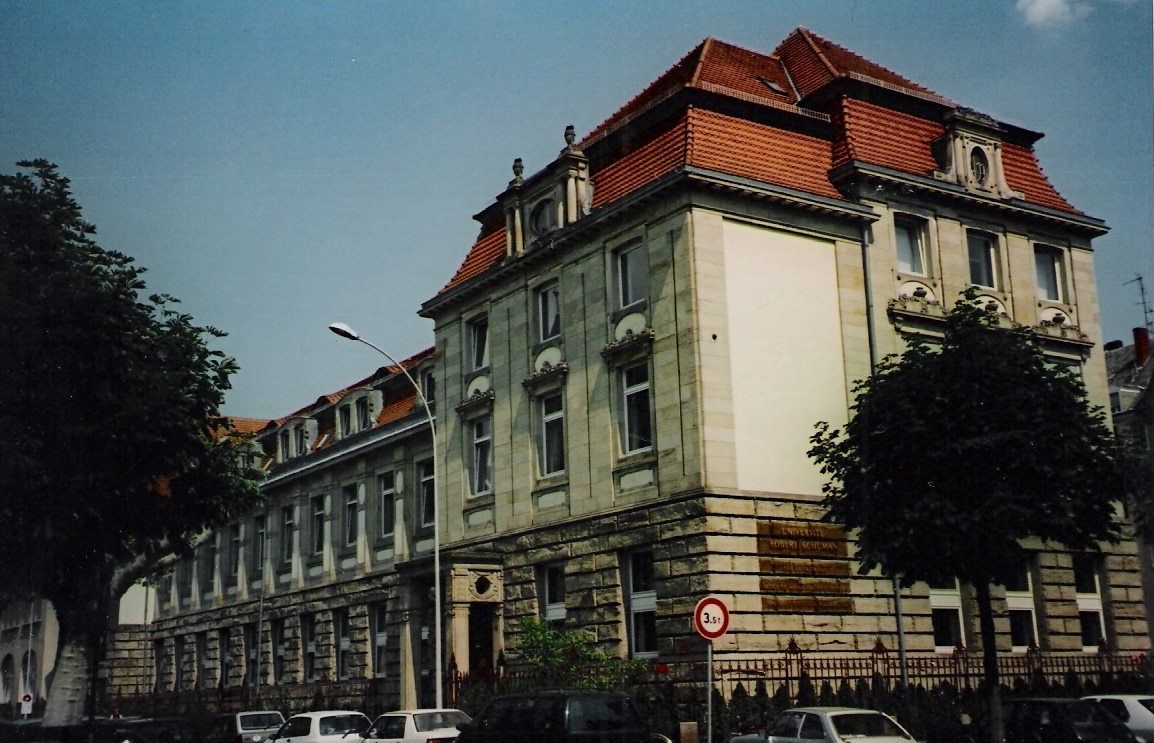
Le Cardo, Strasbourg: the single site of Sciences Po Strasbourg since 2020, at 7 rue de l'Ecarlate, near the historic centre and reachable by Tram A (Porte de l'Hôpital stop) from the main railway station.
Study programmes offered at Sciences Po Strasbourg.
Experiences shared by students of Sciences Po Strasbourg.
Studied here? Share your experience to help other applicants.

Book a free consultation with our expert counsellors and take the first step towards your dream university.
Copyrights © 2026 StudyMapped. All rights reserved.

Enter your credentials to continue.
Join us and start your study abroad journey.


