
University in France
Saint-Germain-en-Laye, Île-de-France, France
University profile
Sciences Po Saint-Germain-en-Laye is one of the ten Sciences Po institutes (Instituts d'études politiques) of the Réseau ScPo. It offers a five-year course training future leaders for the public, voluntary and private sectors, built on multidisciplinary social sciences (political science, law, economics, sociology and history), international openness and professionalisation. It describes itself as a grande école on a human scale, with about 1,100 students in 2025-2026.
It was created on the initiative of two universities, Cergy-Pontoise and Versailles Saint-Quentin-en-Yvelines (UVSQ), now merged into larger institutions: CY Cergy Paris Université and Université Paris-Saclay. This double anchoring gives students access to the libraries, laboratories and teaching resources of both. Since 2013 students have studied on a campus on the edge of the largest state forest in western Île-de-France, around 40 minutes from central Paris by RER.
The programme leads to the Diplôme d'Institut d'études politiques de Sciences Po Saint-Germain-en-Laye, conferring the grade of master. The first cycle (years 1 and 2) builds foundations in social sciences, methods, languages and digital skills, with method conferences in small groups. The third year is spent entirely abroad, either as an academic year at one of the partner universities (Erasmus+ in Europe, bilateral agreements elsewhere, MICEFA in North America) or as a semester of study followed by a 4 to 6 month placement. The master cycle (years 4 and 5) runs as a double degree with a partner master in political science (Université Paris-Saclay, co-accredited by CY Cergy Paris Université), law (UVSQ) or economics (CYU), with six specialisations and long placements of 4 to 6 months in each of the two years.
Other programmes include two integrated double degrees, Ingénieur·e data et humanités digitales (IDHD) with the engineering school CY Tech, and Politiques publiques et management des organisations (PPMO) with Audencia Business School; an Année préparatoire intégrée (API); four diplomas open to continuing education (DAGSeN, DAPP, DiReM and the IEP diploma by VAE); and competitive-exam preparation (Carrières justice-sécurité-défense, administrative exams and journalism schools).
Student life centres on 23 active student structures (18 associations, three branches of national organisations and one union), the three annual inter-Sciences Po events (Artefact, Prix Mirabeau and the inter-Sciences Po games), an annual themed Event Week and Thursday afternoons kept free of classes for cultural and sporting activities. Students may begin a second language such as Italian, Portuguese, Russian, Arabic, Japanese or French Sign Language. International students arrive mainly as exchange students from partner universities (82 partners are cited in the key figures) or as free-movers.
Registration fees for the Diplôme d'IEP are modulated by parental taxable income per tax share (progressive scale): scholarship holders on social criteria (CROUS, including échelon 0) and students with a disability rate above 80% pay 0 euros; then 300 euros (income 0-14,000), 700 (14,001-18,000), 1,200 (18,001-22,000), 1,700 (22,001-26,000), 2,200 (26,001-30,000), 2,700 (30,001-34,000), 3,300 (34,001-38,000), 4,100 (38,001-50,000) and 5,000 euros above 50,001. Each is plus 34 euros as a university library contribution. A gap-year registration is charged at reduced rates (from 0 to 1,225 euros plus 34 euros).
The IDHD double degree is charged on the same type of income scale from 0 to 9,900 euros for the current intake; for students who began their first year before 2025 the stated fees are 4,966 euros (9,966 euros for non-EU students). The PPMO double degree with Audencia costs 4,750 euros for scholarship holders and 9,500 euros for others for promotions starting from September 2026. Prepa fees: journalism preparation from 200 euros (Sciences Po scholarship holders) to 1,200 euros (external students); Carrières justice-sécurité-défense from 0 euros (Prépa Talents) to 1,680 euros (external students).
A revision commission can re-examine fees after a substantial change in family circumstances (illness, death, unemployment, divorce, over-indebtedness); a written, supported request is sent to [email protected] and any revision applies to that academic year only.
The Contribution vie étudiante et de campus is 105 euros for 2026-2027, paid on the national platform (cvec.etudiant.gouv.fr) before enrolment; it is due once per year even if enrolled in several programmes, and scholarship holders are exempted automatically.
Third-year students benefit from the international mobility aid run by CY Cergy Paris Université, funded by the Ministry of Higher Education and Research for scholarship holders and by Erasmus+ grants, cumulative with the CROUS social-criteria grant. The school also offers support towards departure costs for students most in need, particularly for the most expensive destinations, and an aid for using low-carbon transport to reach the mobility destination.
The school's democratisation programme (PaÏdEIa, partner lycées, preparation for the entry contest) supports pupils from modest backgrounds. The Prépas Talents du service public offer free places in the Carrières justice-sécurité-défense preparation. The Visale rental guarantee and a student-life service for housing ([email protected]) are also signposted. Official pages: fees, enrolment, democratisation programme.
Browse the scholarships listed for Sciences Po Saint-Germain-en-Laye and check each award’s eligibility.
View scholarships for Sciences Po Saint-Germain-en-Laye →Entry to year 1 is by the common competitive examination shared by seven Sciences Po (Aix, Lille, Lyon, Rennes, Saint-Germain-en-Laye, Strasbourg, Toulouse). It is open to candidates preparing the baccalauréat 2026 or holding the 2025 baccalauréat, or an equivalent diploma (foreign diplomas or DAEU). Registration is only through Parcoursup, with a single application valid for all seven schools. For the 2026 contest, 1,220 places were open, registration ran from 19 January to 12 March 2026 and was confirmed by 1 April 2026, the written tests took place on 25 April 2026 and results were available on Parcoursup from 2 June 2026. The application fee is 210 euros (40 euros for scholarship holders). Admission rests on three anonymous written tests marked out of 20, none eliminatory: Questions contemporaines (3 hours, coefficient 3), Histoire (2 hours, coefficient 3) and Langues vivantes (1 hour, coefficient 2; German, English, Spanish or Italian). The Saint-Germain-en-Laye examination centre is the Parc des Expositions Paris Nord Villepinte.
Candidates with a Très bien mention at the baccalauréat of the current year can apply on file for up to 10% extra places (12 places in 2026): a committee considers academic excellence, social criteria, involvement in associative, sporting, cultural, humanitarian or political activities and motivation. In 2026 the fee was 40 euros (15 euros for scholarship holders), applications ran from 7 to 15 July and results were sent from 21 July. Documents: Parcoursup Fiche Avenir, baccalauréat transcript, school reports since seconde, and where relevant scholarship notice or pupille de la Nation certificate.
Two integrated double degrees also admit at year 1 via Parcoursup: Ingénieur·e data et humanités digitales (IDHD, 25 places, with CY Tech, 6 years) and Politiques publiques et management des organisations (PPMO, with Audencia).
Admission to year 4 is for a double degree combining the Sciences Po diploma with a Master 1 in Political Science (Politiques publiques multiniveaux, Paris-Saclay/CYU; 30 places in 2026), Law (Concours Justice-Sécurité, UVSQ; 25 places) or Economics (Économie, data et transition, CYU; 10 places). Applicants must hold a licence or diploma of at least 180 ECTS from an EU institution, a diploma obtained outside the EU equivalent to at least three years of higher education, or come from a classe préparatoire (CPGE). Law candidates also register on Mon Master. All candidates apply on the school's competition platform (fee 100 euros, 60 euros for scholarship holders, in 2026), choose one of six specialisations and submit the required documents; admission is by file review (admissibilité) then a 20-minute remote interview with two teacher-researchers (5-minute presentation). In 2026 applications ran from 17 February to 16 March. Candidates without at least 4 months of experience abroad at admission must complete such an experience in year 4 or 5.
For CPGE students (ECG, B/L, A/L, D1, D2, scientific) with 120 or 180 ECTS, or business or engineering school students with at least 180 ECTS, in view of entering the master cycle the following year. 20 places in 2026; fee 100 euros (60 euros for scholarship holders); file review, an up-to-date note on a current topic, English level examined, and a remote interview; applications 16 February to 7 April 2026.
Students from partner universities are nominated by their home institution and send the application file to [email protected] by 31 May for September entry or 31 October for January entry. Free-movers from non-partner universities apply directly; they must have completed at least one year of higher education in their home country and show an intermediate level in English or French. A certificate of grades is issued after the stay.
Doctoral training in political science is provided through the joint branch of the doctoral schools ED DSP (CY Cergy Paris Université) and ED SHS (Paris-Saclay).
Administrative registration has three steps: paying the CVEC, completing the enrolment file on Démarches simplifiées, and paying the fees through the online link sent after the file is validated (from 22 June 2026 for the 2026-2027 campaign; fees due within 8 days of the email).
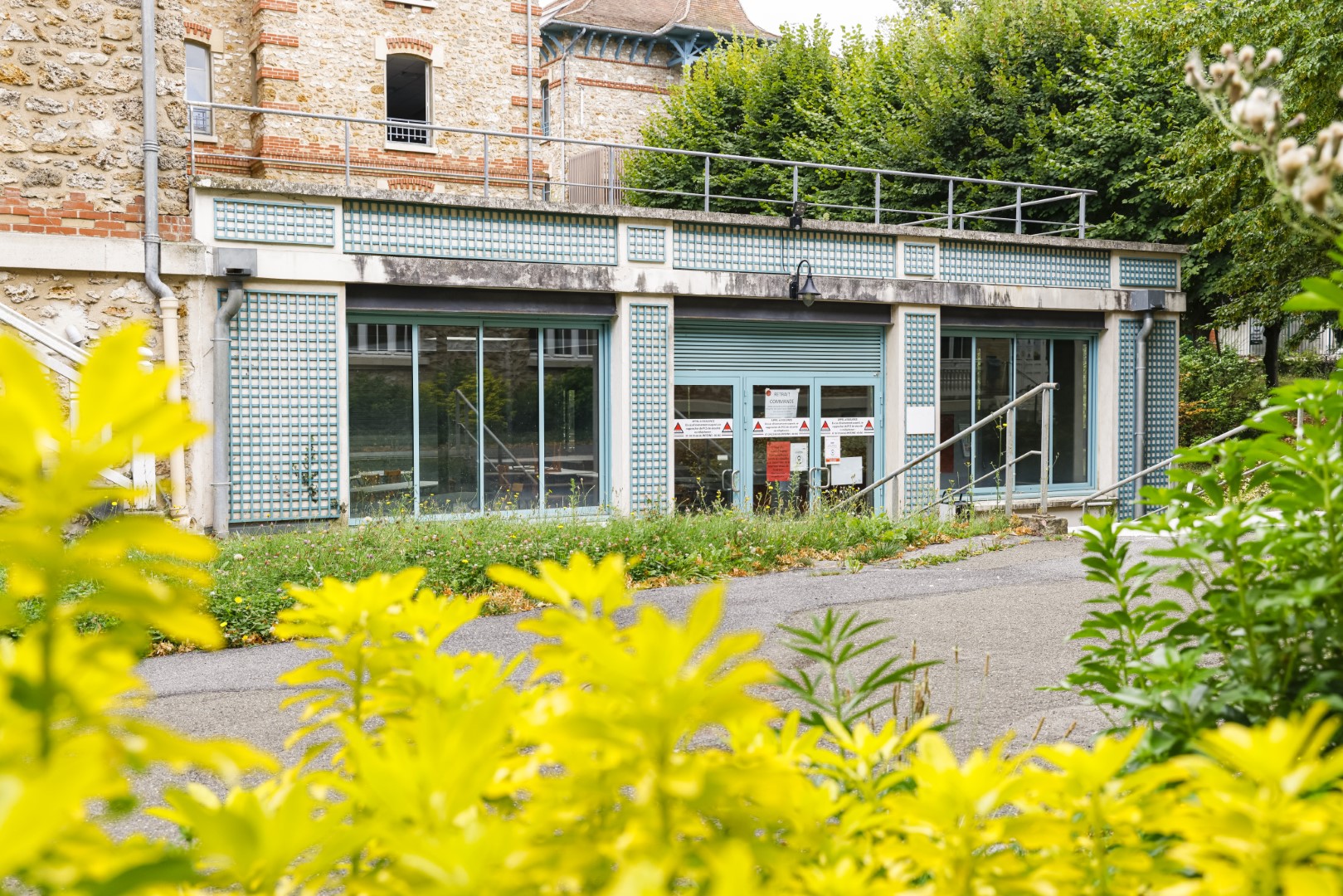
Saint-Germain-en-Laye campus (5 rue Pasteur, 78100 Saint-Germain-en-Laye): a 15,000 m² campus at the northern edge of the town, beside the forest, 40 minutes by RER from central Paris. It occupies the site of the 1913 teacher-training college, with listed buildings around an enclosed landscaped garden, and shares part of its premises with the INSPE.
CY Tech, Cergy: years 5 and 6 of the IDHD double degree are taught at the engineering school CY Tech in Cergy.
Housing: there is no CROUS residence near the campus (the nearest are in Nanterre or Versailles). Private student residences nearby include Thérèse Papillon (opened 2021, opposite the school), Artémis (2017) and Joseph Kessel (2024) in the Lisière Pereire eco-district, Désoyer (2019), Lokora, Alfred Sisley (Le Port-Marly), G. Brousset (Poissy), Médicis (Le Vésinet, 2025, with places reserved for scholarship holders) and the Appart'City Saint-Germain aparthotel; shared and intergenerational housing, a student foyer and the Visale guarantee are also signposted. Contact: [email protected].
Study programmes offered at Sciences Po Saint-Germain-en-Laye.
Experiences shared by students of Sciences Po Saint-Germain-en-Laye.
Studied here? Share your experience to help other applicants.

Book a free consultation with our expert counsellors and take the first step towards your dream university.
Copyrights © 2026 StudyMapped. All rights reserved.

Enter your credentials to continue.
Join us and start your study abroad journey.


