
University in France
Grenoble, Auvergne-Rhône-Alpes, France
University profile
Sciences Po Grenoble – UGA is a grande école of social sciences and one of the ten Instituts d'études politiques (IEP) in France. Since 1 January 2020 it has been a component institution (établissement-composante) with legal personality of the Université Grenoble Alpes (UGA), alongside Grenoble INP and the École nationale supérieure d'architecture de Grenoble (ENSAG). Its multidisciplinary five-year diploma combines political science, law, economics, management, history, sociology and languages, with international mobility built into the course.
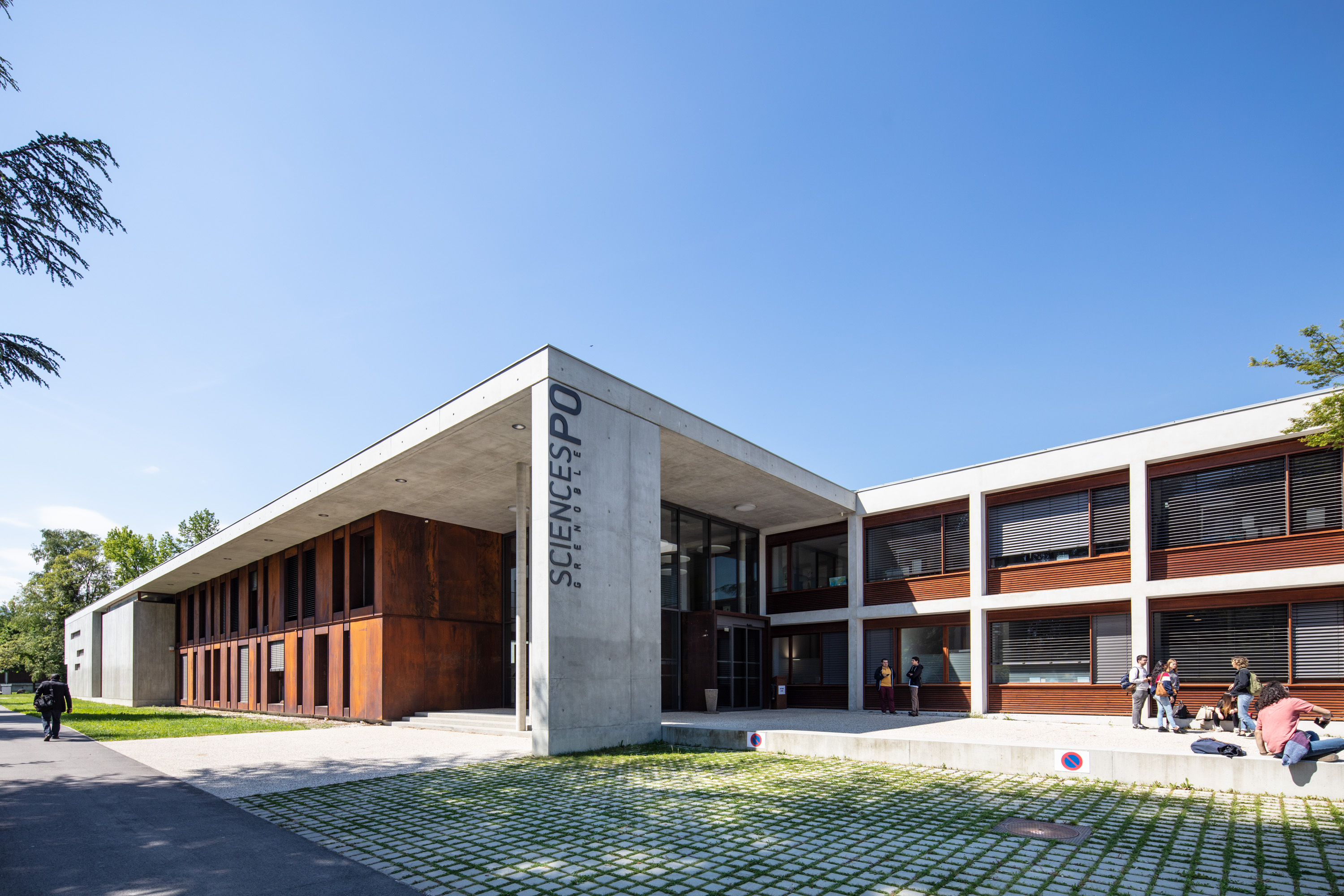
The Institute stands on the main UGA campus at Saint-Martin-d'Hères, on a 175-hectare university estate about 15 minutes by bike or tram from the centre of Grenoble. The building has been renovated and extended by 1,500 m². The campus offers academic, sports and cultural facilities, and the Maison des services à l'étudiant (MUSE) brings together UGA and CROUS services, including the International Students and Scholars Office, the student health centre and the CROUS social, grant and housing services.
The diploma is organised in two cycles. The first cycle (years 1 to 3) teaches the six core disciplines of political science, history, law, sociology, economics and management, together with languages, methods, ecological and digital transitions, sport and a period of academic mobility abroad. The second cycle (years 4 and 5) leads to the Diploma of the Institut d'Études Politiques de Grenoble, conferring the grade of master, and is organised in about eighteen specialisms (parcours) grouped in thematic schools: the École de gouvernance européenne, the Pôle d'études internationales, the École Ingénierie et Gouvernance de l'Action Publique, the Centre de préparation à l'administration générale (CPAG), the École Management, Data Intelligence et Études, Communication, the École Solidarités, Innovations et Territoires, and the École de Journalisme de Grenoble. A tri-curriculum in Architecture, Urbanism and Political Studies (AUEP) is run with ENSAG and the Institut d'Urbanisme et de Géographie Alpine.
Thematic chairs (social and solidarity economy, Mediterranean-Middle East, Jean Monnet, crisis management, serious games) and a Policy Lab link teaching to partners. Double degrees exist with Konstanz, UQAM Montréal, Salamanca and Padua.
Student life centres on about 20 associations approved by the Institute (a student union, an arts bureau, a student newspaper, Model UN, European and international-student societies, solidarity groups and others) within more than 100 associations on the wider campus. Sport is compulsory in years 1 and 3 and optional in the master. The documentation centre holds nearly 100,000 documents. About 250 international students are welcomed each year, from some fifty nationalities, and the Institute has more than 170 partner institutions on five continents. First-cycle international applicants can enter through the English-taught POLIS (Politics and International Studies) programme.
For the IEP diploma in initial, on-site education, fees are modulated according to family income (reference tax income, RFR, per tax share), applied from year 1 to year 5, following decisions of the board of directors (7 December 2021, updated 9 December 2025). Students whose parents declare all their income outside the European Economic Area pay the maximum rate of EUR 6,300 (to which national fees may be added for certain double-degree courses such as the CPI and Journalism). Exemptions apply to CROUS grant holders, French-government scholarship holders, wards of the nation, students with a disability of 80% or more, asylum seekers and refugees, Idex scholars, Graduate School scholars (international students only), Eiffel scholars and Prépa talents laureates. An exemption commission can grant partial or full remission in cases of social emergency. Distance-learning (EAD) tuition is not modulated: EUR 2,400 for initial education students on the distance-learning courses, with other rates for continuing education.
The Contribution de vie étudiante et de campus (CVEC), a separate national levy, is EUR 105 for 2026 and must be paid or an exemption certified before enrolment (cvec.etudiant.gouv.fr).
Three funding routes, which cannot be combined: the Eiffel Excellence scholarship (Campus France, master level only; for the 2027 entry the application deadline is 15 November 2026), UGA Idex scholarships (available once admitted to a year-4 parcours) and Graduate School@UGA scholarships (linked to parcours in the STEEN, Terra, MetroFabLab and EU Values programmes, such as Management et gestion des entreprises, Transitions écologiques, AUEP, Gouvernance européenne and MMO). Contact: [email protected].
The Fonds de solidarité, created in 2001, gives financial aid to students in real hardship, with or without a grant; applications go to [email protected] and are examined by commission (6 October 2025 and 18 June 2026 sessions in 2025-26). A fonds environnemental supports low-carbon travel by covering the difference between air and train tickets. Mobility grants for outgoing exchanges are coordinated at [email protected]. The CROUS offers meals at EUR 1 for students. The POS-POPH tutoring programme (Cordées de la réussite) supports grant-holding and disabled secondary students in the Grenoble académie.
Fees and enrolment · International students · Student support
Eiffel Excellence Scholarship (Master) at Sciences Po Grenoble – UGA →
IdEx Master Scholarship (Université Grenoble Alpes) at Sciences Po Grenoble →
Graduate School@UGA Attractiveness Scholarship (Sciences Po Grenoble pathways) →
Browse the scholarships listed for Sciences Po Grenoble – UGA and check each award’s eligibility.
View scholarships for Sciences Po Grenoble – UGA →Entry to the first year is by competitive selection (concours) run through Parcoursup, open to holders or candidates for the French baccalauréat or an accepted equivalent (European baccalauréat, foreign baccalauréat, DAEU) including applicants from earlier years. The 2026 round closed Parcoursup wish formulation on 12 March 2026 and required files to be completed and confirmed by 1 April 2026. About 200 first-year places are filled each year. The admissibility stage is an algorithmic treatment of marks from the first and final years of secondary school in French, history-geography, philosophy, modern languages and the two chosen specialisms. Admissible candidates sit a 15-minute online oral (a 2-minute presentation, an exchange in English on motivation and project, and an exchange in French on a thematic document file made available from late November). Admissibility and the oral each count for 50% of the final mark.
Applicants educated outside the French system can enter the English-taught Politics and International Studies (POLIS) first cycle by a separate competition. Candidates must be preparing or hold a non-French secondary school-leaving diploma and show English at B2+ level: TOEFL 95, IELTS 6.5, TOEIC 945 (listening and reading) and 360 (speaking and writing), Cambridge certificate 179, or Duolingo 125 overall with at least 110 in each section. French is appreciated but not required. The file contains the school-leaving certificate (if obtained), transcripts for the last two secondary years with certified translation, a one-page English CV, a motivation letter of at most 300 words and the English certificate. The application fee is EUR 110, paid online by card. For the 2026 session the online file was open from 12 January to 17 March 2026. Teaching is in English, with French as a foreign language in years 1 and 3 to reach B2. POLIS does not award a licence; after three years students receive a certificate of 180 ECTS, or continue to the IEP diploma.
About fourteen second-cycle parcours are open to a competition for entry into year 4, for candidates in initial education holding or completing a licence or equivalent (180 ECTS). Applications are made on the Institute's concours platform: for 2026 from 9 March to 4 May 2026, with an account to be created before 30 April. The file contains official transcripts for the three licence years (the first two years plus a certificate of enrolment if the licence is in progress), a CV, a copy of the bachelor's diploma for holders of non-European degrees, and a 'candidate project' of three parts (personal and academic path, scientific project, professional prospects), each limited to two pages. Candidates can apply to two parcours. Admissibility results were published on 27 May 2026, online interviews ran from 3 to 12 June and admission results were published on 23 June 2026. The application fee is EUR 110, or EUR 25 for holders of a CROUS grant. Open parcours for 2026 include Gouvernance européenne, Intégration et mutations en Méditerranée et au Moyen-Orient, Sciences de gouvernement comparées, Management et gestion des entreprises, Communication politique et institutionnelle, Transitions écologiques and others; Politiques et pratiques des organisations internationales was closed to the 2026 competition. Double degrees with UQAM, Konstanz, Padua and Salamanca are open to internal candidates only. A B2+ level in the language of instruction of the chosen parcours is required for international applicants. The School of Journalism (EJDG) runs its own year-4 competition (online registration 14 January to 5 March 2026).
The doctorate takes at least three years and requires a master-grade French diploma or a foreign equivalent (with a waiver request), an agreed supervisor and host laboratory, an approved thesis topic and, depending on the discipline, funding. Most theses are in political science, with others in law, economics, management, history or sociology. Candidates register in a UGA doctoral school, chiefly SHPT (humanities, politics and territory), Sciences juridiques, Sciences économiques or Sciences de gestion. For the SHPT school a discipline pre-selection audition and a single interdisciplinary audition are both required to obtain a doctoral contract; auditions take place between May and early July, the master dissertation must have been defended before July and the candidate must be supported by the intended supervisor.
Teaching is in French in most programmes; the English-taught POLIS first cycle and the Gouvernance européenne parcours are available in English. Exchange students need B2+ in the language of instruction.
Non-EU applicants should consult Campus France for the visa and 'Études en France' procedure for their country.
Study programmes offered at Sciences Po Grenoble – UGA.
Experiences shared by students of Sciences Po Grenoble – UGA.
Studied here? Share your experience to help other applicants.

Book a free consultation with our expert counsellors and take the first step towards your dream university.
Copyrights © 2026 StudyMapped. All rights reserved.

Enter your credentials to continue.
Join us and start your study abroad journey.


