
University in Germany
Bochum, Nordrhein-Westfalen, Germany
University profile
Ruhr University Bochum (Ruhr-Universität Bochum, RUB) is a public research university in the Querenburg district of Bochum, North Rhine-Westphalia. Founded in the 1960s as the first new university in the Federal Republic of Germany, it carries the claim "Built to change" and the motto "Education for all!", reflecting its role in the transformation of the Ruhr area from a mining district into a knowledge region. Since 1 January 2007 it has been a corporation under public law.
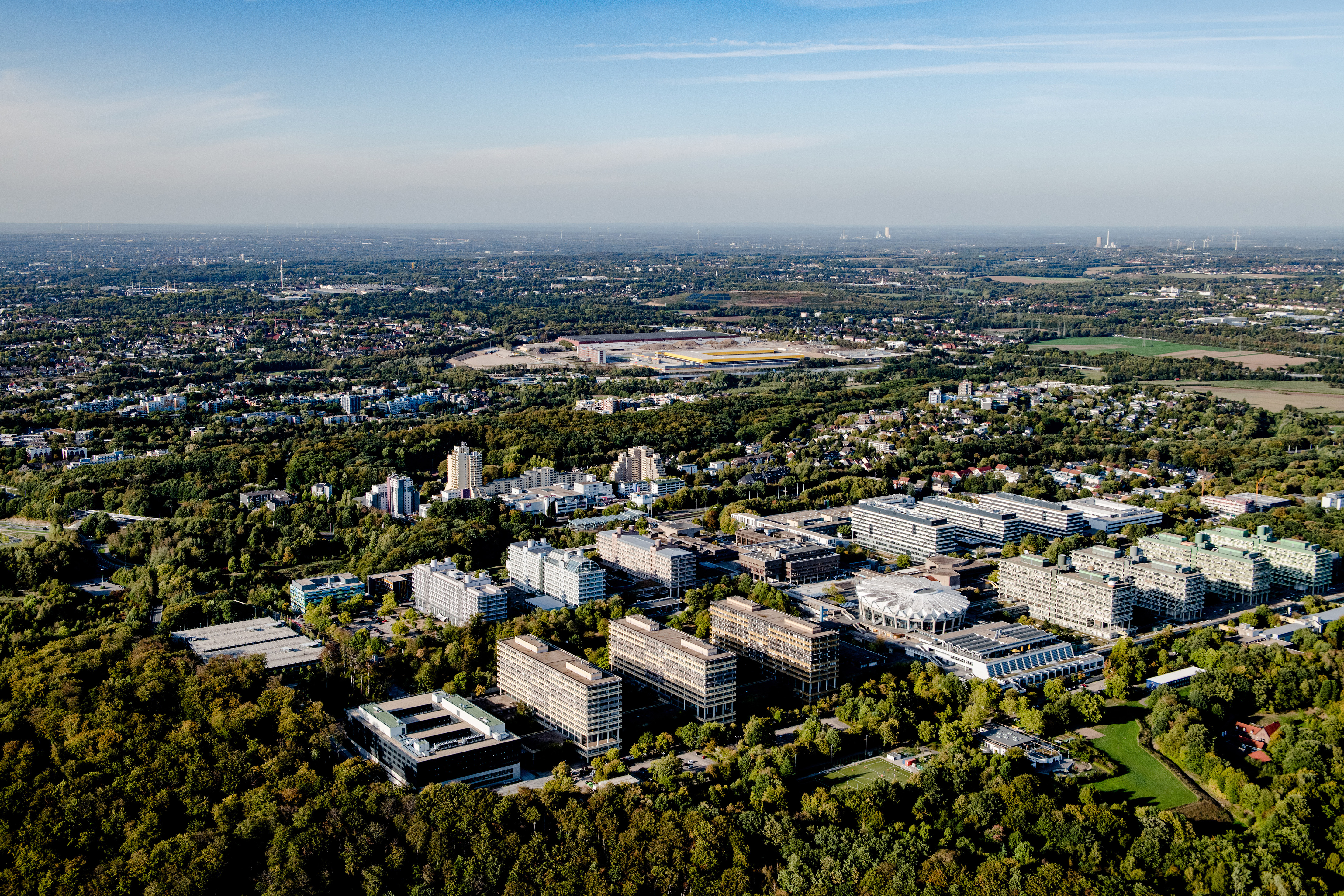
The main campus covers 4.5 square kilometres and is described by the university as the largest campus university in Germany. Under a three-pronged campus strategy RUB also works in downtown Bochum (the Archaeology Triangle, the Bochum Window and Blue Square) and on the former Opel site, now the Mark 51°7 technology campus in the Laer district, where new research buildings are being built.
Teaching and research are organised in 21 faculties covering the humanities and social sciences, engineering, natural sciences and medicine. Humanities and social sciences: Protestant Theology, Catholic Theology, Philosophy and Educational Research, History, Philology, Law, Management and Economics, Social Science, East Asian Studies, Sport Science and Psychology. Engineering: Civil and Environmental Engineering, Mechanical Engineering, Electrical Engineering and Information Technology, and Computer Science (founded in October 2021, the first new faculty in more than 35 years). Natural sciences: Mathematics, Physics and Astronomy, Geosciences, Chemistry and Biochemistry, and Biology and Biotechnology. Medicine: the Faculty of Medicine with the RUB Clinics. Central institutes include CERES and the IFHV, and the affiliated institutes include MERICS and the TestDaF Institute.
37,653 students are enrolled, among them 6,739 international students, supported by 6,471 members of staff. Teaching is research-based and the university offers 22 double and joint degrees with partner universities. International work follows the strategy RUB International 2030, adopted in November 2024, and the university is a member of the UNIC network (European University of Cities in Post-Industrial Transition) and of the University Alliance Ruhr with TU Dortmund University and the University of Duisburg-Essen.
Campus life includes the Botanical Garden, art collections, the Arts Centre (Musisches Zentrum), the Unifit gym and university sports, a daycare centre (Unikids) and the campus radio Radio c.t. Students live in private accommodation or in halls of residence run by Akafö, the student union of Bochum's universities, rather than by the university itself. The International Office team RUBiss offers orientation days and counselling for international students. In October 2026 Ruhr University Bochum and TU Dortmund University were selected for funding as the "Ruhr Innovation Lab", a University Consortium of Excellence, with funding starting on 1 January 2027.
Students pay a social contribution (Semesterbeitrag) of about 350 euros per semester, due before the start of each semester (about August for the winter semester and about February for the summer semester). The contribution is not a tuition fee; it covers Akafö, the student body (AStA) and the Semesterticket for public transport in North Rhine-Westphalia (except IC and ICE).
International students enrolled in a regular course of study, with a foreign nationality and a university entrance qualification not obtained in Germany, can apply from the third semester onwards (Master's students with a RUB Bachelor's degree can apply earlier). The scholarships are funded by the Ministry of Culture and Science of North Rhine-Westphalia (MKW) and the DAAD, are subject to the provision of funds, and pay 500 euros per month over six months, or 300 euros per month if the student also receives BAföG, with an accompanying programme. Total gross monthly income including the scholarship must not exceed 1,595 euros during the funding period. The application is made online and requires a motivation letter, CV, recommendation from a university lecturer, residence permit or passport, bank statements, a self-disclosure of the financial situation, BAföG notice if available, study certificate and transcript of records. The 2026/27 winter semester window ran from 16 June to 13 July 2026. Selection criteria are academic achievement, motivation, social situation, recommendation and social commitment. Official page
International refugee students can apply for a University Entrance Scholarship for the first semester or a One-Year Scholarship from the second semester, funded by the MKW. The University Entrance Scholarship application period for winter semester 2026/27 ended on 20 July 2026. Official page
Students within the standard period of study with outstanding academic achievements and social commitment can apply once a year for 300 euros per month for one year, with re-application possible; international students are eligible. Selection is made by the faculties and the Rector's Office in the winter term. For 2026/27 the application phases were 27 April to 14 May 2026 and 6 to 16 July 2026. Official page
The International Office advises on DAAD scholarships, which usually fund students from the Master's phase onwards, and on student loans (KfW student loan and education loan, and the interest-free Daka loan of the Studierendenwerke for students enrolled at an NRW university who pay the social contribution and have a sponsor living in Germany). BAföG for international students is handled by AStA and Akafö. In a financial emergency, students can apply to the Ausländerhilfsfonds e.V. for one-off support. Non-EU students with a §16b residence permit may work 140 full or 280 half days a year. Student finance advice: [email protected]; scholarship advice: [email protected]. Official page
Browse the scholarships listed for Ruhr University Bochum and check each award’s eligibility.
View scholarships for Ruhr University Bochum →Applications are made online through the RUB application portal. For restricted-admission first-semester programmes, non-EU applicants apply for the winter semester from the beginning of May to 15 July and for the summer semester from the beginning of November to 15 January; EU/EEA applicants apply from the beginning of November (winter semester) or December (summer semester) to the same deadlines. Non-restricted subjects are usually accepted until the start of lectures. All documents must be uploaded by the deadline; uploads are not possible afterwards. Applicants with a foreign (non-EU) school leaving certificate and no German or European citizenship need sufficient German for Bachelor's and state examination programmes. EU applicants are on an equal footing with German applicants; Medicine is applied for through Hochschulstart, restricted one-subject Bachelor's programmes and Law are coordinated through the Dialogue-Oriented Service Procedure (DoSV) of Hochschulstart (non-EU applicants do not register there), and Psychology considers the BaPsy-DGPs aptitude test. A lottery procedure and entry into advanced semesters are available in some cases.
Copy of passport; proof of German language proficiency; school report with an officially certified translation (German or English); university degree certificate with list of grades where applicable; proof of passing the university entrance examination where applicable (for example for certificates from Turkey or Iran); the assessment test (Feststellungsprüfung) where applicable; and an APS certificate for applicants with certificates from China, Vietnam or India (collective APS certificates for other universities are not accepted).
Accepted proof: TestDaF with at least 16 points within one examination; DSH level 2 or 3; Deutsches Sprachdiplom (DSD) II; ZOP or Goethe-Zertifikat C2; KDS or GDS of the Goethe-Institut; ÖSD C1; telc Deutsch C1 Hochschule; or the German part of the Feststellungsprüfung. Some programmes have additional language requirements. The bilingual Bachelor of Science in IT-Engineering (from winter semester 2025/26) requires one of these German certificates at application and an English certificate at B2 level (for example IELTS or TOEFL) by enrolment.
Most Master's programmes are taught in German; exclusively English-taught Master's programmes require no German but proof of English as set on each programme page. International applicants apply online from the beginning of June to 15 July for the winter semester and from the beginning of December to 15 January for the summer semester. A number of programmes run their own application procedures with separate deadlines, including Computer Science, Applied IT Security, Lasers and Photonics, Materials Science and Simulation, Molecular Sciences, Accounting and Auditing, Development-Management, the European Master's Programme in Human Rights and Democratisation, International Humanitarian Action (NOHA), Subsurface Engineering and Economic and Taxation Law (LL.M.). The application requires a passport copy, German language proof for German-taught and bilingual programmes, the school report, the degree certificate with transcript of records or subject and grade list (certified translation in German or English), proof of other language skills such as English where applicable, APS certificate where applicable and module descriptions of the Bachelor's programme. CVs, letters of motivation, photos and letters of recommendation are not to be uploaded. After admission, a consultation with the student advisory service is mandatory for almost every Master's programme.
Enrolment as a doctoral candidate is possible year-round. A degree (Master's, diploma, magister or state examination) and a supervisor are generally required, and the faculty's Promotionsordnung governs admission. The dean's office must certify acceptance for the doctorate ("Annahme zur Promotion") together with the supervision agreement (Betreuungsvereinbarung), which are uploaded at enrolment together with the first university entrance qualification, passport, degree certificates and, if applicable, de-registration certificates from earlier German universities. All doctoral candidates register with the Research School after enrolment.
Admission Office hotline in German and English: +49 234 3226644, [email protected] (Monday to Thursday 9 a.m. to 4 p.m., Friday 9 a.m. to 2 p.m.). Enrolment is online and documents are uploaded in PDF format.
Student residences in Bochum are run by Akafö, the student union of Bochum's universities, and the university's guest houses are managed by the International Office.
Study programmes offered at Ruhr University Bochum.
Experiences shared by students of Ruhr University Bochum.
Studied here? Share your experience to help other applicants.

Book a free consultation with our expert counsellors and take the first step towards your dream university.
Copyrights © 2026 StudyMapped. All rights reserved.

Enter your credentials to continue.
Join us and start your study abroad journey.


