
University in United Kingdom
London, England, United Kingdom
University profile
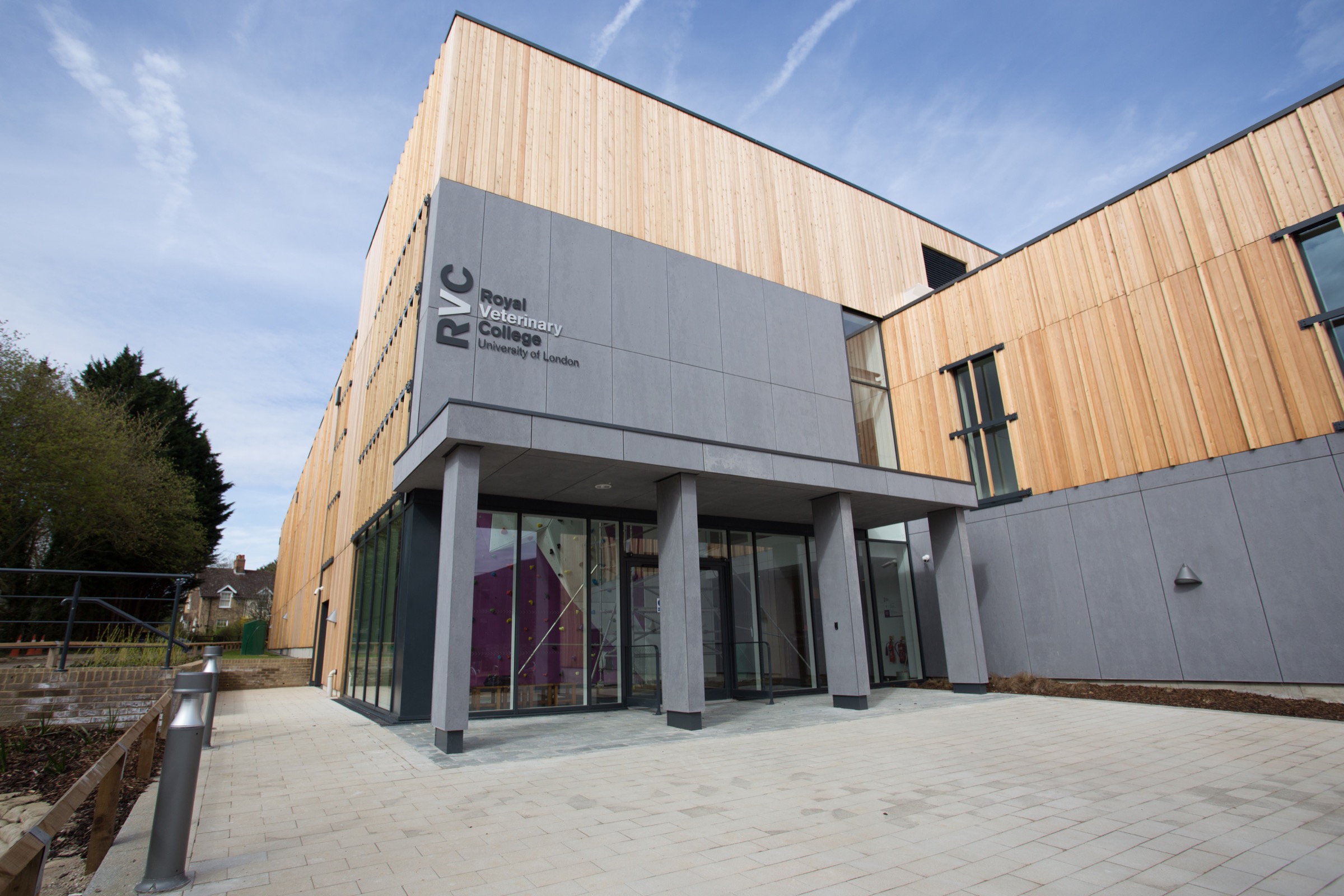
The Royal Veterinary College (RVC) is a specialist institution for veterinary medicine, veterinary nursing and the biological sciences, and describes itself as the UK's largest and longest-established independent veterinary school. It is a Member Institution of the University of London, which it joined fully in 1949 while keeping its own Royal Charter.
The college works across two campuses. The historic Camden Campus on Royal College Street in central London hosts the early years of veterinary medicine and most of the biological sciences teaching, while the 230-hectare Hawkshead Campus at North Mymms, near Potters Bar in Hertfordshire, hosts the clinical years, veterinary nursing and specialist training, together with the Queen Mother Hospital for Animals, the Equine Hospital and Boltons Park Farm.
Academic work is organised in three departments: Comparative Biomedical Sciences, Clinical Science and Services (the hospitals, Clinical Skills Centre and LIVE Centre) and Pathobiology and Population Sciences (production animals, epidemiology, public health and pathology). Programmes run from the BVetMed, the BVSc with Aberystwyth University, biosciences and veterinary nursing degrees to taught MSc, MRes, PhD and clinical residencies.
Clinical teaching runs through three hospitals and two first opinion practices: the Beaumont Sainsbury Animal Hospital in Camden, the Queen Mother Hospital for Animals (a full-service small animal referral hospital) and the Equine Hospital with its ambulatory practice at Hawkshead, plus a Farm Animal Clinical Centre and a working dairy and sheep farm. The college also owns the London Bioscience Innovation Centre, home to over 40 life science companies.
Student life is supported by the RVC Students' Union, which runs the Haxby and Buttery bars and clubs and societies including 13 sports teams. First-year Camden students live in College Grove on campus, Mary Brancker House in Kentish Town or University of London intercollegiate halls, while Hawkshead offers the Student Village, Odiham Hall and College Close for veterinary nursing students.
The BVetMed holds accreditation from the Royal College of Veterinary Surgeons (RCVS), the European Association of Establishments for Veterinary Education (EAEVE) and the American Veterinary Medical Association Council on Education, with reciprocal recognition allowing graduates to practise in Australia, New Zealand, Ireland and South Africa. Veterinary nursing courses are RCVS accredited and the biosciences degrees carry Royal Society of Biology accreditation.
Home (including Channel Islands and Isle of Man) undergraduate fees are £9,790 a year. International fees for 2026-27 entrants are £50,360 for the BVetMed, Graduate Accelerated BVetMed and BVSc (Aberystwyth), £27,510 for BSc and MSci biosciences degrees, and £19,810 for the BSc Veterinary Nursing and FdSc Veterinary Nursing; the Veterinary Gateway is open to home students only. Placement years cost £1,950. Taught MSc fees range from £15,495 to £17,010 (home) and £31,285 to £33,650 (international) for full-time study. MPhil, PhD, MRes and professional doctorate fees are £5,238 (home) and £34,620 (international) full-time. Fees are generally subject to annual increases under the Student Fee Policy. Tuition fees 2026/27
Home undergraduates from households with income below £35,000 a year receive a non-repayable RVC Bursary of £1,000 a year, paid in December and March. No application is needed: eligibility is assessed automatically from Student Finance household income data. A Care Leaver Bursary of £1,000 for the first year supports estranged students and care leavers. RVC Bursary
Eligible applicants are contacted by the Admissions team and may be asked to complete an application. Undergraduate scholarships
Options include a discretionary Bursary for Postgraduate Taught Courses for outstanding home students (typically £5,000 or more), an RVC Humanitarian Scholarship of £15,000 a year for master's students, a Fees Bursary of £5,000 a year for PhD studentship holders in areas of strategic importance, Commonwealth Master's Scholarships and the Commonwealth Shared Scholarship Scheme, and a 20% tuition fee discount for self-financing RVC alumni. Funded PhD studentships usually cover home fees, bench fees and a stipend. External awards listed by the college include Chevening, Fulbright, the IVC Evidensia Diversity Scholarship and the Vets Now Ethnic Diversity Nursing Scholarship. Postgraduate scholarships | Other funders
There is no mandatory funding for international undergraduates, who must secure funding for fees and living costs before starting. The RVC participates in the US William D. Ford Direct Loan Program for students from the United States. Funding for international students
RVC Excellence Scholarship (BVetMed, International) →
RVC Humanitarian Scholarship (Undergraduate) →
Rufus of Ruskinmere Sciences Scholarship (BSc Bioscience) →
Catt Scholarship (BSc Veterinary Nursing) →
Browse the scholarships listed for Royal Veterinary College and check each award’s eligibility.
View scholarships for Royal Veterinary College →Undergraduate applications, including those from international students, are made through UCAS (institution code RVET R84). For 2027 entry the deadline is 15 October 2026 for the BVetMed (D100) and the BVSc with Aberystwyth University (D105), and 13 January 2027 for the Veterinary Gateway (D190) and the biosciences degrees. Deferred entry is possible through UCAS. Graduates from US or Canadian colleges applying to veterinary medicine use VMCAS instead. No RVC course requires the BMAT.
The standard offer is AAA at A Level including Biology and Chemistry at grade A, plus a third subject that does not overlap with them (not General Studies), with a pass in each science practical; contextual offers of ABB (with an A in Biology or Chemistry) apply to applicants meeting the widening participation criteria. Equivalents include the IB Diploma with 666 at Higher Level including Biology and Chemistry (contextual 655), Advanced Highers AA in Biology and Chemistry plus five Highers at AAAAB, the Irish Leaving Certificate at H1 H1 H2 H2 H2 H2, a science Access to HE Diploma with Distinctions in Biology and Chemistry credits, and BTEC Level 3 National Extended Diplomas in Applied Science or Animal Management at D*D*D* with specified Distinctions; at least five GCSEs at grade 7 (A) are also required. Applicants need 140 hours of work experience within the 18 months before the deadline (70 hours in veterinary practice and 70 hours in other animal environments) and must complete the Applicant Supplementary Form within five days of applying. Offers are made only after an in-person interview; 2026-27 interviews run in Camden (December 2026), Newark and Los Angeles (November 2026) and Singapore and Hong Kong (January 2027). A Work Experience Support Programme is open to applicants from under-represented backgrounds. Graduates with a 2:1 in a relevant bioscience can apply to the four-year Graduate Accelerated BVetMed (D102).
The BSc Biological Sciences and related bioscience degrees ask for ABB (with an A in Biology or Chemistry) or BBB with two sciences, with contextual offers one grade lower in each subject. The BSc Veterinary Nursing asks for BCC including Biology, with an interview and animal-handling work experience. The six-year Veterinary Gateway (home students only) asks for CCC at A Level.
Country-specific equivalents are set for each course, covering qualifications such as US Advanced Placement with SAT or ACT, Canadian provincial diplomas, the European Baccalaureate, CAPE, STPM, Singapore A Levels, ACSEE and UACE. Where a country's school qualifications are not equivalent to A Levels, the University of London foundation programmes for international students and the UCL University Preparatory Certificate for Science and Engineering (70% overall and in Biology and Chemistry for BVetMed) are accepted. The six-year BVetMed with Integrated Foundation Year is open only to international students whose school systems prevent them from studying both Biology and Chemistry at advanced level.
BVetMed, biosciences and research degree applicants need IELTS Academic 7.0 with at least 6.5 in each component. Accepted alternatives include TOEFL iBT 101 with no section below 23, PTE Academic 69 with no less than 62 in each section, Cambridge C1 Advanced or C2 Proficiency at 185 with 176 in each section, and GCSE English Language at grade 6/B. IELTS One Skill Retake is accepted. Requirements must be met by 31 July for a September start.
Postgraduate taught, research and clinical training applications are made directly to the RVC through the RoVeR online portal. PhD applicants need, or expect, a first or upper second class honours degree, or an MSci or master's, in a relevant discipline; a lower second plus a relevant master's is also considered. Funded studentships are advertised throughout the year with the main round in January, and applicants first agree supervision with a researcher before applying formally.
International students on courses over six months need a Student visa. The RVC issues a Confirmation of Acceptance for Studies (CAS) once all offer conditions are met; it expires six months after issue. Veterinary Medicine is exempt from the five-year cap on degree-level study. Some research students need ATAS clearance; no taught course requires it.
Study programmes offered at Royal Veterinary College.
Experiences shared by students of Royal Veterinary College.
Studied here? Share your experience to help other applicants.

Book a free consultation with our expert counsellors and take the first step towards your dream university.
Copyrights © 2026 StudyMapped. All rights reserved.

Enter your credentials to continue.
Join us and start your study abroad journey.


