
University in Canada
Kingston, Ontario, Canada
University profile
The Royal Military College of Canada (RMC) is Canada's national military university, educating bilingual, fit and ethical leaders for the Canadian Armed Forces (CAF). It delivers undergraduate programmes in the social sciences, the humanities, science and engineering in both official languages, with 20 undergraduate programmes taken by 1,200 students, each built around a core curriculum connected to the profession of arms. RMC is a federally designated learning institution operated by the Department of National Defence.
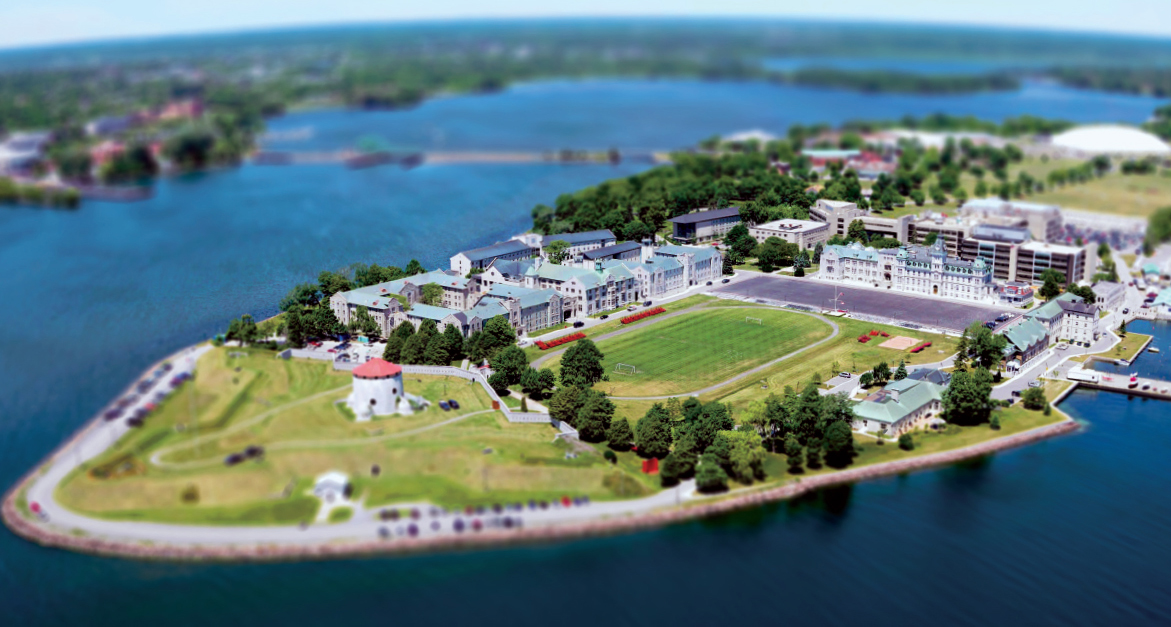
The campus is on Point Frederick, a small peninsula just east of downtown Kingston, Ontario, at the junction of Lake Ontario and the St. Lawrence River, midway between Toronto and Montreal and two hours from Ottawa. It holds two National Historic Sites of Canada, the Royal Naval Dockyard and the Point Frederick buildings. Quebec cadets who finish Secondary V take a preparatory year (first-year CEGEP) at the Collège militaire royal de Saint-Jean before the Kingston campus.
The RMC degree rests on four interlocking pillars: academics, military training, physical fitness and bilingualism. Cadets in the Regular Officer Training Plan (ROTP) who complete all four, within a BA, BSc or BEng degree, earn the "rmc" post-nominal. Academic work is organised in a Faculty of Social Sciences and Humanities, a Faculty of Engineering and a Faculty of Science, with departments including Applied Military Science, Chemistry and Chemical Engineering, Civil Engineering, Defence Studies, Electrical and Computer Engineering, English, French Literature and Culture, History, Management, Mathematics and Computer Science, Mechanical and Aerospace Engineering, Military Psychology and Leadership, Physics and Space Science, and Political Science and Economics.
Undergraduate honours and major programmes lead to a BA in English, Culture and Communication, French Literature and Culture, History, Political Science, Economics, Business Administration, and Military and Strategic Studies, and to a BSc in chemistry, computer science, mathematics, physics and space science, alongside engineering degrees. The Division of Graduate Studies offers master's and doctoral programmes in engineering, humanities, social sciences and science, including an MBA, an MPA, Military and Strategic Studies, a Master and PhD in War Studies, and a Cyber programme. RMC Online offers the Bachelor of Military Arts and Science, the BA (General) and certificates to CAF members, spouses of Regular Force members and federal government employees. Cadets and Queen's University students may take third- and fourth-year courses at each other's institution, subject to departmental approval.
RMC admits applicants connected to the CAF and the federal government; civilians may be admitted to graduate programmes. Student services include the RMC Success Centre, the Writing Centre, the Math Centre, the Massey Library, athletics, a campus museum and the Indigenous Leadership Opportunity Year. RMC is a federal institution established for the CAF rather than a provincially funded university.
RMC students fund their studies through the Ontario Student Assistance Program (OSAP) or the student aid programme of their home province or territory, depending on residency. RMC does not receive provincial funding directly, so students must pay tuition to RMC themselves from whatever aid they receive. For RMC students the OSAP office acts as the direct administrator. Cadets in subsidized CAF programmes such as the ROTP are sponsored by the CAF.
Apply through the OSAP website with a full-time or part-time application. Full-time funding is normally paid in two instalments, 60% in September and 40% in January. Full-time and part-time students with study periods of 21 weeks or more must apply no later than 60 days before the end of the study period; part-time students with periods of 20 weeks or less, 40 days. Students must maintain satisfactory academic progress, and full-time status requires the minimum credits per term (3 per term and 8 per year in Arts, Business Administration, Science and BMASc; 4 per term and 8 per year in Engineering). Documents are uploaded as PDFs under 2 MB. Students with existing loans must keep them interest-free through the online Continuation of Interest-Free Status application.
Undergraduate Student Research Awards (USRA) are arranged through the Dean of the department concerned, and the MITACS internship programme is available. Awards sources named include Universities Canada, the Claudette MacKay-Lassonde Excellence Scholarship and the Canada Council for the Arts. The Financial Aid Office is in Mackenzie Building, Room 361 ([email protected]). Details: Student Financial Aid.
Browse the scholarships listed for Royal Military College of Canada and check each award’s eligibility.
View scholarships for Royal Military College of Canada →Applicants must be applying to a subsidized CAF education entry programme such as the Regular Officer Training Plan (ROTP), be a serving CAF member who has completed basic MOSID training (or has a written recommendation from their unit or formation commander), be a released CAF member who completed basic MOSID qualification, be a term or indeterminate employee of the Department of National Defence or another federal department, or be a spouse of a Regular Force CAF member. Certain release categories make a member inadmissible for three or five years unless re-enrolled. The Division of Graduate Studies may admit civilians to its graduate programmes.
The ROTP is open to high school and college/university students, who are enrolled in the CAF and complete a degree at RMC or a Canadian civilian university. The ROTP application deadline is 31 January. CAF Reserve members complete a Component Transfer first. RMC Online serves CAF members, spouses of Regular Force members and federal employees with full-time, part-time, interest-only, mature and visiting student options. Other CAF-sponsored routes include the University Training Plan - Non-Commissioned Members, the Initial Baccalaureate Degree Programme and the Continuing Education Officer Training Plan. Since 7 September 2021, CAF members taking a degree open to cadets must pass the mandatory athletics and language courses unless granted legacy rights by Senate.
Applicants must be completing or have completed a Grade 12 diploma at a pre-university level with credits sufficient for regular admission to a university in their province, the first year of a two-year pre-university programme at a Quebec CEGEP (normally 14 credit courses), an equivalent, or qualify as mature students. Quebec Secondary V graduates complete a five-year programme including a preparatory year at the Collège militaire royal de Saint-Jean. RMC may reject applicants on their overall academic record even when entrance requirements are met; applicants required to withdraw from another institution for academic reasons are normally not considered until a full academic year has passed, and academic suspensions are upheld.
US high school: four years of English (not ESL) to Senior Level, three other full-year Senior Level academic subjects and three years of mathematics to Junior Level; SAT1 minimum 1200 (no less than 580 Critical Reading and 520 Mathematics) or ACT minimum 26. Science needs Senior Level pre-calculus plus two of biology, chemistry or physics; Engineering needs pre-calculus, two years of Senior Level chemistry and two years of Senior Level physics (or AP).
British GCE: at least seven subjects including English, with at least three at Advanced Level; the competitive range is a minimum average of B in three A Level subjects, with Ordinary level grades of C or higher. Science requires A Level mathematics and two of biology, chemistry or physics; Engineering requires A Level mathematics, chemistry and physics.
French baccalaureate: classe de terminale at an AEFE-recognised lycée in Canada, with a minimum overall average of 11/20 and at least 12/20 in each required course.
International Baccalaureate: full IB Diploma with three Higher Level subjects and a minimum total of 28 (excluding bonus points), with a minimum score of 4 in each required course. Mathematical Studies and Further Mathematics are not acceptable prerequisites. Home-schooled applicants are assessed case by case, and Advanced Placement courses are accepted as prerequisites. SAT Reasoning and Subject Tests may be considered in lieu of subject prerequisites.
Canadian university credits with C- or higher may be granted one for one as unallocated credits. Up to 10 transfer credits are normally granted for college courses (C- or higher) and up to 10 for CEGEP courses, with a two-year CEGEP DEC earning 10 credits. Military courses and professional training can be assessed for credit through Prior Learning Assessment and Recognition. Transcripts and course outlines must be sent on acceptance, before leaving for the Basic Officer Training Course for sponsored students. Students who reach the bilingual standard (BBB) may receive second-language credits, up to four for the second official language.
Master's and doctoral programmes are open to CAF officers and to civilians through the Division of Graduate Studies; requirements are set out in the Graduate Studies Calendar.
Study programmes offered at Royal Military College of Canada.
Experiences shared by students of Royal Military College of Canada.
Studied here? Share your experience to help other applicants.

Book a free consultation with our expert counsellors and take the first step towards your dream university.
Copyrights © 2026 StudyMapped. All rights reserved.

Enter your credentials to continue.
Join us and start your study abroad journey.


