
University in United Kingdom
London, England, United Kingdom
University profile
The Royal Central School of Speech and Drama (Royal Central) is a specialist conservatoire for theatre and performance in London and a member institution of the University of London. Founded by Elsie Fogerty in 1906, it is also a member of Conservatoires UK and is registered with the Office for Students. It offers undergraduate, postgraduate, research and short courses spanning acting, actor training, applied theatre, theatre crafts and making, design, drama therapy, movement, musical theatre, performance, producing, puppetry, scenography, stage management, teacher training, technical arts, voice and writing.
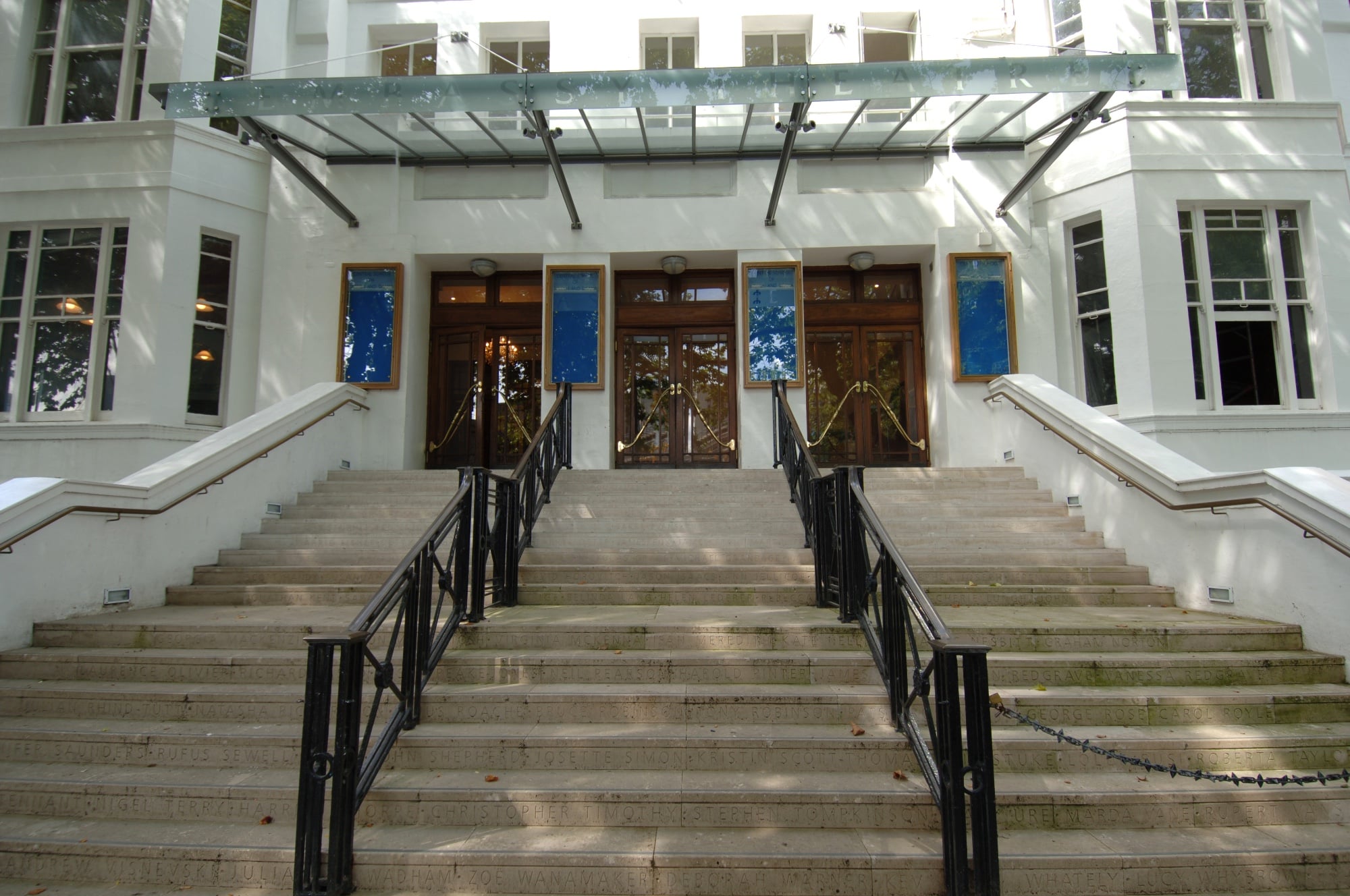
The school occupies the Embassy campus at 62-64 Eton Avenue in Swiss Cottage, in the London Borough of Camden, opposite Swiss Cottage Underground station. The campus has grown around the historic Embassy Theatre, which the school took over in 1957, and now includes the North Block, opened in 2019, with a film, media and digital studio and four further double-height rehearsal and production spaces.
Undergraduate teaching is organised in three departments: Performance (BA Acting: Classical and Contemporary, Contemporary and Devised, and Musical Theatre), Practice (BA Drama and Applied Theatre, Performance and Contemporary Arts, and Writing for Performance) and Producing (BA Costume Production, Performance Design, Production Arts: Props, Painting and Set, and Production Technologies and Stage Management). Postgraduate study includes MA and MFA programmes in acting, acting for screen, actor training and coaching, advanced theatre practice, applied theatre, creative producing, drama and movement therapy, movement, musical theatre, scenography, voice studies and writing for theatre, film, radio and television, alongside PhD research.
Research is led by the Research and Knowledge Exchange department and the Centre for Performance, Technology, and Equity (PTEQ), established with a £5.6 million grant from Research England. In the 2021 Research Excellence Framework, 75% of Central's research was classed as world leading.
Student life centres on the Students' Union and its campus bar, with Liberation Officers representing student communities. The Student Centre brings together the Neuro-Inclusion and Disability Centre, a free counselling service and the Student Advice Service, which also helps with accommodation. Students have places in the University of London's Intercollegiate Halls, an allocation of rooms with iQ Student Accommodation, and access to private halls, private rented housing and homestay; most live in private rented accommodation.
Central admits students from around the world; in 2021-22 students came from more than 65 countries. International undergraduates apply through UCAS and postgraduates apply directly, with online interviews and auditions available via Zoom. Alumni include Dame Judi Dench, Sonia Friedman and Riz Ahmed.
Offer-holders may need to pay a non-refundable deposit, deducted from fees at registration: £1,000 for Home postgraduates and £2,000 for Overseas students. Home undergraduates with a Student Loans Company tuition fee loan pay no deposit. EU, EEA and Swiss nationals starting from autumn 2022 normally pay Overseas fees unless they hold settled or pre-settled status. Tuition fees and additional costs
£1,250 for new Year 1 UK-based undergraduates with household income under £40,000 (as assessed by the UK student finance bodies) who apply for a maintenance loan. It is awarded automatically and paid by 30 November of the first year. For 2026/27 the household income must be confirmed by 26 October 2026.
Applicants with an offer for a BA, MA or MFA course make a single application, using the link in their offer pack, and are considered for every fund they qualify for. Deadlines are 26 January 2027 (offers made 1 November 2026 to 19 January 2027), 30 March 2027 (offers 20 January to 22 March 2027) and 27 May 2027 (offers 23 March to 20 May 2027). Funds include:
Funds for continuing students include the Central Bursary, Kay Frosdick Memorial Bursary, The January Embassy Scholarship, The Portal Trust Bursary, Tunstall Award, Fishmongers' Company Bursary and a University of London Scholarship. For 2026/27, applications open on 7 December 2026 and close on 8 January 2027.
Partial and full bursaries are available for the Gap Year Diploma and Acting Diploma. External sources include Snowdon Trust grants of up to £5,000 for disabled students, Wayne Sleep Foundation awards, Ian Fleming Musical Theatre Awards, the Mab Gwalia Drama Student Scholarship for Welsh students and Postgrad Solutions bursaries. Central also pays for access to The Alternative Guide to Postgraduate Funding (PIN from [email protected]). Doctoral funding has come through London Arts and Humanities Partnership AHRC studentships and PTEQ collaborative PhD calls.
Scholarships, bursaries and awards | Student finance and funding
Central Bursary (Continuing Students) →
Browse the scholarships listed for Royal Central School of Speech and Drama and check each award’s eligibility.
View scholarships for Royal Central School of Speech and Drama →All BA applications are made online through UCAS (main Undergraduate scheme, not UCAS Conservatoires), using institution code C35; no campus code is needed and direct applications are not accepted. Applicants to BA (Hons) Acting are considered for all three strands (Classical and Contemporary, Contemporary and Devised, Musical Theatre) from a single UCAS choice.
Standard academic entry requirements range between 120 and 96 UCAS tariff points, drawn from A levels, BTECs, T Levels and other qualifications; international qualifications and others outside the tariff can also be accepted, and lower or unconditional offers may be made to exceptional candidates or those with relevant experience. Selection relies on interviews, auditions and portfolios depending on the course: auditions for the Department of Performance and interviews for the Departments of Practice and Producing.
BA (Hons) Acting closes on the January UCAS Equal Consideration Deadline, usually the last Wednesday in January, and applications, including references, must be complete by then. Other BA programmes stay open after January, but applying before it guarantees an interview. Second-year (Level 2) entry is possible on some courses for applicants with relevant prior study such as an HNC or HND, but not on BA (Hons) Acting. Clearing opens on 5 July each year, and applicants add Central as a Clearing choice only after receiving an offer following interview. Deferral is granted only in very limited circumstances.
The free online Supported Pathways programme helps UK Home applicants prepare UCAS applications, personal statements, auditions, portfolios and interviews.
MA, MFA and PG Certificate applications are made directly to Central through its online portal via the 'Apply now' link on each course page, not through UCAS. Applicants normally hold a degree or equivalent qualification, in some programmes in an arts-related subject, and/or relevant professional experience, and each application must include the postgraduate personal statement form and at least one reference. Applications usually open in mid-October for entry the following September/October; most programmes consider applications until full, while some performance courses such as MA Acting for Screen close their first round in May. There is no application fee, but performance programmes such as MA Acting, MA Acting for Screen and MA Musical Theatre charge an audition fee. Applicants may apply for up to three postgraduate programmes at once.
The PhD runs for a minimum of three years full time (normally four years maximum) or six years part time (normally eight years maximum), and may be submitted as a written thesis or as artistic practice with a written component. Enquiries go to [email protected].
Applicants from outside the UK apply in the same way as UK applicants: through UCAS for undergraduate courses and directly for postgraduate courses. Interviews and auditions can be taken online via Zoom. Applicants must provide evidence of their highest qualifications, with certified translations of documents not in English.
The minimum level is CEFR C1. English GCSE, A level, Scottish National 4 or 5, or Scottish Higher or Advanced Higher in English taken at a UK school or college begun before age 18 is accepted. Otherwise a Secure English Language Test taken within two years of enrolment is required:
Online or home-edition tests and IELTS Indicator are not accepted. Evidence must reach the Admissions Office by 1 August of the year of entry.
Offer-holders without a British passport or settled/pre-settled status need a Student Route visa. A CAS is typically issued in July, once the offer has been accepted, conditions such as English language have been met and the deposit has been paid. Term-time work is limited to 20 hours per week.
Admissions: [email protected], +44 (0)20 7722 8183 (9am to 4.45pm weekdays). Undergraduate applications | Postgraduate applications
Embassy campus, Swiss Cottage, London NW3 3HY: the school's single campus, at 62-64 Eton Avenue in the London Borough of Camden, used for all undergraduate, postgraduate, research and short course teaching.
Off-campus spaces: some classes, rehearsals and productions take place at St Peter's Church and at Wac Arts, both a short walk from the campus.
Accommodation: rooms in the University of London's Intercollegiate Halls in central London and with iQ Student Accommodation, alongside private halls, private rented housing and homestay.
Study programmes offered at Royal Central School of Speech and Drama.
Experiences shared by students of Royal Central School of Speech and Drama.
Studied here? Share your experience to help other applicants.

Book a free consultation with our expert counsellors and take the first step towards your dream university.
Copyrights © 2026 StudyMapped. All rights reserved.

Enter your credentials to continue.
Join us and start your study abroad journey.


