
University in United Kingdom
London, England, United Kingdom
University profile
The Royal Academy of Music is Britain's oldest conservatoire, founded in 1822 and granted a Royal Charter by King George IV in 1830. It trains performers and composers from pre-school level through to doctoral research, with students drawn from more than 60 countries. Alumni include Simon Rattle, Felicity Lott, Elton John, Harrison Birtwistle and Evelyn Glennie. The Privy Council granted the Academy degree-awarding powers in 2012.
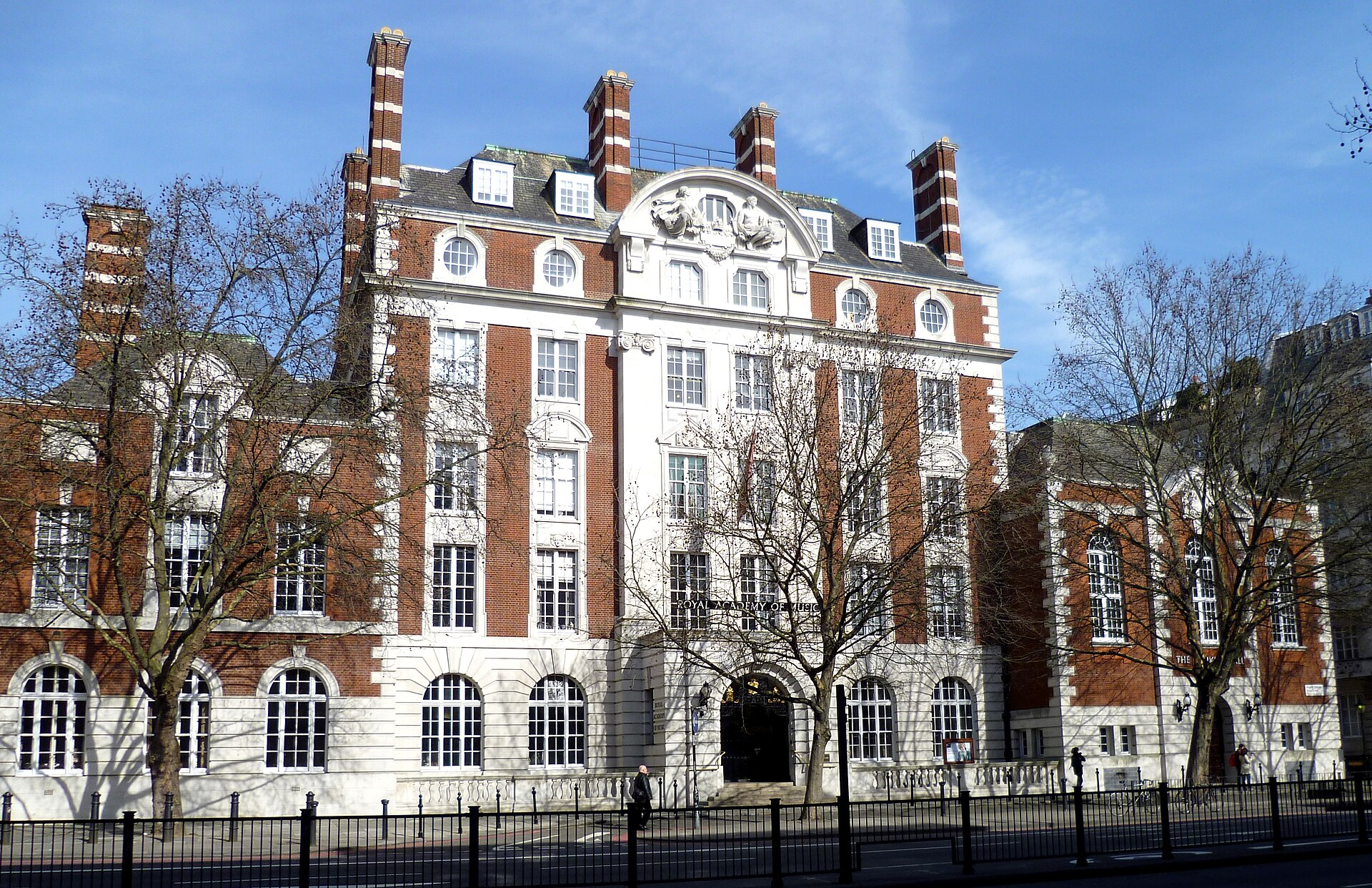
The Academy occupies a purpose-built Edwardian building on Marylebone Road in central London, its home since 1911, extended by the neighbouring 1-5 York Gate and modern additions including the Susie Sainsbury Theatre and Angela Burgess Recital Hall (both opened in 2018). Further practice space is provided at the Cross Keys Practice Centre near Marylebone High Street and at St Mark's Church.
Teaching is organised in departments: Academic Studies; Accordion; Brass; Choral Conducting; Composition and Contemporary Music; Conducting; Ensemble Piano; Guitar; Harp; Historical Performance; Jazz; Musical Theatre; Opera; Organ; Piano; Strings; Timpani and Percussion; Vocal Studies; and Woodwind, alongside Research Degrees, the Junior Academy (founded 1915), Open Academy and Widening Participation. Programmes run from the four-year BMus (Honours), a Gap Year, Organ Foundation and a fully funded Foundation Year, through the MA, MMus and Postgraduate Certificate, to Professional, Advanced Professional, Advanced Artist and Advanced Opera Diplomas and an integrated MPhil/PhD. The LRAM music teaching licence is open to senior undergraduates, postgraduates and alumni.
The Academy's Library holds over 200,000 items, and its Special Collections and Archives hold Designated status. The Academy Museum, opened in 2001, is an Accredited Museum whose collections include stringed instruments by Stradivari and the Amati family and historic keyboards by Broadwood, Pleyel and Erard. The Academy founded its own recording label in 1997.
Every enrolled student belongs to the Students' Union, which runs Freshers' Week, a Thames boat party, a Christmas party and Summer Ball, and clubs ranging from the African-Caribbean Society to football, basketball and tag rugby. International students are welcomed during Enrolment Week and supported by English Language Support Tutors, weekly language classes and a writing help desk. Students live mainly in University of London intercollegiate halls, International Student House or private accommodation.
Since 1999 the Academy has been a member institution of the University of London, the first conservatoire admitted as a full member. BMus, PG Cert, MA, MMus, MPhil and PhD students graduate with University of London awards. The Academy was rated Gold in the Teaching Excellence Framework in 2017 and again in 2023.
Fees for one academic year (UK / international):
Fees rise annually. UK BMus fees follow the government's maximum fee cap. Full tables for every course are on the Fees and Funding page.
All degree and diploma auditionees are automatically considered for merit-based entrance scholarships; there is no separate application. Composers are assessed at their second-round interview. Awards range from small sums to full tuition fees and appear in the UCAS Conservatoires offer. For UK and eligible EU BMus students they are paid as maintenance awards through the Student Loans Company. Awards on courses longer than one year are reviewed annually. Gap Year and Organ Foundation students are not eligible.
Need-based Financial Assistance Bursaries are open to most international and Home postgraduate students. Offer-holders receive the application form by email. The 2026/27 window ran from 9 January to 25 May; applications for 2027/28 open in early January 2027. In 2024/25, 180 students received bursaries, most of between £1,000 and £2,000. Bursaries must be reapplied for each year. UK and eligible EU BMus students with household income of £25,000 or below receive a £3,000 Income Bursary, and those with income between £25,001 and £33,500 receive £2,000, paid through Student Finance. Maintenance bursaries are also available for UK-fee BMus students in the most difficult circumstances. A means-tested Hardship Fund is open to all enrolled students.
UK and eligible EU BMus students can take government tuition fee and maintenance loans, and UK postgraduates can apply for government Master's and Doctoral loans. See Scholarships and Bursaries and the External Funding Guide for trusts and foundations.
Royal Academy of Music Entrance Scholarships →
Royal Academy of Music Financial Assistance Bursary →
Browse the scholarships listed for Royal Academy of Music and check each award’s eligibility.
View scholarships for Royal Academy of Music →Undergraduate and postgraduate applicants, UK and international, apply through UCAS Conservatoires and must also submit an Acceptd profile for their Principal Study, with any recordings and supporting files required by the department. For most courses the deadline for both is 1 October 2026, though some courses have later deadlines. Applications carry an Academy assessment fee of £100 plus the UCAS registration fee. One referee is nominated in the UCAS application. Exchange and study abroad applicants apply directly via Acceptd.
UK applicants who have received Free School Meals or are care leavers may qualify for the UCAS Application and Assessment Fee Waiver Scheme. The Academy's own fee waiver covers applicants receiving benefits such as the 16-19 Bursary, EMA, Disabled Students' Allowance, Universal Credit, Income Support, Jobseeker's Allowance or Tax Credits; fee-waiver recipients under 27 living in the UK may also claim up to £100 towards standard-class audition travel.
Entry is by audition, interview or assessment of a first-round submission. The main London audition period runs from 7 to 18 December 2026. International auditions are held in Qingdao, Hong Kong, Brisbane and Sydney (November 2026, deadline 1 October 2026) and New York (early March 2027, deadline 13 January 2027), with video pre-screening for the first round; video auditions are offered for most courses. Candidates who reach the required standard may have an academic interview on the same day, and Jazz candidates sit a short jazz theory paper. Results appear in the UCAS Conservatoires Hub, usually before Christmas for December auditions. The minimum age for study is 18 by 1 September of the year of entry.
Applicants need professional performing potential or a high standard of composition, sound general musicianship and a good aural response. No music examinations are required, but successful performance candidates usually play at least at Grade 8 distinction level. Music theory at Grade 6 and piano at Grade 5 are recommended for those without them. Prior experiential learning can be recognised through APEL.
Examples of accepted qualifications for BMus Year 1:
Transfer into Year 2 or 3 is possible with transcripts showing equivalent study; entry into Year 4 is not. Academic results must normally be submitted by 17 July 2026.
Equivalences given include a US/Canadian GPA of 3.0/4.0 for a lower second and 3.3/4.0 for an upper second, and a Chinese GPA of 2.6 (73%) for a lower second and 3.1 (78%) for an upper second.
Applicants whose first language is not English, and who are not nationals of a UKVI-exempt country, must present IELTS Academic, PTE Academic, TOEFL iBT or Cambridge C1 Advanced results, normally by 1 May before the course starts. IELTS minimums:
PTE Academic minimum for BMus Year 1, Gap Year, MA and Postgraduate Certificate is 59 overall with at least 59 in each component. A UKVI-specific test is not required, and scores from different tests can be combined.
Students who need a Student visa request a CAS through the Academy's student portal once their offer is unconditional. The Admissions Team advises on immigration. The Gap Year and Organ Foundation courses are not eligible for the Student visa route.
Main building, Marylebone Road, London NW1 5HT: the Academy's home since 1911, with teaching, practice and rehearsal rooms, Jebsen House practice spaces, the Library and the Academy Museum. Performance venues include:
Cross Keys Practice Centre, off Marylebone High Street: additional practice facilities and a composition suite for contemporary and electronic work.
St Mark's Church, nearby: houses the Academy's 1763 Neapolitan organ and is used for specialist study and rehearsal.
Library and Museum: the Library holds over 200,000 items, including autograph manuscripts by Purcell, Sullivan and Vaughan Williams, the Robert Spencer lute book collection and an Orchestral Library of about 4,000 sets of parts. The Museum (opened 2001) displays instruments, art, manuscripts and scores. Students may also apply for access to Senate House Library (University of London) and the British Library.
Accommodation: no Academy-owned halls; students are allocated rooms in University of London intercollegiate halls such as Nutford House, College Hall (both catered) and The Garden Halls (self-catered), with International Student House on Great Portland Street a five-minute walk away. University of London Housing Services gives free advice on private renting.
Support: counselling, health and wellbeing, and access and disability services; a canteen serves hot and cold food.
Study programmes offered at Royal Academy of Music.
Experiences shared by students of Royal Academy of Music.
Studied here? Share your experience to help other applicants.

Book a free consultation with our expert counsellors and take the first step towards your dream university.
Copyrights © 2026 StudyMapped. All rights reserved.

Enter your credentials to continue.
Join us and start your study abroad journey.


