

University in Nigeria
Ejigbo, Lagos State
University profile
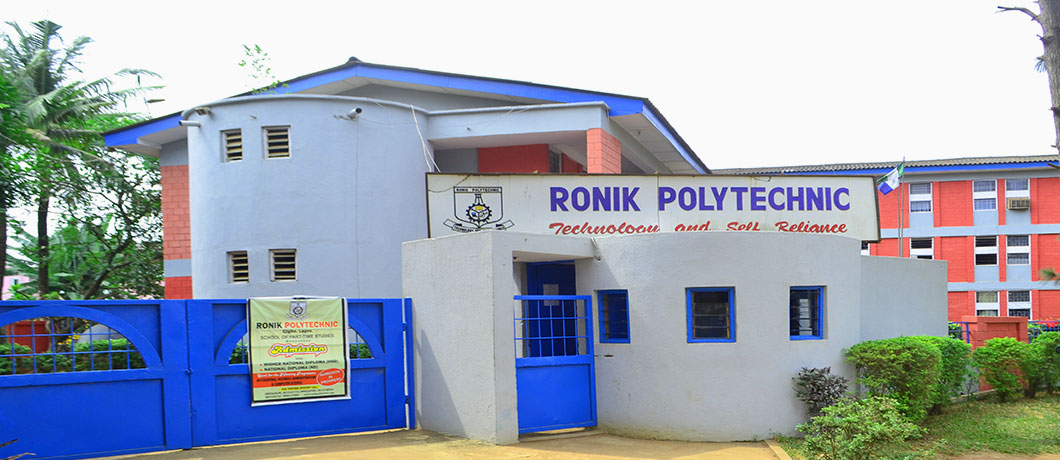
Ronik Polytechnic is a private polytechnic at Ejigbo, Lagos State, offering National Diploma (ND) and Higher National Diploma (HND) programmes. It grew out of the Ronik International Institute of Secretarial, Computer and Management Studies, founded in 1991, and its motto is "Technology for Self Reliance". The polytechnic is approved by the Federal Government of Nigeria, accredited by the National Board for Technical Education (NBTE) and listed in the JAMB brochure.
Its stated philosophy is to foster technical academic excellence and to produce self-sufficient, practical-minded graduates in an environment free of discrimination. Programmes, staff and facilities are updated regularly, and the institution promotes external engagement through publications, consultancy and community service. All programmes and resources are open to applicants regardless of gender, religion, ethnicity or nationality.
Academic departments are grouped into schools headed by Directors, with each department led by a senior academic who reports to the Rector through the Director of School. The schools are Business and Management Studies (Business Administration and Management, Accountancy, Taxation, Marketing), Science and Engineering (Electrical/Electronics Engineering, Computer Science), Applied Sciences (Statistics) and Applied Arts (Fashion Design and Clothing Technology). ND programmes include Business Administration, Accountancy, Taxation, Marketing, Statistics, Computer Science (with Networking, Software Development, Artificial Intelligence and Cyber Security options), Computer Engineering Technology, Electrical/Electronic Engineering Technology (Telecommunications option) and Fashion Design and Clothing Technology. HND programmes are offered in Accountancy, Business Administration and Management, Computer Science and Electrical/Electronic Technology.
Full-time ND and HND programmes run for two academic sessions, and part-time (weekend) ND and HND programmes are also available. The polytechnic uses the course unit system, with two 17-week semesters per session (15 weeks of lectures, practicals and quizzes and 2 weeks for registration and examination). A minimum of 70 percent attendance is required in each course. Engineering and computing students complete the compulsory Students Industrial Work Experience Scheme (SIWES) after the first year of the ND programme, and educational visits to relevant establishments are organised.
Students' departmental activities run under national associations such as NABUS (Business Administration and Management), NAPAS (Accountancy), NAPES (Engineering) and NACOSS (Computer Science), organising workshops, symposia, public lectures and exhibitions. A counselling unit in the Registry offers confidential support to students with academic or personal difficulties.
Browse the scholarships listed for Ronik Polytechnic, Ejigbo, Ikeja and check each award’s eligibility.
View scholarships for Ronik Polytechnic, Ejigbo, Ikeja →Candidates apply through JAMB (UTME) with a minimum score of 150 and need five O'Level credits, including English and Mathematics, at WAEC/NECO level with programme-specific subjects as below. Direct Entry routes are available for some programmes.
UTME: Minimum UTME score 150. Subjects: English, Economics, Mathematics and one of Government or Geography. O'Level: 5 credits including English, Mathematics and two from Geography, Further Mathematics, Chemistry, Physics, Biology, Agricultural Science or Economics. Direct Entry: 4 credits in TC II or NTC including Mathematics and three of Statistics, Geography, Further Mathematics, Chemistry, Physics, Biology, Agricultural Science, Economics, with a pass in English; or Pre-ND (Science and Technology) with passes in Mathematics, English and two of the above.
UTME: Minimum UTME score 150. Subjects: English, Mathematics and two from Physics, Chemistry, Economics or Geography. O'Level: 5 credits including English, Mathematics, Physics and two from Geography, Further Mathematics, Chemistry, Biology, Agricultural Science, Economics. Direct Entry: Relevant NTC/NBC/NVC with Mathematics, Physics and two related subjects plus a pass in English; or a pass in the Computer Foundation Exam (CFE) of the CPN.
UTME: Minimum UTME score 150. Subjects: English, Mathematics, Economics and either Government or Geography. O'Level: 5 credits including English, Mathematics, Economics and two from Geography, Accounting, Commerce, Literature-in-English, Financial Accounting, History, Office Practice, Biology, Agricultural Science.
UTME: Minimum UTME score 150. Subjects: English, Mathematics, Accountancy and either Government or Economics. O'Level: 5 credits including English, Mathematics, Economics and two from Geography, Accounting, Commerce, Literature-in-English, Financial Accounting, History, Office Practice, Biology, Agricultural Science.
UTME: Minimum UTME score 150. Subjects: English, Mathematics, Accountancy and either Government or Economics. O'Level: 5 credits including English, Mathematics and three from Economics/Commerce, Geography, Accounting, Literature-in-English, Financial Accounting, History, Statistics, Office Practice, Biology/Agricultural Science.
UTME: Minimum UTME score 150. Subjects: English, Mathematics, Economics and one of Accountancy, Government or Geography. O'Level: 5 credits including English, Mathematics, Economics and two from Marketing, Geography, Accounting, Commerce, Literature-in-English, Financial Accounting, History, Office Practice, Biology, Agricultural Science.
UTME: Minimum UTME score 150. Subjects: English and three from Economics, Government, History or Geography. O'Level: 5 credits including English, Mathematics and three from History/Government, Clothing/Textile, Chemistry, Biology/Health Science, Technical Drawing.
UTME: Minimum UTME score 150. Subjects: English, Mathematics and two from Physics, Chemistry, Economics or Geography. O'Level: 5 credits including English, Mathematics, Physics, Chemistry and one from Metal Work, Wood Work, Basic Electronics, Basic Electricity, Computer Studies, Data Processing, Geography, Further Mathematics, Technical Drawing, Agricultural Science, Economics.
UTME: Minimum UTME score 150. Subjects: English, Mathematics and two from Physics, Chemistry, Economics or Geography. O'Level: 5 credits including English, Mathematics, Physics and two from Data Processing, Geography, Further Mathematics, Chemistry, Technical Drawing, Agricultural Science, Economics.
HND entry requires a good ND, not below Lower Credit, in a relevant field, plus at least one calendar year of relevant post-ND industrial work experience and an academic transcript. Programme notes: HND Accountancy and Business Administration and Management require five credits in English (not Literature-in-English or Oral English), Mathematics and three relevant subjects; HND Computer Science accepts an ND in Computer Science or an NID in Software Engineering or Networking and Security, with options in AI, Software Development, Networking and Cyber Security; HND Electrical/Electronics (Telecom option) accepts ND Electrical/Electronics at Lower Credit with one year post-ND experience, ND at pass level with two years' experience, or NID in Telecommunication Engineering with two years' experience. Other documents: ND result, JAMB admission letter, photocopy of O'Level result, birth certificate, secondary school testimonial, six passport photographs, letter of recommendation, scratch card for verification and ND transcript.
Applicants need at least five O'Level credits including English Language and Mathematics (SSCE, GCE, NECO, NABTEB, Trade Test or City and Guilds, in one or two sittings) and must be 16 years old by 1 October of the year of entry. JAMB examination is not required, but applicants register on the JAMB CAP portal indicating part-time, using their NIN. HND applicants need an ND/NID from an accredited institution with good grades in a related field. The admission form costs N15,000 (non-refundable): get an invoice on the polytechnic website, pay online, upload results, fill in address details, submit and bring the printed summary to the polytechnic. Transcripts go to the Part-Time Programme Coordinator.
Successful candidates bring original and certified true copies of certificates or statements of result, a letter of recommendation from a reputable Nigerian citizen, secondary school testimonial, birth certificate, six passport photographs, six self-addressed stamped envelopes and a medical certificate of fitness (conducted by the institution's medical team). Students may withdraw within the first four weeks of a semester and receive a refund of fees less administrative charges.
Maximum duration is four years (8 semesters) full-time or 12 semesters part-time. The maximum load is 25 credit hours per semester. Awards are classified by CGPA: Distinction 3.50 and above, Upper Credit 3.00-3.49, Lower Credit 2.50-2.99, Pass 2.00-2.49.
The polytechnic operates from a single campus at 23-25 Ailegun Road, off Ejigbo/Egbe Road, Ejigbo, Lagos (P.M.B. 21764, Ikeja), where all schools and departments are based. The Bursary, Registry, Rectorate and counselling unit are located on the campus. Opening hours are Monday to Friday, 8:00 a.m. to 5:00 p.m.
Study programmes offered at Ronik Polytechnic, Ejigbo, Ikeja.
Experiences shared by students of Ronik Polytechnic, Ejigbo, Ikeja.
Studied here? Share your experience to help other applicants.

Book a free consultation with our expert counsellors and take the first step towards your dream university.
Copyrights © 2026 StudyMapped. All rights reserved.

Enter your credentials to continue.
Join us and start your study abroad journey.


