

University in United Kingdom
Belfast, Northern Ireland, United Kingdom
University profile
Queen's University Belfast is a public research university in Belfast, Northern Ireland. It was founded by Royal Charter in 1845 as Queen's College Belfast and became an independent university in 1908. It is a member of the Russell Group of research-intensive universities and the only Russell Group university in Northern Ireland.
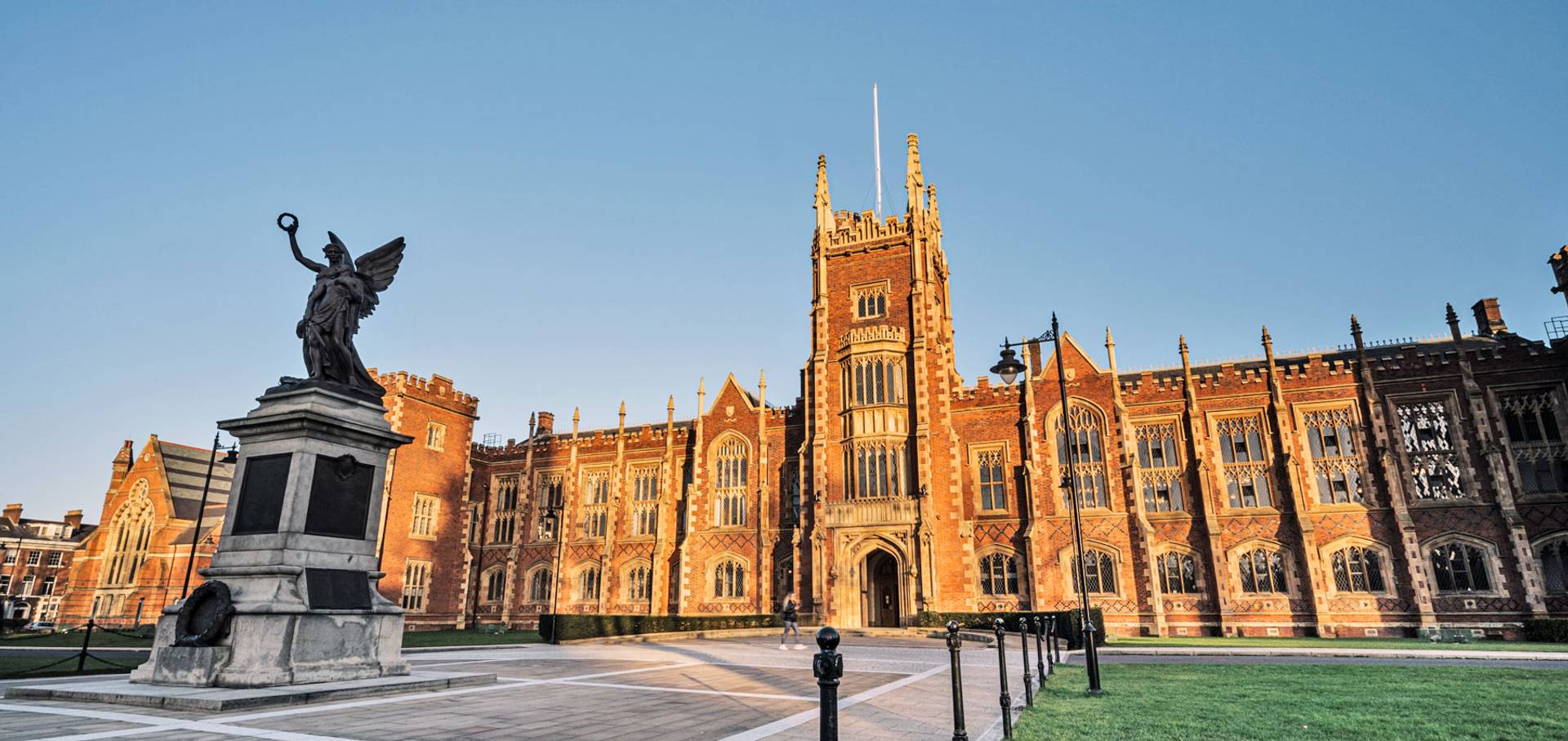
Queen's is a campus university in the Queen's Quarter of south Belfast, within ten minutes' walk of the city centre and next to the Ulster Museum and Botanic Gardens. At its centre is the Lanyon Building, completed in 1849 and designed by Sir Charles Lanyon. Other sites include the Medical Biology Centre, the dental school on the Royal Victoria Hospital campus, ECIT at the Northern Ireland Science Park, the Upper Malone sports grounds and student housing at Elms BT9 and in the city centre.
Teaching and research are organised into three faculties and fifteen schools:
Interdisciplinary research is led by four Global Research Institutes: the Institute for Global Food Security, the Institute of Electronics, Communications and Information Technology (ECIT), the Senator George J. Mitchell Institute for Global Peace, Security and Justice, and the Institute for Health Sciences. Queen's has won the Queen's Anniversary Prize for Higher and Further Education seven times. It holds an Athena Swan Gold Award, and the National Cyber Security Centre recognises it as an Academic Centre of Excellence in Cyber Security Education. Queen's Business School holds EQUIS accreditation.
Student life centres on One Elmwood, which houses the Students' Union, student services and social spaces. Queen's Sport runs the Physical Education Centre, the Upper Malone pitches and the Boat House, and there are more than 50 student sports clubs. University accommodation includes the Elms BT9 student village and city-centre residences. First-year students from the Republic of Ireland, Great Britain and overseas are guaranteed a place if they meet the application deadline.
Queen's has over 3,800 international students from 112 countries (Queen's Planning Office, 2025). Queen's University Belfast International Study Centre, run with INTO on the main campus, offers international foundation, International Year One and pre-master's pathways.
Undergraduate, 2026-27 (full-time, per year):
International undergraduate, 2026-27:
International undergraduate, 2027-28 entry: £24,600 (Fee Rate 1), £28,500 (Fee Rate 2) and £39,990 (Fee Rate 3).
Postgraduate taught, 2026-27:
Postgraduate research, 2026-27: £5,238 for NI/ROI/GB students, and £22,500 (Fee Rate 1) or £28,000 (Fee Rate 2) for international students. EU students other than Republic of Ireland nationals pay international fees.
The following awards are for 2026-27 entry. Details are on the International Scholarships page.
Queen's has invested £7.7 million in postgraduate research scholarships. Queen's University/China Scholarship Council joint PhD scholarships and doctoral training partnerships are also available. The Fulbright-Queen's University Belfast Award covers a taught master's degree in any discipline. The Hillary Rodham Clinton Award for Peace and Reconciliation is a full tuition-fee waiver for a female student from the USA. The Queen's MBA carries a scholarship of £6,000 for international students and £10,000 for NI/ROI/GB students for 2026 entry. The Funding and Scholarships finder lists all current awards, including the Lavery Further Education Award and the Sports Bursary Programme.
Vice-Chancellor's International Attainment Scholarship (Undergraduate) →
Vice-Chancellor's International Attainment Scholarship (Postgraduate Taught) →
Browse the scholarships listed for Queen's University Belfast and check each award’s eligibility.
View scholarships for Queen's University Belfast →Applications for full-time undergraduate degrees are made through UCAS (institution code name QBELF, code Q75). Key dates for 2027 entry:
For applications submitted by 13 January 2027, universities must make decisions by 12 May 2027. Part-time applicants apply directly to Queen's.
All applicants need GCSE English Language at grade C/4, or an acceptable equivalent such as Level 2 Essential Skills in Communication. Applicants must also meet one of the following:
Offers are made in grades, not UCAS Tariff points, and are normally based on three A-levels or equivalent. Current grade requirements for each course are in the Course Finder. Predicted grades are not normally used, except in very borderline cases. GCSE and AS-level performance can count, particularly for high-demand programmes. Some courses use interviews, admissions or aptitude tests, or auditions. Offers to repeat applicants may be one grade higher. The Extended Project Qualification and the Welsh Baccalaureate Advanced Skills Challenge Certificate are recognised. A pass in the practical element of reformed science A-levels is required. Home-educated applicants are welcome, and there is a Recognition of Prior Learning scheme.
International applicants apply through UCAS by 30 June 2027, or by 15 October 2026 for Medicine and Dentistry. International applicants applying only to Queen's can use the direct-entry Queen's Portal instead. The portal is not available for Medicine, Dentistry, Nursing/Midwifery, Pharmacy or Social Work. Entry requirements vary by country. Applicants who do not meet them can take an International Foundation, International Year One or pre-master's course at Queen's University Belfast International Study Centre (INTO) on the campus. First-year students from outside Northern Ireland are guaranteed university accommodation if they firmly accept their offer and apply for accommodation by the published deadline (30 June 2026 for 2026 entry).
IELTS Academic (including One Skill Retake) and TOEFL iBT are accepted for direct entry. Courses fall into three bands:
Medicine and Dentistry require IELTS 7.5 overall, with 7.0 in Speaking and Listening and at least 6.5 (Medicine) or 6.0 (Dentistry) in Reading and Writing. The Duolingo English Test is accepted at 110 overall (comparable to IELTS 6.0) or 120 (comparable to IELTS 6.5), with at least 100 in each subskill. PTE Academic, LanguageCert, Cambridge, Trinity ISE and the International Study Centre's own tests and pre-sessional courses are also accepted. IELTS and TOEFL results must be no more than two years old at the start of the course. Nationals of countries the UKVI treats as majority English-speaking normally meet the requirement. Students on courses below degree level need a Secure English Language Test (SELT) for the Student visa.
Applications for most postgraduate programmes are made online through the Queen's Portal. The normal minimum for a master's degree is a second-class honours degree from a UK or Republic of Ireland provider, or an acceptable equivalent. For MPhil and PhD study, schools normally require an upper second-class (2.1) honours degree in a related subject. Applicants upload transcripts and degree certificates and give two referees, normally academics. MPhil, PhD and MD applicants also submit a research proposal. Closing dates are set for some courses, and international applicants should apply early to allow time for the visa. International applicants who accept an unconditional offer for a one-year taught course pay a £2,500 tuition deposit. Non-UK and non-Irish nationals need a Student visa for study of six months or longer.
Queen's operates from a main campus in south Belfast with specialist sites across the city.
Study programmes offered at Queen's University Belfast.
Experiences shared by students of Queen's University Belfast.
Studied here? Share your experience to help other applicants.

Book a free consultation with our expert counsellors and take the first step towards your dream university.
Copyrights © 2026 StudyMapped. All rights reserved.

Enter your credentials to continue.
Join us and start your study abroad journey.


