
University in Germany
Marburg, Hessen, Germany
University profile
Philipps-Universität Marburg is a public university in Marburg, Hesse, founded in 1527 by Landgrave Philip the Magnanimous. It is the oldest university in the world still in existence that was founded as a Protestant institution. It is a statutory corporation under public law and a state institution under the Hessian Higher Education Act, supervised by the Hessian Ministry for Science and Research, Art and Culture. Teaching and research cover almost all scientific disciplines except the engineering sciences.
Since 1970 the disciplines have been organised in departments (Fachbereiche) rather than faculties; there are 16 today, alongside 12 research centres and a University Hospital. The departments are: Rechtswissenschaften (FB 01), Wirtschaftswissenschaften (FB 02), Gesellschaftswissenschaften und Philosophie (FB 03), Psychologie (FB 04), Evangelische Theologie (FB 05), Geschichte und Kulturwissenschaften (FB 06), Germanistik und Kunstwissenschaften (FB 09), Fremdsprachliche Philologien (FB 10), Mathematik und Informatik (FB 12), Physik (FB 13), Chemie (FB 15), Pharmazie (FB 16), Biologie (FB 17), Geographie (FB 19), Medizin (FB 20), and Erziehungswissenschaft und Sportwissenschaft (FB 21).
In the winter semester 2025/26 the university had 20,899 students, of whom 4,739 (22.7 per cent) were international. The university offers 208 degree programmes (winter semester 2026/27), including 24 mono Bachelor programmes, two combination Bachelor programmes with 28 major and 48 minor subjects, 73 Master programmes, 8 continuing-education Master programmes, 21 subjects for teacher training for Gymnasien and four state-examination programmes. About 4,054 staff are employed full-time, including 391 professorships (December 2025).
Research is concentrated in seven profile areas, among them microbiology, biodiversity and climate; mind, brain and behaviour; virology and infection biology; security, order and conflict; inflammation, immunology and tumour biology; and materials, interfaces and semiconductors. Interdisciplinary centres include SYNMIKRO (Synthetic Microbiology), the Centre for Near and Middle Eastern Studies (CNMS), the Center for Mind, Brain and Behavior (CMBB), and the Bildarchiv Foto Marburg.
Student life is organised around the city of Marburg, where many districts can be reached on foot. Most student halls are run by the Studierendenwerk Marburg, which also operates the canteens (Mensa Erlenring and Mensa Lahnberge); shared flats are the most common form of housing. The university library system has 10 sites, and the university maintains five museums and two botanical gardens. The Studienkolleg Mittelhessen, part of the university, prepares international applicants for study at Marburg, Giessen and the Technische Hochschule Mittelhessen.
No tuition fees or long-term study fees are charged at Philipps-Universität Marburg, including for doctoral studies. Every student pays the Semesterbeitrag (semester contribution, which is not tuition): EUR 424.80 for the winter semester 2026/27, made up of the semester ticket share (EUR 230.50, including the Deutschland-Ticket and Nextbike), the Studierendenwerk (EUR 125.50), the student body (EUR 18.80) and an administrative fee (EUR 50.00). Exchange students under agreements can have the EUR 50 administrative fee waived.
The university awards the Deutschlandstipendium annually to high-achieving students of all nationalities: EUR 300 per month, from October 2026 to September 2027, with applications from 22 July to 31 August 2026 through an online portal; 66 scholarships were awarded in 2025/26. Applications need a CV, motivation letter, transcripts and a short reference from a lecturer (not required for those starting in October). It can be combined with BAföG. Contact: [email protected]. Official call.
Funded by the DAAD from the German Federal Foreign Office, STIBET offers study-completion scholarships to international students and doctoral candidates matriculated at Marburg who earned their entrance qualification abroad, can demonstrate financial need, receive no other scholarship and will finish within 12 months. In 2026, 8 scholarships of five months were available: EUR 990 per month for 5 students and EUR 1,200 per month for 3 doctoral candidates. The 2026 deadline was 31 May 2026. Exchange students, language-course students and Studienkolleg students cannot apply. Selection is by academic achievement, then social situation. STIBET details.
Hessian state scholarships for refugee and persecuted students, doctoral candidates and researchers: EUR 300 per month for students, EUR 1,200 for doctoral candidates and EUR 2,300 for researchers, normally for 12 months. The 2026 call ran to 31 July 2026 for funding from 1 October 2026 to 30 September 2027. HessenFonds details.
For non-EU students the university lists the DAAD, political foundations, KAAD, Brot für die Welt and the WUS STUBE programme; non-EU students are generally not entitled to BAföG. The university also lists the Philipp Schwartz Initiative for at-risk researchers, funding for doctoral candidates and funding for families. Scholarships and funding for international students. Doctoral candidates must show proof of means for a visa; the Deutsches Studentenwerk average is about EUR 820 per month for living costs.
Deutschlandstipendium at Philipps-Universität Marburg →
STIBET Final-Degree Scholarship for International Students and Doctoral Candidates (Marburg) →
HessenFonds Scholarships for Refugee and At-Risk Students (Marburg) →
Browse the scholarships listed for Philipps University of Marburg and check each award’s eligibility.
View scholarships for Philipps University of Marburg →A university entrance qualification (Hochschulzugangsberechtigung) is required; it does not always have to be the Abitur. Pathways include the general university entrance qualification, the Fachhochschulreife, vocational qualifications and foreign school-leaving certificates. Programmes may also set special requirements such as language skills. Programmes without a numerus clausus (NC) are enrolled directly; NC programmes (Pharmazie, Zahnmedizin and Humanmedizin with nationwide NC, and Psychologie and Humanbiologie with local NC) allocate places by selection limits.
Applicants first check whether their certificate gives direct or indirect access (via the anabin database or the uni-assist check tool); the university does not pre-check certificates. With a direct entitlement they apply through uni-assist (my.uni-assist.de) for both NC-free and NC programmes if they are non-German, non-EU nationals. With an indirect entitlement they attend the Studienkolleg Mittelhessen first and pass the Feststellungsprüfung (FSP), then apply again for the subject programme via uni-assist, observing the university's subject restrictions (Fachbindungen). German citizens and those treated as German applicants with a foreign certificate apply through hochschulstart (for NC programmes) and Marvin, the university portal, with a recognition notice or uni-assist assessment report. Documents are uploaded digitally; certificates not in German or English need sworn translations.
Winter semester: NC programmes 1 June to 15 July; NC-free programmes 1 June to 15 August (Bewegungs- und Sportwissenschaften B.A. and Bildende Kunst as a minor: 1 June to 15 July); Studienkolleg 1 March to 15 April. Summer semester: NC programmes 1 November to 15 January; NC-free programmes 1 November to 15 February; Studienkolleg 1 September to 15 October. For German entrance qualifications the summer semester 2027 deadline is 18 March 2027 for NC-free programmes and 15 January 2027 for NC programmes (application from 1 December 2026). The uni-assist fee is EUR 75 for the first application and EUR 30 for each further one.
For most programmes the DSH (Deutsche Sprachprüfung für den Hochschulzugang) is required at level DSH-1, DSH-2 or DSH-3 as set by the programme. DSH-1 equivalents include Goethe-Zertifikat B2, ÖSD B2, telc B2 and TestDaF with at least 3 points in all parts; DSH-2 equivalents include TestDaF with at least 4 points in all parts, telc Deutsch C1 Hochschule, DSD II with C1 and Goethe-Zertifikat C2; DSH-3 requires TestDaF with at least two 4s and two 5s. Applicants without German can apply to NC-free programmes and receive a conditional admission, allowing up to two semesters of enrolment as a language student before the subject programme; this does not apply to NC programmes. Studienkolleg applicants with German below B2 may enrol first as language students; those with B2 or above are invited to an entrance test.
Consecutive Master programmes require a first degree from a state-recognised institution in an accredited programme; programme pages list the specific prerequisites under 'Was du mitbringen musst', and some programmes require an aptitude assessment (Eignungsfeststellungsverfahren). Applicants without a final Bachelor certificate may apply if they have at least 80 per cent of the credits (144 of 180 ECTS or 192 of 240 ECTS). A simple copy of the Bachelor certificate is enough. Applicants with a foreign degree apply through uni-assist (EUR 75 for the first application, up to three programmes per round), and applicants with a German degree through Marvin. Foreign institutions should be recognised (status H+ in anabin). Continuing-education Master programmes generally require a first degree plus at least one year of relevant professional experience.
Summer semester 2027: foreign degrees 1 November 2026 to 26 February 2027; German degrees 1 December 2026 to 26 February 2027; several programmes have earlier closing dates (for example Biochemie, Psychologie, Economics, Institutions, and Behavior and Bildende Kunst: 15 January 2027; Computer Science, Data Science and Business Informatics: 1 November to 31 December 2026 for foreign degrees). Winter semester 2026/27: foreign degrees 1 May to 21 August 2026; German degrees 1 June to 21 August 2026, with programme exceptions (for example LL.M. Grundzüge des deutschen Rechts to 15 July 2026).
A degree from the home country that entitles to doctoral study and is comparable to a German academic degree is required; the Zentralstelle für ausländisches Bildungswesen (ZAB) is consulted if needed. The topic must fit the research field of a potential supervisor (Betreuer), and the Promotionsausschuss of the department decides on acceptance. Recommended documents: Bachelor and Master certificates and transcripts, curriculum vitae, a research proposal of up to ten pages including methodology, schedule and bibliography, and recommendation letters if available. Nearly a quarter of doctoral candidates come from abroad. The MARA research academy supports early-career researchers.
All enrolled students submit the entrance qualification, proof of payment of the Semesterbeitrag, an electronic notification of health insurance, and further programme-specific documents. Applications are made and enrolment is completed online in Marvin.
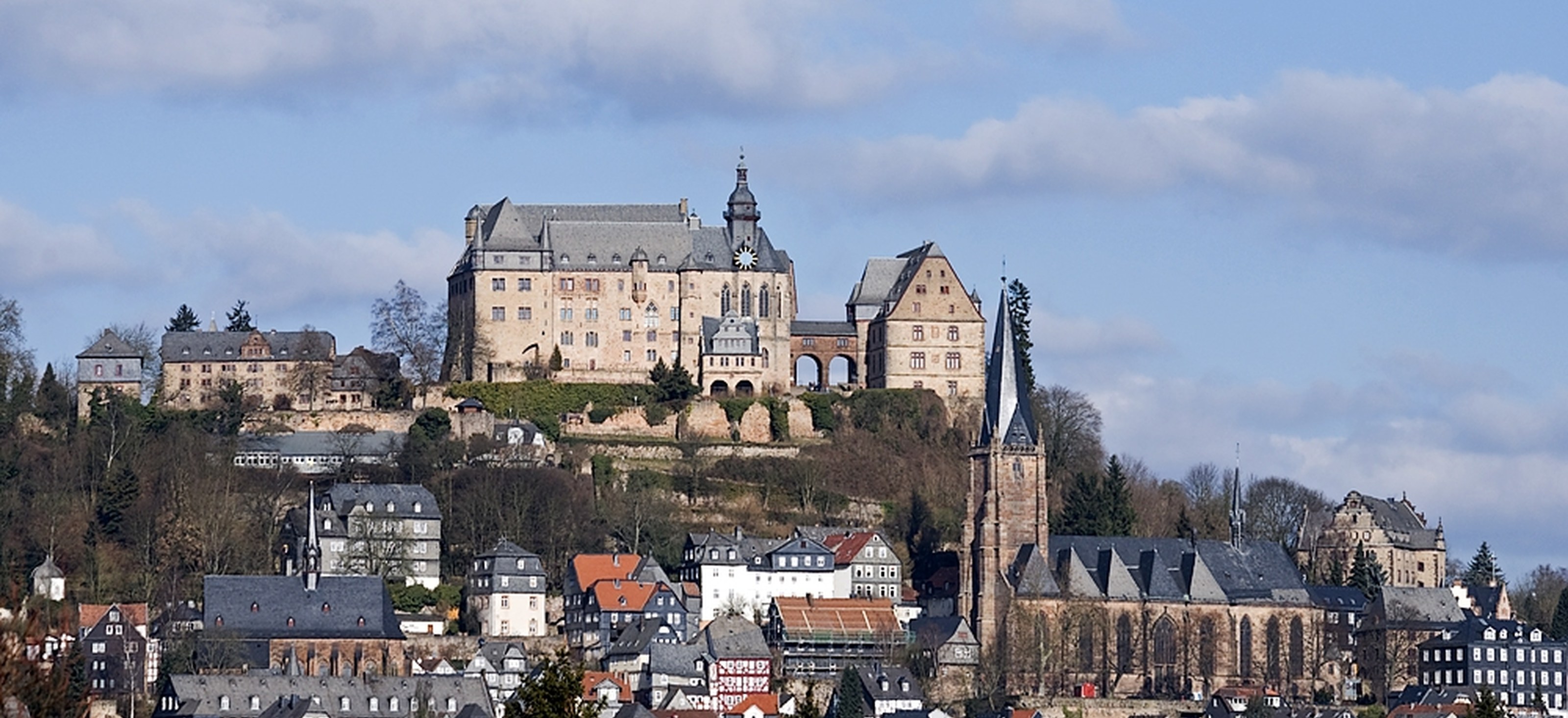
The university is spread across several areas of Marburg rather than a single walled campus.
The library system has 10 locations: the Central University Library, and departmental libraries for biology, German linguistic atlas, Protestant theology, classical archaeology, art and cultural studies, mathematics and computer science, law, prehistory and early history, economics, and the Central Medical Library. Study spaces include bookable work cabins, PC pools run by the computing centre, parent-and-child rooms and accessible workstations. The university also runs two botanical gardens (the New Botanical Garden covers 20 hectares), five museums and the XSpaces, creative workspaces for 3D printing, prototyping and serious gaming.
Study programmes offered at Philipps University of Marburg.
Experiences shared by students of Philipps University of Marburg.
Studied here? Share your experience to help other applicants.

Book a free consultation with our expert counsellors and take the first step towards your dream university.
Copyrights © 2026 StudyMapped. All rights reserved.

Enter your credentials to continue.
Join us and start your study abroad journey.


