
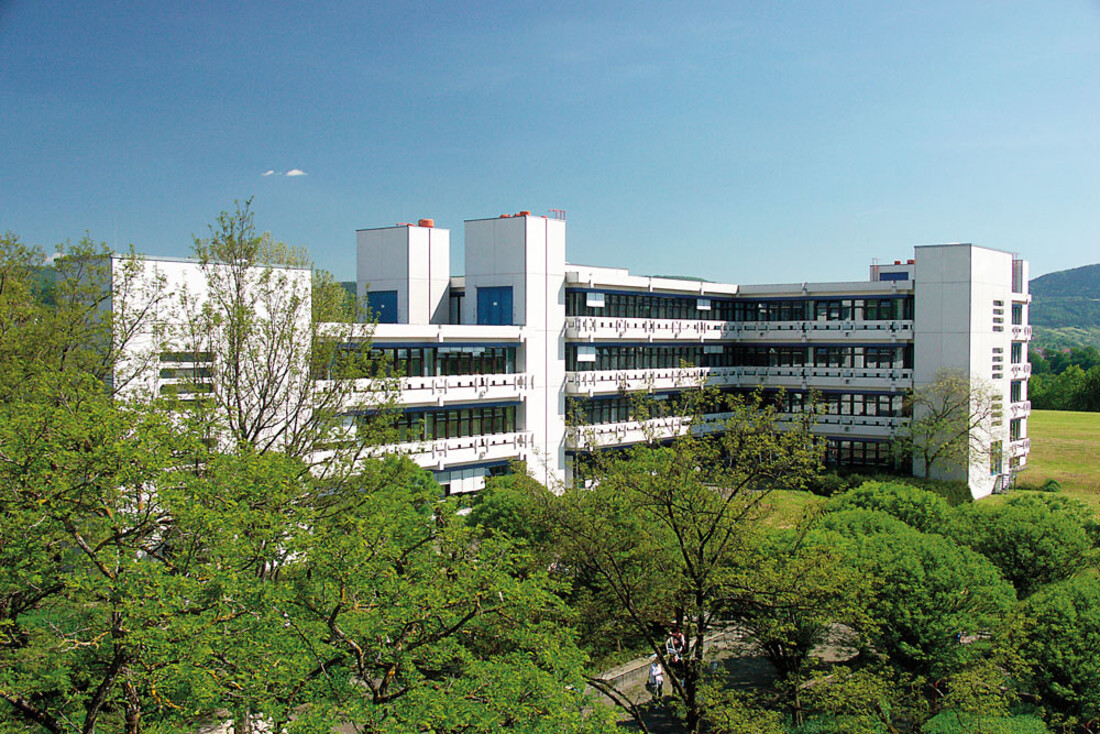

University in Germany
Schwäbisch Gmünd, Baden-Württemberg, Germany
University profile
The PH Schwäbisch Gmünd University of Education (Pädagogische Hochschule Schwäbisch Gmünd) is a state university of education in Schwäbisch Gmünd, Baden-Württemberg, with roots in teacher training that go back to 1825. It has a university profile built around three priorities: education, health and interculturality. Its programmes range from primary and lower-secondary teacher education and early childhood education to health promotion, nursing science and intercultural master's programmes.
The main campus is at Oberbettringer Straße 200 in the Oberbettringen area, a few minutes from the town centre, where the university moved into new buildings on the Hardt in 1972. The campus has since been extended with Institute Building M on Heidenheimer Straße (2024), the CHAL building and a student house (2025), and the research and transfer centre Transfer Hub of Innovation in Society (THIS, 2026). The Art Nouveau seminar building on Lessingstraße (the Alte PH) is still used by Music. Schwäbisch Gmünd has about 60,000 inhabitants and lies some 50 km from Stuttgart.
Teaching and research are organised in two faculties. Faculty I includes the Institute for Education, Occupation and Technology (vocational education, adult and continuing education, technology), the Institute of Educational Science, the Institute for Health Sciences, the Institute for Human Sciences (philosophy, educational and health psychology, sociology, cultural studies), the Institute for Nursing Science and the Ecumenical Institute for Theology and Religious Education. Faculty II includes the Institutes for Language and Literature (German, English), the Arts (Art, Music), Social Sciences (geography, history, political science, economics), Mathematics and Computer Science, Childhood, Youth and Family, and Natural Sciences (biology, chemistry, physics).
Notable strengths include health promotion (Bachelor and Master programmes with about 160 students), early childhood and social pedagogy, language promotion and STEM education (with school laboratories such as the Unicorner and the Math Activity Center), counselling and psychosocial development support, and the interculturality programmes. The university collaborates with schools, public and private institutions, companies and over 50 higher education institutions worldwide,.
Student life centres on the campus: the student-run café Matrikü(h)l in the student house, a canteen, a campus shop, the ecumenical university chaplaincy, a choir, a university band and free university sport open to all students (sports hall, fitness room, beach volleyball courts and slacklines). Single rooms in a hall of residence are available on the campus grounds. International students are supported by the International Office, which advises degree-seeking and exchange students, and about 30 exchange students from Europe, the USA and Asia arrive each semester.
All students pay a semester contribution of EUR 177 per semester, made up of EUR 80 administrative cost contribution, EUR 82 Studierendenwerk contribution and EUR 15 student body contribution. This is not tuition. It remains payable in full during exemption from tuition or leave of absence.
Baden-Württemberg charges tuition of EUR 1,500 per semester to international students who are not nationals of an EU/EEA state and who start a Bachelor or consecutive Master programme. Exempt are students from other EU/EEA states, students with a German entrance qualification, exchange students from partner universities and refugees. A limited number of international students can be exempted from the fee because of special talent, under the university's exemption statute (application form in the forms section). A second degree after a German degree costs EUR 650 per semester, except for teacher-education students and Höheres Lehramt students, who have been exempt since summer semester 2025. The continuing-education master M.A. Bildungsmanagement und Leadership im Elementarbereich charges EUR 600 per semester.
The Erasmus Mundus joint master Education, Migration and Diversity (EDU_MIG) offers 25 places a year to European and international students, with scholarship applications due by 15 February. The Studierendenwerk Ulm advises on BAföG, education loans and scholarships; BAföG is paid half as a grant and half as an interest-free loan. The university points students to scholarship programmes such as the Stiftung der Deutschen Wirtschaft scholarships for teacher-education students, the Studienstiftung des deutschen Volkes and the Aufstiegsstipendium. The Akademisches Auslandsamt works with funders such as DAAD, Erasmus+, the Baden-Württemberg Stiftung and Fulbright. Overview: Scholarships and prizes and Semester contribution and fees.
PH Schwäbisch Gmünd Tuition Fee Waiver for Particularly Gifted International Students →
Browse the scholarships listed for PH Schwäbisch Gmünd University of Education and check each award’s eligibility.
View scholarships for PH Schwäbisch Gmünd University of Education →Admission to an undergraduate programme requires a university entrance qualification (Hochschulzugangsberechtigung). Applicants without the general or subject-specific Abitur can qualify through the Delta examination (for holders of the Fachhochschulreife) or the aptitude examination for vocationally qualified applicants, or through a vocational advancement qualification. Applicants must also complete a study orientation test: the teacher orientation test (CCT) for teacher-education Bachelor programmes, and www.was-studiere-ich.de or www.check-u.de for all other Bachelor programmes. Art and Sport require an aptitude test; for Music a motivation letter is submitted with the application. Programmes are partly admission-restricted (B.A. Primary Teaching) and partly open (B.A. Lower Secondary Teaching, B.A. Childhood Education, B.Sc. Health Promotion and Prevention). Where places remain after allocation, they are awarded by lot; the lottery application must reach the university by 15 September (winter semester) or 15 March (summer semester).
All applications are made directly to the university through its online portal at campus.ph-gmuend.de; no paper documents are submitted. Winter semester: 1 June to 15 July for B.A. Primary Teaching; 1 June to 15 September for B.A. Lower Secondary Teaching, B.A. Childhood Education and B.Sc. Health Promotion and Prevention. Summer semester: 1 December to 15 January for B.A. Primary Teaching; 1 December to 15 March for B.A. Lower Secondary Teaching. The Ingenieurpädagogik Bachelor is applied for at Hochschule Aalen. Master programmes: 12 to 31 May (winter semester) for M.Ed. Primary and Lower Secondary Teaching; 1 June to 15 July for the other winter-semester Master programmes; 1 December to 15 January for summer-semester Master programmes. The Erasmus Mundus joint master Education, Migration and Diversity has its own deadlines (15 February for scholarship applicants, 31 May for others).
Admission of applicants with foreign certificates is decided by the university on the equivalence of their prior education. EU/EEA applicants apply online; applicants from non-EU/EEA countries also submit the PDF application form for foreign applicants (Bachelor or Master) in addition to the online application. A quota of 8% of the available places is reserved for applicants from non-EU countries. Certified copies and certified translations (unless in German, English or French) of school and university certificates are uploaded; originals are not sent. Applicants who are German citizens with a foreign entrance qualification need a certificate of equivalence from the Regierungspräsidium Stuttgart. Grades are entered as printed on the foreign certificate and converted to the German scale by the university.
All applicants with foreign educational certificates must prove sufficient German before starting: TestDaF with at least level 4 in all sections, DSH II, the Zentrale Oberstufenprüfung, the Deutsches Sprachdiplom Stufe II of the Kultusministerkonferenz, telc C1 Hochschule, the Großes or Kleines Deutsches Sprachdiplom. Applications without proof of language skills, or with less than B2, cannot be accepted. Applicants to the M.A. Germanistik und Interkulturalität/Multilingualität and the M.A. Interkulturalität und Integration with a very good or good degree in German studies or German didactics from a recognised foreign university are exempt. Exchange students need at least B1 German for the winter semester; summer-semester applicants with very good English can also be admitted without German.
Applicants upload proof of a completed first degree (with Diploma Supplement and Transcript of Records, or a record of all examinations and the average grade if the certificate is not yet available), the entrance qualification, a tabular CV and, where required, a description of professional career and a motivation letter. M.A. Pflegepädagogik requires a completed vocational training in a health profession. Several Master programmes (Germanistik und Interkulturalität/Multilingualität, Höheres Lehramt Ingenieurpädagogik, Gesundheitsförderung und Prävention, Kindheits- und Sozialpädagogik, Migration, Diversität und Teilhabe, Pflegepädagogik) have a selection procedure set out in their admission statutes. Teacher-education Master applicants may add evidence of study or placements abroad, committee work, childcare or care of relatives, and national or voluntary service.
The university awards the Dr. paed. and Dr. phil. in all subjects represented by at least one professor. Candidates are normally admitted with a Master or a degree of at least four years' standard period of study with a very good or good result; particularly qualified Bachelor or state-examination graduates can enter through an aptitude procedure of up to 60 credit points within four semesters. Applications for acceptance as a doctoral candidate go to the faculty doctoral committee (Faculty I or II) at least four weeks before its meeting and include a supervision agreement (Promotionsvereinbarung). Doctoral candidates accepted from 1 April 2018 must enrol at the university.
Campus Oberbettringen, Oberbettringer Straße 200, 73525 Schwäbisch Gmünd: the main campus with lecture halls, institute buildings, the library, the canteen (Mensa), the campus shop, the student house with the student café Matrikü(h)l and the CHAL building, a sports hall with changing rooms and showers, a fitness room, beach volleyball courts and slacklines, and a hall of residence with single rooms on the campus grounds.
Facilities include the university library (open Monday to Thursday 8:30-18:00 and Friday 8:30-16:30, with an online catalogue, e-books, e-journals, interlibrary loan and the OPUS publication server), the ME.Lab media education laboratory, the Unicorner school laboratory, the MINT Education Lab, the university chaplaincy with a co-working space, and the Transfer Hub of Innovation in Society (THIS) on the campus. Parking requires a permit sold at the information centre in Building A.
Study programmes offered at PH Schwäbisch Gmünd University of Education.
Experiences shared by students of PH Schwäbisch Gmünd University of Education.
Studied here? Share your experience to help other applicants.

Book a free consultation with our expert counsellors and take the first step towards your dream university.
Copyrights © 2026 StudyMapped. All rights reserved.

Enter your credentials to continue.
Join us and start your study abroad journey.


