

University in Germany
Osnabrück, Niedersachsen, Germany
University profile
Osnabrück University (Universität Osnabrück) is a state university in Osnabrück, Lower Saxony, founded in 1974. It enrols around 14,000 students and employs around 1,800 people, including around 1,000 professors, lecturers and research assistants. Its research strengths include membrane biology, comparative law, artificial intelligence, cognitive science and migration research, and it follows a principle of research-based learning.
Around 180 Bachelor's and Master's programmes are organised in eight schools: Cultural Studies and Social Sciences; Educational and Cultural Studies; Biology/Chemistry; Mathematics/Computer Science/Physics; Linguistics and Literary Studies; Human Sciences; Business Administration and Economics; and Law. More than twenty institutes and their teaching units sit within these schools. Teacher education for primary, secondary and vocational schools is a further focus, including a cooperation with Osnabrück University of Applied Sciences for electrical and metals engineering and ecotrophology teaching at vocational schools.
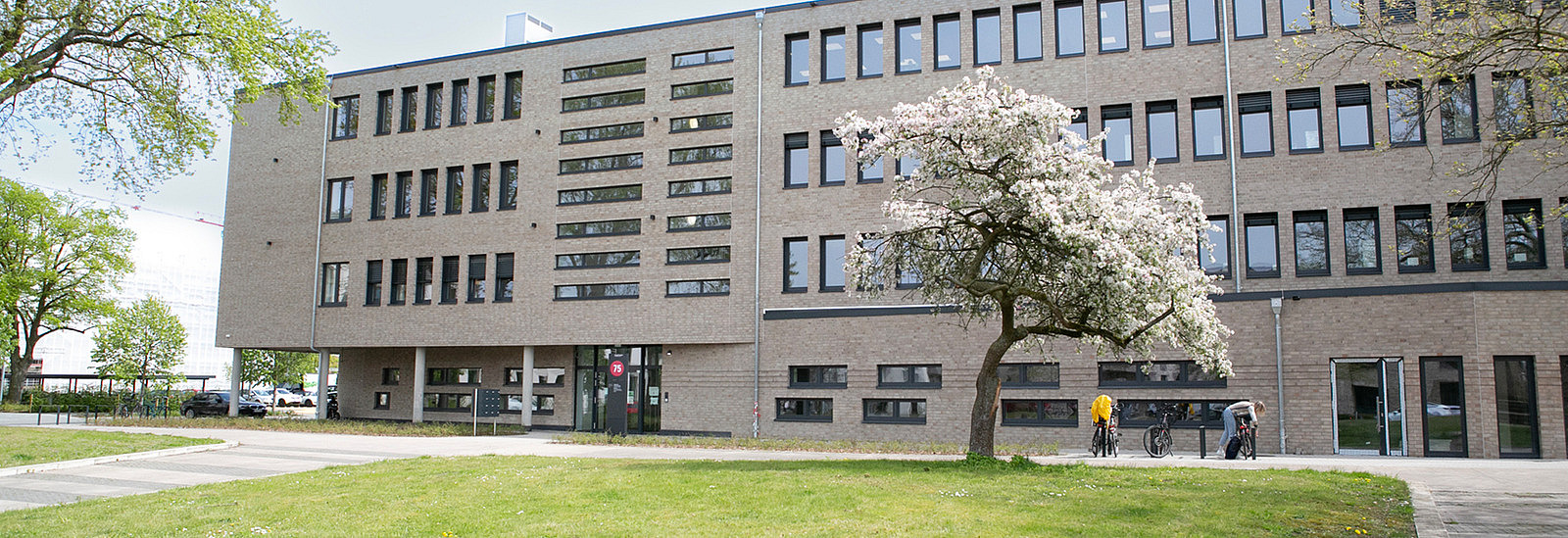
The university is embedded in the city. Many buildings lie close to the historic old town, where the humanities, social sciences and law are based and the former Prince-Bishop's Palace houses the Presidential Board and administration. The natural sciences, mathematics, computer science and environmental systems science are on the Westerberg campus, and psychology is at the Science Park. The Botanical Garden serves teaching and research. The university and the city jointly run the Osnabrück Peace Forum and the Erich Maria Remarque Peace Center.
Studies are supported by the Student Service Center StudiOS, the Admissions Office, the International Office, a Central Study Counselling Service and a Language Center that offers German as a foreign language, tandem learning and a language café. Osnabrück Student Services (Studierendenwerk Osnabrück) arranges around 1,700 places in halls of residence for students of the city's two universities, with residence tutors supporting international students. The student government (AStA), university sport and the University Library are further parts of campus life.
International students can choose from English-taught Master's programmes such as Biology: From Molecules to Organisms, Cognitive Computing, Cognitive Science, Conflict Studies and Peacebuilding, Economics, English and American Studies, European Technology Law, Nanosciences and Physics. The university takes part in the International Network of Universities and Scholars at Risk, and runs the Costa Rica Center. International applicants from outside the EU and EEA apply to Bachelor's programmes with restricted admission within a five percent quota of places.
The university charges no tuition for standard programmes. Every student pays a semester fee (Semesterbeitrag, not tuition): €459.30 for the winter semester 2026/27, made up of €135 for Student Services, €249.30 for the student body (including €226.80 for the Deutschlandticket and €22.50 for the student government) and €75 administrative contribution. Fees are charged for LL.M. European Technology Law, M.Sc. Cognitive Computing, Psychological Psychotherapy, Child and Adolescent Psychotherapy and the Master's extension courses in Teacher Education. Long-term tuition fees of €500 per semester apply once the study entitlement (standard period plus six semesters) is used up; doctoral students are generally exempt. Guest students pay €75 or €100 per semester.
Scholarships of €300 per month, funded equally by the federal government and private sponsors, run for one year from 1 October and may be extended within the standard period of study. Bachelor's, state-examination and consecutive Master's students within the standard period can apply, judged on grades, academic achievement, commitment and personal circumstances. The 2027/28 call is expected in April 2027. Official page.
One-off scholarships of €500, with 154 awarded in 2026, for special achievement, aptitude, voluntary work or international exchange. Quotas are 10 percent for first-semester students, 75 percent for German students from the second semester and 15 percent for foreign students, with need considered for international applicants. Applications are made online from 1 to 31 October. Official page.
The DAAD Award of €1,000 goes to an international student for academic excellence and social and intercultural commitment. More than 20 Funding Awards from regional and national donors recognise outstanding study, examination and doctoral achievements, with nominees put forward by lecturers. Funding Awards.
Liaison lecturers advise on thirteen German foundations for gifted students, including the German National Academic Foundation, Konrad-Adenauer-Stiftung, Friedrich-Ebert-Stiftung, Heinrich Böll Foundation and Evangelisches Studienwerk Villigst. Details.
Landesstipendium Niedersachsen (Osnabrück University) →
DAAD End-of-Studies Scholarship (STIBET, Osnabrück University) →
Deutschlandstipendium (Osnabrück University) →
Browse the scholarships listed for Osnabrück University and check each award’s eligibility.
View scholarships for Osnabrück University →Admission to a Bachelor's programme or the First State Examination in Law requires a qualification equivalent to the Abitur; recognition of certificates can be checked at anabin.kmk.org and through uni-assist. Applicants whose certificate does not directly entitle them to study may attend a Studienkolleg: the university has none of its own and refers applicants to the Niedersächsisches Studienkolleg in Hanover, where a one-year specialisation course (T, M, W or G course) ends with the Feststellungsprüfung. Studienkolleg applicants need German at B1 or higher, with deadlines of 15 June for the winter semester and 15 January for the summer semester. Music/Musicology and Art/Art Education require an aptitude test. Undergraduate programmes start in the winter semester only. Study places in restricted programmes go 5 percent to non-EU/EEA applicants; for EU/EEA applicants, 80 percent are selected by the university's own procedure and 20 percent by waiting period.
International applicants apply either through uni-assist (My assist) or the university's HISinOne portal; applicants for Master's programmes with foreign certificates apply through uni-assist only. Applicants with German citizenship, a German Abitur or earlier study in Germany use the university portal. uni-assist deadlines are 15 June for the winter semester and 15 December for the summer semester; restricted-admission Bachelor's programmes and the First State Examination in Law close on 15 June, and admission-free Bachelor's programmes on 15 August. The university portal deadlines are 15 July (winter) and 15 January (summer); Master of Education closes 15 August and 15 February. Foreign-language documents need translations by sworn translators, and an APS certificate is mandatory for certificates from China, India or Vietnam.
Many Bachelor's programmes require C1 German. Accepted C1 evidence is DSH2, Goethe-Zertifikat C2, telc C1 Hochschule, TestDaF 16 points or ÖSD C1. Applicants without C1 can apply with a B2 certificate (DSH1, Goethe-Zertifikat B2, telc B2, TestDaF 12 points, ÖSD B2) and be admitted provisionally, submitting C1 for enrolment. Certificates must not be older than two years. Some programmes ask for less, such as B2 with a compulsory German course in the first two semesters (Biology, Computer Science, Mathematics, Environmental Systems Science, Embedded Software Systems) and B1 for Cognitive Science (with English B2). B2 English is required for Business Administration and Economics, Cognitive Science, Geography and Psychology (Bachelor of Science).
Master's programmes are consecutive: a first university degree in the same or a related field is required, and the responsible selection committee decides on suitability under each programme's admission regulations. Language and further requirements, such as a letter of motivation or CV, are set programme by programme. Applicants may apply before finishing the Bachelor's degree if 150 credit points are proven and the degree is expected in the first Master's semester. Applications for most Master's programmes run 11 May to 15 July for the winter semester and 3 December to 15 January for the summer semester through the university portal; international applicants use uni-assist.
A Master's degree, state examination, Diplom, Magister, an equivalent foreign degree or a relevant degree from a University of Applied Sciences entitles the holder to start a doctorate, normally with an above-average result. Requirements and procedure are set in each school's doctoral regulations. PhD applications through the university portal close on 30 September (winter) and 31 March (summer); the Law and Nanosciences doctoral programmes close on 15 July and 15 January. The PhD/Postdoc Career Center (ZePrOs) supports doctoral candidates.
A student visa requires admission to a German university and, besides a passport and a letter of admission or confirmation of application, proof of funding and health insurance. Non-EU/EEA students must show €11,904 (€992 per month) for the first year. Students from the EU, EEA and Switzerland need no visa.
Facilities include the University Library with area and institute libraries, dining halls, the Student Service Center StudiOS, the University Archive, university sport, language courses and Studierendenwerk halls of residence (around 1,700 places across the city's two universities, single rooms at €255 to €490 per month with an initial deposit of €500 or €600). The railway station is a 15 minute walk from the city centre, and the city is served by the A1, A30 and A33 motorways.
Study programmes offered at Osnabrück University.
Experiences shared by students of Osnabrück University.
Studied here? Share your experience to help other applicants.

Book a free consultation with our expert counsellors and take the first step towards your dream university.
Copyrights © 2026 StudyMapped. All rights reserved.

Enter your credentials to continue.
Join us and start your study abroad journey.


