
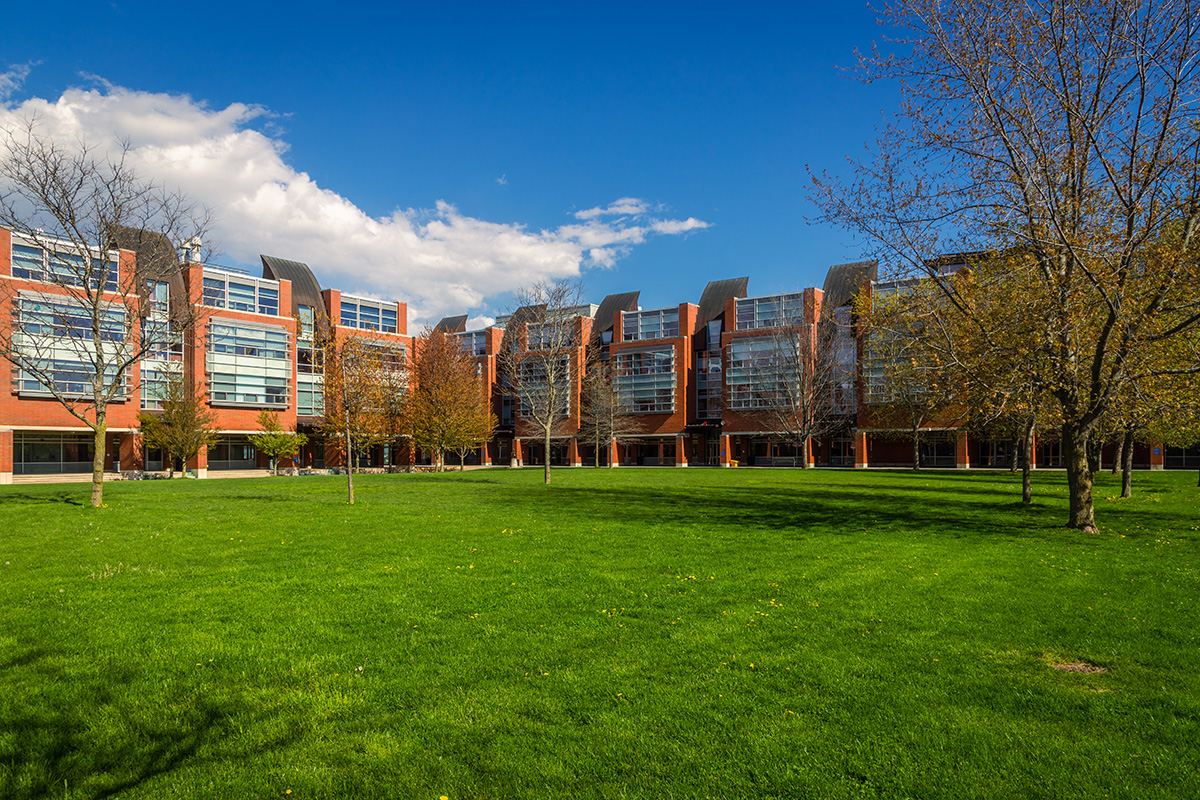

University in Canada
Oshawa, Ontario, Canada
University profile
Ontario Tech University is a public university in Oshawa, Ontario, in the eastern Greater Toronto Area. It was founded as the University of Ontario Institute of Technology and is now known by its operating name Ontario Tech University. It has more than 15,000 graduate and undergraduate students, more than 33,500 alumni and more than 2,500 faculty and staff. Its identity centres on technology-enabled learning, applied programs and research, and on the social and ethical implications of technology.
Teaching is organised in six faculties: Business and Information Technology, Engineering and Applied Science, Health Sciences, Science, Social Science and Humanities, and the Frazer Faculty of Education. The School of Artificial Intelligence and the School of Graduate and Postdoctoral Studies complete the academic structure. The university offers 75 undergraduate programs, 40 graduate programs and 31 college-to-university transfer programs, leading to bachelor's, master's and doctoral degrees, and more than 100 programs have a direct-entry co-op option.
Several programs are distinctive in Canada, among them Automotive Engineering, Nuclear Engineering, a Railway Engineering specialization, Forensic Science (accredited by the American Academy of Forensic Sciences), Forensic Psychology and Medical Laboratory Science. About 85 percent of upper-year undergraduates take part in experiential learning such as co-ops, internships, practicums and research projects, and the university works with more than 500 industry partners.
The university operates from two locations, North Oshawa and downtown Oshawa. Student life includes hundreds of clubs, cultural events and recreation, and the Ridgebacks varsity teams compete in badminton, basketball, curling, dance, golf, ice hockey, lacrosse, rowing and soccer. Supports include academic advising, learning support, accessibility services, a campus health centre, mental health services, career services and Indigenous education and cultural services. Residence is on the North Oshawa campus in two buildings with living-learning communities.
International students make up part of the community, with dedicated admissions routes, scholarships and an international emergency bursary. All in-person bachelor degree programs and all master's and PhD programs are eligible for the Post-Graduation Work Permit. Ontario Tech is a publicly assisted Ontario university established by provincial legislation, the University of Ontario Institute of Technology Act, 2002.
Automatic first-year awards for recent Canadian secondary school graduates, based on the best six 4U/4M courses: $4,000 for 95 percent or higher, $2,000 for 90 to 94.9 percent and $1,000 for 85 to 89.9 percent.
Canadian citizens and permanent residents studying full-time at a Canadian secondary school with a minimum 85 percent average can apply for the Chancellor's Scholarship ($36,000, $9,000 a year for four years), two President's Scholarships ($30,000 each) and two Founder's Scholarships ($24,000 each). One application covers all three, and an essay, letters of support and evidence of leadership are required. The FIRST Robotics Canada Scholarship is $12,000 over four years for Engineering entrants who took part in an FRC team. These were closed for 2026-2027.
The Global Leadership Award is valued at $120,000 CAD ($30,000 a year for four years) for international secondary-school applicants studying outside Canada; closed for 2026-2027, and the usual deadline is in February. International Merit Awards are $20,000 CAD over four years ($5,000 a year) for study-permit holders with an admission average of 80 percent or higher, renewable with 80 percent course load and a 3.30 GPA, and cannot be combined with other scholarships. The International Emergency Bursary offers 10 awards of $20,000 CAD each, renewable for up to four years, for international students transferring to Canada because of war or environmental catastrophe; the 2027-2028 deadline is February 11, 2027, and questions go to [email protected].
Returning full-time students with a combined GPA of 3.7 or above (4.3 scale) receive $1,000 (3.7 to 3.99) or $1,500 (4.0 or above) automatically, for up to three years. Need-based tuition bursaries are applied for each semester through MyOntarioTech, and the Indigenous Student Bursary and Ontario First Generation Bursary are applied for in the student portal in the fall. Entrance scholarships require entry from secondary school within 18 months of graduation, no previous post-secondary study, an 80 percent course load, and only one scholarship held at a time.
Teaching, research and graduate research assistantships are the primary funding for full-time graduate students, usually set out in the offer of admission. Questions go to [email protected].
Undergraduate scholarships | International scholarships and awards | Bursaries | Graduate funding
Ontario Tech Automatic Awards of Recognition →
Ontario Tech Major Entrance Scholarships (Chancellor's, President's and Founder's) →
Browse the scholarships listed for Ontario Tech University and check each award’s eligibility.
View scholarships for Ontario Tech University →Applicants complete six Ontario 4U/M courses including program prerequisites, and apply through the Ontario Universities' Application Centre (OUAC) using the Undergraduate Application. Admission is competitive and the required average varies from year to year, so meeting the minimum does not guarantee an offer. Selection considers marks, the distribution of subjects taken and performance in subjects relevant to the program. Typical prerequisites are ENG4U plus: for Business, one of MDM4U, MCV4U or MHF4U; for Engineering, MHF4U, MCV4U, SCH4U and SPH4U; for Science, MHF4U and two of MCV4U, SCH4U, SBI4U or SPH4U; for Nursing, SBI4U, SCH4U and one of MCV4U, MHF4U or MDM4U. IB equivalents are published for each program, and prerequisites may be taken at Standard or Higher Level unless specified. The January 15 deadline applies to Ontario secondary school students; Nursing and Medical Laboratory Science are Early Application Programs.
International applicants are non-citizens and non-permanent residents who are not in a Canadian high school day program. They apply through OUAC or directly through the university's International Application page, applying to up to three programs for a $100 application fee. The OUAC deadline for equal consideration is March 31, with January 29 for the Early Application Programs (Nursing, Nursing Post-RPN and Medical Laboratory Science) and February 11 for the Global Leadership Award. Accepted curricula include British-patterned (GCE with at least five IGCSE/GCSE/O Level subjects and two A Levels at grade C or better), IB, US-patterned, French-patterned, Caribbean (CSEC and CAPE), and many national systems. Applicants from Ghana, Liberia, Nigeria, Sierra Leone and The Gambia must submit all senior secondary grades including WASSCE results, and official WAEC results are shared electronically through the WAEC Digital Certificate website with [email protected]. SAT code 4192 and ACT code 5265. Post-secondary credentials obtained outside Canada may require authentication by World Education Services (WES). Residence applications by June 1 guarantee a place.
Applicants whose first language is not English can show three years of full-time study in English at secondary or post-secondary level (excluding ESL), or a test result no more than two years old: IELTS Academic 6.5 with no sub-score below 6.0 (7.0 for Education and Nursing); TOEFL iBT overall 4.5 with no section below 4.0 (code 7178); Duolingo English Test 120 (130 for Education and Nursing); PTE Academic 58; Cambridge English Advanced 180 with no band below 170; CAEL 70 with no sub-score below 60; Oxford ELLT 7 (8 for Education and Nursing). IB applicants may present a grade of 4 in IB English A. English for Academic Purposes pathways run through the Oxford International Digital Institute.
Advanced Placement (score of 4), IB Higher Level (score of 5) and A Levels (grade C or better) can earn up to 18 credit hours each, subject to faculty approval. Other university or college courses are assessed case by case.
Mature applicants have not attended post-secondary study, have been away from formal education for at least two years, will be 21 or older in the year they start, and are Canadian citizens or permanent residents. They need secondary-level prerequisite courses and a competitive average. Transfer applicants have attended another Canadian post-secondary institution, must complete the program prerequisites (which may combine secondary and post-secondary study) and be in good academic standing. Both groups apply through OUAC, with a March 31 deadline for programs other than the Early Application Programs.
Master's programs require a four-year honours degree or equivalent in a related area with at least a B average (GPA 3.0 on a 4.3 scale, 73 to 76 per cent) and a B average in the last two years. Doctoral programs require a research master's with a minimum B+ average (GPA 3.3, 77 to 79 per cent). Graduate diplomas require a minimum B-minus average (GPA 2.7, 70 to 72 per cent). Graduate English minimums: IELTS 6.5 (7.0 for MBAI, MFDA, MA Education, EdD and MHSc), TOEFL iBT 4.5 with no section below 4.0 for tests after January 21, 2026 (5.0 for MA Education, EdD, MHSc, MBAI and MFDA), Duolingo 120 or 130 depending on program, PTE and CAEL 70. Priority deadlines for January 2027 entry include September 1, 2026 for MASc programs and October 1, 2026 for international applicants to most course-based master's programs; applications are made through the Graduate Admissions Portal. All master's and PhD programs are PGWP eligible.
2000 Simcoe Street North, Oshawa, shared with Durham College. It holds the Science Building, the Business and Information Technology Building, the OPG Engineering Building with 17 labs, the Automotive Centre of Excellence, the Energy Research Centre and Clean Energy Research Laboratory, the Software and Informatics Research Centre (home of the Office of the Registrar) and Shawenjigewining Hall, which houses the Faculty of Health Sciences and Mukwa's Den, an Indigenous student space. The Campus Library, Campus Recreation and Wellness Centre (8,400 square metres), Campus Ice Centre with two NHL-size pads, Campus Fieldhouse, Campus Tennis Centre and two residence buildings are on this campus. The 190 acres of former Windfields Farm land to the north and west are covered by the Campus Master Plan, and Crime Scene House supports the Forensic Science program.
The downtown footprint includes the Faculty of Education at 11 Simcoe Street North, the Faculty of Social Science and Humanities in Bordessa Hall at 55 Bond Street East, the 61 Charles Street building, the Regent Theatre at 50 King Street East, space at 2 Simcoe Street South, and the Baagwating Indigenous Student Centre. A downtown library serves social science, humanities and education.
Study programmes offered at Ontario Tech University.
Experiences shared by students of Ontario Tech University.
Studied here? Share your experience to help other applicants.

Book a free consultation with our expert counsellors and take the first step towards your dream university.
Copyrights © 2026 StudyMapped. All rights reserved.

Enter your credentials to continue.
Join us and start your study abroad journey.


