
University in Canada
Halifax, Nova Scotia, Canada
University profile
NSCAD University, in Halifax, Nova Scotia, is a specialist university for art, craft, design and media. Students have studied art, design and craft there since 1887, and it describes itself as one of Canada's oldest independent cultural institutions and a principal centre for education and research in visual culture. Its mission is to nurture transformative experiences that challenge conventional thinking through art, craft, design and media.
Teaching is organised in four divisions: Craft, Design, Fine Arts and Media Arts. Every undergraduate begins with a year-long Foundation Studies program that introduces all the disciplines taught. Degree programs lead to the Bachelor of Fine Arts (Ceramics, Expanded Media, Film, Fine Art in Drawing, Painting, Printmaking and Sculpture, Interdisciplinary Arts, Jewellery and Metalsmithing, Photography, Textiles and Fashion), the Bachelor of Design (Interdisciplinary Design) and the Bachelor of Arts (Art History, Studio and Non-Studio). Graduate programs are the Master of Arts in Art Education, the Master of Design and the Master of Fine Arts. Certificates include the Post-Baccalaureate Certificate in Design, the Visual Arts Certificate in Studio and the Visual Arts Certificate for Teachers, and there are pre-university studies.
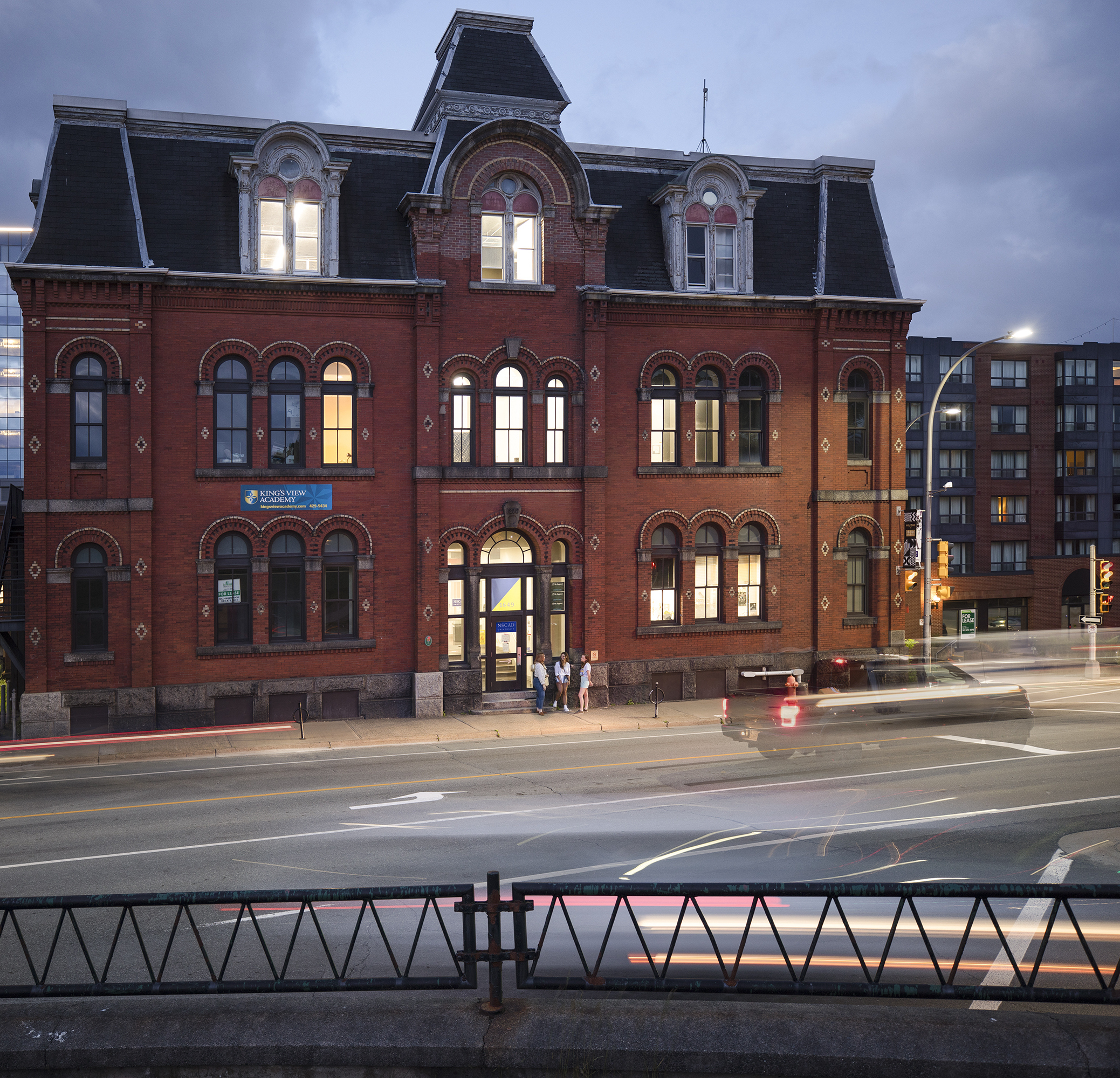
The university runs three campuses in downtown Halifax: the Fountain Campus on Duke Street, the Port Campus on the waterfront and the Academy Campus near Citadel Hill. Facilities include twelve fabrication studios staffed by technicians, with unlimited studio access for students, computer labs on all campuses, the NSCAD University Library and the Anna Leonowens Gallery and Treaty Space Gallery.
The student body is small: 854 undergraduate and 55 graduate students, with a student-faculty ratio of 8:1, an average class size of 13 and 93% of classes under 30 students. International students make up 26% of the community, from 24 countries, and more than 70 exchange opportunities are available. NSCAD does not operate on-campus residences; students can apply for residence space, subject to availability, at partner universities in Halifax (Saint Mary's University, University of King's College, Atlantic School of Theology and Mount Saint Vincent University) or rent privately. Student health care is available through the Saint Mary's University clinic, and the Student Union of NSCAD (SUNSCAD) runs the domestic student health plan.
International students are required to hold health insurance, which is included in fees through NSCAD's International Health Insurance Plan, and acceptance letters carry the university's Designated Learning Institution number (019021269652) for study permit applications.
Undergraduate applicants who apply for admission by March 1 are automatically considered for entrance scholarships and bursaries. Individual entrance awards currently range from $500 to $9,000, and some are renewable for up to four years of study. The March 1 deadline applies to undergraduate admission only; the graduate admission deadline is January 15.
NSCAD offers more than 90 internal scholarships and bursaries each academic year, totalling about $100,000 annually. Most require at least one full-time semester of study before a student can apply. Applications are posted through the year in the NSCAD Form Portal, and awards are credited to the student's tuition and fees account in the following semester.
An annual award with one $5,000 grand prize (a purchase for the President's Art Bank) and nine $1,000 best-in-category prizes across nine disciplines, with nominated works exhibited at the Anna Leonowens Gallery.
External scholarships from government, corporate and non-profit organisations, such as the Harrison McCain Scholarships and the Canada Graduate Awards, are open to all students and are circulated to students by email; external funding can exceed $40,000 per year. Together, internal and external awards total about $200,000 per academic year.
More information: Scholarships and bursaries, Tuition and fees.
NSCAD University Entrance Scholarships and Bursaries →
Browse the scholarships listed for NSCAD University and check each award’s eligibility.
View scholarships for NSCAD University →Applicants must have completed grade 12 (or the highest grade required for secondary graduation) with an average of 70% or higher, including at least 70% in grade 12 English for university preparation. A record of all studies from at least grade 10 onward is required, including mid-term or first-semester grades for the graduating year. A portfolio, an admissions essay (five short prompts, about 250-500 words in total) and transcripts are part of every undergraduate application.
An International Baccalaureate Diploma with a minimum grade of 24 is acceptable for entry; Higher Level courses with a grade of 5 or higher are eligible for transfer credit, as are Advanced Placement courses with a grade of 4 or higher. Quebec CEGEP applicants need at least one full year of a DEC with an overall average of 70% or higher; a completed two-year DEC may receive up to one year of transfer credit. Quebec grade 12 applicants need a 70% average including 70% in grade 12 English. Applicants studying toward the General Certificate of Secondary Education (for example in the United Kingdom, West Indies, Bermuda, East and West Africa or Hong Kong) need at least two Advanced (A) Level subjects and three Ordinary (O) Level subjects with an overall average of C and no subject below D; two AS Level courses may replace one A Level course.
Applicants whose language of instruction was not English for at least three years of high school or one year of post-secondary study must provide a test result sent directly by the testing service. Undergraduate minimums: TOEFL 90 (no section below 20); IELTS 6.5 (no band below 6.0); Duolingo English Test 120 (no sub-score below 110); PTE Academic 70 (no score below 65); CAEL 69 (no test below 60); CAE grade B; MELAB 82 (no test below 80); Oxford ELLT 7 (no band below 6); IB English A1 or A2 HL grade 5; AP English grade 4. Graduate minimums: TOEFL 94 (no section below 22); IELTS 7.0 (no band below 6.0); Duolingo 130 (no sub-score below 110); PTE Academic 70 (no score below 65); Oxford ELLT 8 (no band below 7). Applicants who do not yet meet the requirement receive a conditional offer and may take English studies through partner language-school pathway programs.
Admitted students receive an acceptance letter with the university's Designated Learning Institution number for the Canadian study permit application, which is required for study longer than four months; visiting or exchange students staying under six months do not need a permit. Health insurance is mandatory and included in fees. The recommended budget for 8-12 months of study is a minimum of $20,000 to $25,000 (Cdn), excluding airfare. Graduates of the Nova Scotia International Student Program from a Nova Scotia secondary school pay the domestic out-of-province tuition rate for the full length of their undergraduate degree. All degree students must meet a writing requirement, normally through FNDN 1800 Writing for the Arts in the Foundation year.
Mature applicants are at least 22 years old, have never been enrolled in full-time post-secondary study, have been out of school three years or longer and may not have graduated from high school; they submit available academic records and two letters of recommendation, are considered case by case and apply to the Foundation Program. Transfer credit is available for AP or IB coursework, previous post-secondary study, or study at an institution with an articulation or pathway agreement with NSCAD. Visiting students need a Letter of Permission from their home institution; non-degree students submit high school or post-secondary transcripts. Exchange students from partner institutions need home-institution approval.
Applicants to the Master of Fine Arts should hold a BFA or equivalent four-year qualification; applicants to the Master of Design should hold a Bachelor of Design, a related bachelor's degree or equivalent, with an overall B average in relevant coursework. The application requires a statement of intent (maximum 500 words), transcripts, two letters of recommendation and a portfolio of up to 20 images or files (time-based excerpts not exceeding 15 minutes in total); for the Master of Arts in Art Education the portfolio is optional and a writing sample from the last six years is required. A non-refundable application fee of $75 USD applies. Up to three graduate liberal arts credits may be transferred.
Undergraduate portfolios include 10-20 recent examples of finished work in at least three mediums, 5-10 examples of process work, and a list of works giving title, medium and materials, dimensions and year.
All applications are made through the SlideRoom portal (nscad.slideroom.com) with an online form, application fee, transcripts, essay and portfolio. Undergraduate fall (September) entry opens October 1; the deadline for entrance scholarship consideration is March 1; extended deadlines are May 1 (international), June 1 (transfer) and July 31 (domestic). Winter (January) entry: October 1 for international, domestic and transfer applicants, with an extended domestic deadline of November 30. Late applications may be considered on request. Graduate programs start in fall only, with an application deadline of January 15 (early deadline November 1 for the Master of Design and the Master of Arts in Art Education). The Post-Baccalaureate Certificate in Design has a March 1 deadline. Undergraduate and certificate decisions can come in as little as two weeks; graduate decisions follow 4-6 weeks after the deadline. Transcripts may be sent by the school to [email protected], through electronic services such as MyCreds, or by mail to NSCAD Admissions, 5163 Duke Street, Halifax, Nova Scotia B3J 3J6.
Facilities: computer labs with printing and photocopying on all three campuses; the NSCAD University Library, the largest dedicated collection of visual arts, craft and design materials in Atlantic Canada, with more than 50,000 books and periodicals; the Anna Leonowens Gallery and Treaty Space Gallery, which mount over 125 exhibitions and over 50 events a year; twelve fabrication studios. There are no on-campus residences; partner-university residences and private housing are used.
Study programmes offered at NSCAD University.
Experiences shared by students of NSCAD University.
Studied here? Share your experience to help other applicants.

Book a free consultation with our expert counsellors and take the first step towards your dream university.
Copyrights © 2026 StudyMapped. All rights reserved.

Enter your credentials to continue.
Join us and start your study abroad journey.


