
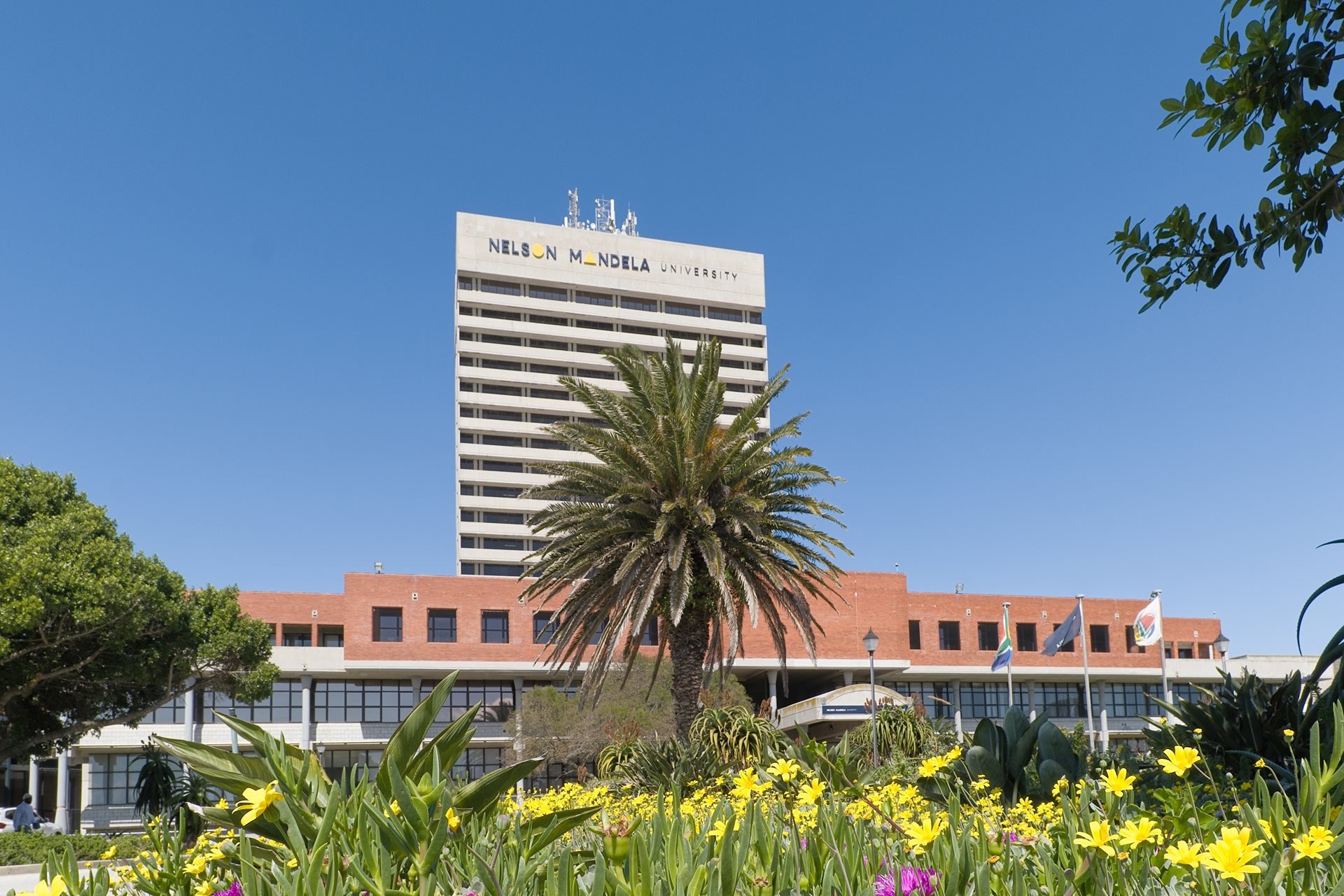

University in South Africa
Gqeberha, Eastern Cape, South Africa
University profile
Nelson Mandela University is a public university in Gqeberha (Port Elizabeth), Eastern Cape. It opened on 1 January 2005 as Nelson Mandela Metropolitan University and took its present name on 20 July 2017. It states that it is the only higher education institution in the world to carry the name of Nelson Rolihlahla Mandela. Its vision is to be a dynamic African university recognised for leadership in generating cutting-edge knowledge for a sustainable future, and its stated values are respect for diversity, excellence, social justice and equality, Ubuntu, integrity and sustainable stewardship.
The university states that six of its campuses are in Nelson Mandela Bay and one is in George in the Southern Cape. It offers more than 500 study programmes, from Higher Certificates through to PhDs, and says it is well known for art and design, building, chartered accounting, engineering, health and environmental sciences and information technology. Many programmes include workplace experience as part of the curriculum.
Teaching is organised in seven faculties: Business and Economic Sciences (Business School; Industrial Psychology and Human Resources; Accounting; Economics, Development and Tourism; Management Sciences), Education, Engineering, the Built Environment and Technology (Architecture; Engineering; Information Technology; Built Environment and Civil Engineering), Health Sciences (Behavioural and Lifestyle Sciences; Clinical Care and Medical Sciences; Medicine), Humanities (Government and Social Sciences; Language, Media and Communication; Visual and Performing Arts), Law and Science. The Health Sciences faculty describes about 4,000 students in eleven departments, with an Interprofessional Education project. The university also lists a Medical School, an Ocean Sciences focus and a Centre for Women and Gender Studies.
Student life is built around associations, cultural societies and sport clubs; the sport teams are known as the Madibaz and the mascot is Diba the dolphin. The university lists library and information services, campus health services, Emthonjeni (student wellness and counselling), an arts, culture and heritage unit, student governance and the Student Representative Council, and Universal Accessibility and Disability Services. It states that it provides 24-hour security on all campuses, access-card control at campuses and residences, and a scheduled shuttle linking campuses during office hours. On-campus residences exist in Gqeberha and on the George Campus, and accredited off-campus accommodation is available.
International students may apply for full degrees, short programmes (a summer school of 3 to 8 weeks) and study-abroad options, and the university says African students come from 34 countries. It states that its programmes are accredited by the relevant professional bodies, locally and in many cases internationally.
The university states that full-time students can receive financial assistance in the form of bursaries, merit awards and scholarships, and it publishes general financial information, funding for postgraduate students and international fee guidelines under Study at Mandela. Bursaries for students with disabilities are available through NSFAS. Applicants who need NSFAS funding should apply through the NSFAS website. Amounts, criteria and deadlines are on the Financial Aid Office pages.
Official pages: Study at Mandela: Discovery (financial information); Financial Aid Office; MyFuture: Funding your studies.
Nelson Mandela University Scholar Merit Award →
Nelson Mandela University Student Merit Awards →
Nelson Mandela University Madibaz Sport Bursaries →
Browse the scholarships listed for Nelson Mandela University and check each award’s eligibility.
View scholarships for Nelson Mandela University →Applicants must meet the statutory minimum for the qualification type, plus any university requirements. Higher Certificate: NSC pass with at least 30% in the language of learning and teaching (English at the university). Diploma: NSC pass with at least 30% in English and an achievement rating of 3 (40-49%) or better in four recognised 20-credit subjects (Life Orientation excluded). Bachelor's degree: NSC pass with at least 30% in English and a rating of 4 (50-59%) or better in four recognised 20-credit subjects (Life Orientation excluded). Meeting the minimum does not guarantee admission.
The AS is calculated from six subjects, excluding Life Orientation, using the most recent Grade 12 percentages (not March results). It must include home language, first additional language, and Mathematics, Mathematical Literacy or Technical Mathematics. With seven subjects the AS is the sum of the six 20-credit subjects (out of 600); with eight or more it is the three fundamental subjects plus any subjects the programme requires plus the next-best subjects, up to six. Applicants from quintile 1 to 3 schools with 50% or more in Life Orientation receive 7 extra points. Programmes may add subject-specific percentage requirements; the university states that it no longer tests applicants for admission, so applicants who miss the AS or subject marks must choose another qualification. A calculator is on the university's MyFuture site.
Applications are accompanied by a certified copy of the final Grade 11, most recent Grade 12 (June/September) or matric results, certified ID, a certified ID of a parent or guardian and a declaration by parent form where the applicant is a dependant, and certificates, academic records and certificates of conduct for anyone who has studied elsewhere. Some programmes need extra items: a portfolio and online interview (Bachelor of Architectural Design, Diploma in Architectural Technology, Diploma in Interior Design, Bachelor of Visual Arts), audition video (Music programmes), medical report (Human Movement Sciences, Biokinetics, EMC), proof of employment or a CV (several advanced diplomas and certificates), proof of current sport participation (Diploma in Sports Management), and a degree certificate or proof of final-year registration (PGCE). The PGCE and Advanced Diplomas are applied for under the Undergraduate tab.
Current Mandela University diploma students apply online for an Advanced Diploma by 3 August 2026 with no supporting documents; late applications may be considered on merit until 30 September 2026. Others submit ID, academic record and certificate of conduct.
Honours applicants should consult their faculty because some courses close earlier. Early applications for 2027 closed 3 August 2026 and late applications may be considered to 30 September 2026 if space remains; Masters and PhD applications by research are open throughout the year. Documents include certified certificates and academic records, ID, the postgraduate (U24) form and a draft research proposal.
International undergraduate and postgraduate applicants for 2027 apply by 30 September 2026 (MBChB, BPharm and Radiography earlier) and pay an application fee of R500 payable annually. Further requirements are published by the Office for International Education.
Applications opened 13 April 2026. Closing dates: 30 June 2026 for MBChB, Bachelor of Nursing and Nursing Extended, BPharm and Bachelor of Radiography (Diagnostic); 3 August 2026 for early applications; 30 September 2026 for late applications and all student housing applications. The university may close a programme once capacity is reached. Online applications for South African applicants carry no application fee. Applications are made at applyonline.mandela.ac.za.
The university states that it has six campuses in Nelson Mandela Bay and one in George (Southern Cape).
Facilities the university lists across its campuses: laboratories, computer laboratories (some open 24 hours), lecture halls, libraries, counselling and health services, cafeterias, food courts and coffee shops, and sport facilities through Madibaz Sport. A scheduled shuttle links the campuses during office hours.
Study programmes offered at Nelson Mandela University.
Experiences shared by students of Nelson Mandela University.
Studied here? Share your experience to help other applicants.

Book a free consultation with our expert counsellors and take the first step towards your dream university.
Copyrights © 2026 StudyMapped. All rights reserved.

Enter your credentials to continue.
Join us and start your study abroad journey.


