
University in Germany
Halle (Saale), Sachsen-Anhalt, Germany
University profile
Martin Luther University Halle-Wittenberg (MLU) is the largest and oldest higher education institution in Saxony-Anhalt, formed in 1817 by the merger of the University of Wittenberg (founded 1502) and the Friedrichs University of Halle (founded 1694). It offers a broad range of subjects across the humanities and social sciences and the natural and medical sciences, with more than 150 undergraduate and almost 80 postgraduate programmes.
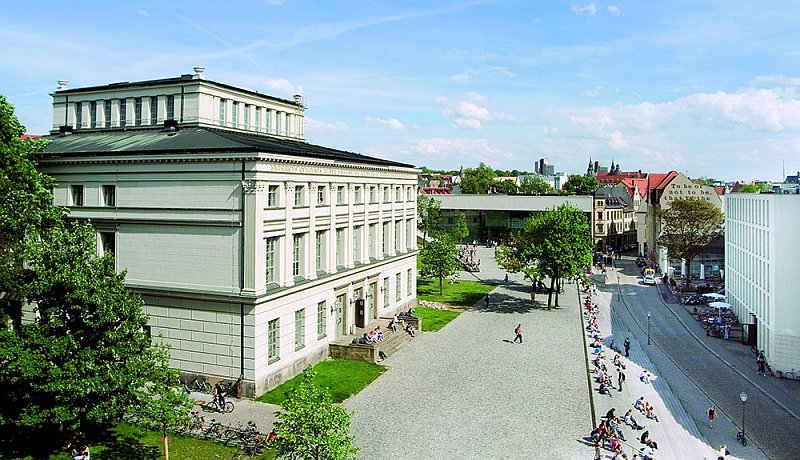
The university has about 19,000 students, around 350 professors and more than 4,000 staff. Besides the Weinberg Campus, which hosts the natural science institutes next to the Weinberg Campus technology park and neighbouring Max Planck, Fraunhofer, Leibniz and Helmholtz institutes, it has three further main sites: the central Universitätsplatz with the main buildings, the Steintor Campus with many humanities and social science institutes, and the Francke Foundations, home of the faculties of education and theology.
Teaching is organised in nine faculties and one centre: the Faculty of Theology; the Faculty of Law and Economics; the Faculty of Medicine; Faculties of Philosophy I, II and III; Faculties of Natural Sciences I, II and III; and the Centre for Engineering Sciences. Speech Science and Medical Physics are rare subjects in Germany. MLU carries the main responsibility for teacher education for general schools in Saxony-Anhalt, with 1,000 places per study year and more than 4,000 trainee teachers, and is also responsible for training lawyers in the state. University Medicine Halle, with its university hospital, trains doctors, nursing specialists and midwives, including at the Dorothea Erxleben Learning Centre.
More than 40 academic collections and museums belong to the university, six of them listed in the register of nationally valuable cultural property, including the Geiseltal Collection of Eocene fossils and the Meckel Collections of anatomy. Student life includes the University Sports Centre, the Collegium musicum, the language centre and the student council (StuRa). The Studentenwerk Halle runs several student halls of residence; places are limited and not guaranteed, so applicants are advised to look for private housing in parallel.
International students numbered 1,754 among 18,789 students at 31 October 2025. The university cooperates with more than 100 partner universities, and the International Office, the International Graduate Academy (InGrA) and the Welcome Portal support international students and doctoral candidates. Most of the roughly 230 degree programmes are taught in German; seven programmes are taught in English and three binational double-degree programmes are offered. The Landesstudienkolleg Halle, run jointly with Anhalt University of Applied Sciences, prepares applicants whose qualifications do not equal a German university entrance qualification. MLU is a member of the Central German University Association Halle-Jena-Leipzig.
As a state university MLU charges no tuition fees for a first degree. Exceptions are a second degree (500 euros per semester, except for a consecutive Master following a first degree), students aged 60 or over (500 euros per semester) and three postgraduate continuing-education Master programmes. Long-term study fees were abolished from winter semester 2020/21. All students pay a semester contribution, which is a social contribution and not tuition: 333.30 euros for winter semester 2026/27 (90.00 euros Studentenwerk, 226.80 euros Deutschlandsemesterticket, 16.50 euros student body) and 315.30 euros for summer semester 2026. The Studentenwerk and Deutschlandsemesterticket portions are compulsory.
The university has awarded Deutschlandstipendien since winter semester 2011. The scholarship is 300 euros per month, funded by the federal government and private sponsors, independent of income and parental income, and not offset against BAföG. It is open to students of all subjects within the standard period of study and to prospective students with very good school or study results, judged also on awards, vocational experience, voluntary engagement and personal circumstances. Doctoral students, Studienkolleg students, auditors and Erasmus exchange students are not eligible. It is normally granted for two semesters and can be extended to the end of the standard period of study. The next application phase for winter semester 2027/28 is expected to start in summer semester 2027. See Deutschlandstipendium at MLU.
The university points students to BAföG via the Studentenwerk Halle, the Aufstiegsstipendium for professionals, and foundations and Begabtenförderwerke such as Cusanuswerk, Evangelisches Studienwerk Villigst, Friedrich-Ebert-Stiftung, Hans-Böckler-Stiftung, Hanns-Seidel-Stiftung and Heinrich-Böll-Stiftung, several of which support international students and doctoral candidates. Information is at Studienfinanzierung; the International Office advises on funding for international students and doctoral candidates (International Office).
Deutschlandstipendium at Martin Luther University Halle-Wittenberg →
Browse the scholarships listed for Martin Luther University Halle-Wittenberg and check each award’s eligibility.
View scholarships for Martin Luther University Halle-Wittenberg →Applications for the first subject semester go through the university's online application portal. Eight Bachelor programmes (Business Administration, Biology, Biochemistry, Nutrition Science, Education Science (180 credits), Psychology (180 credits), Economics and Business Information Systems) are allocated through the dialogue-oriented service procedure (DoSV) via hochschulstart.de. Medicine, Pharmacy and Dentistry are handled entirely through hochschulstart. Applicants can submit up to four equal applications for other programmes with a numerus clausus (NC); programmes without NC allow direct online enrolment after registration. Admitted applicants in NC programmes normally have 10 to 14 days to complete online enrolment, which includes paying the semester contribution, uploading a photo and proving health insurance status.
Applicants with a non-German university entrance qualification or degree, a Studienkolleg certificate (FSP), a German overseas school certificate without Abitur examination, or an International Baccalaureate apply only via uni-assist using the standard procedure; the VPD procedure is not accepted. Applicants check their eligibility with the uni-assist Hochschulzugang tool and the subject-specific entry requirements (minimum grades, aptitude test or pre-study internship) in the study programme database. Documents are uploaded as scans, with sworn translations into German or English where needed; no certification and no paper copies are required. A provisional Bachelor certificate is accepted if the final one follows within four months of semester start (31 January for winter, 31 July for summer). Applicants with degrees from India, China or Vietnam must provide an APS certificate; those from Pakistan need HEC attestation. The uni-assist fee is currently 75 euros for the first and 30 euros for each further application; MLU itself charges no application fee. EU/EEA applicants to Medicine, Dentistry and Pharmacy apply via hochschulstart instead of uni-assist. The age limit for first-semester applications is 55. Conditional admissions are not issued and admissions cannot be deferred to the next semester.
Winter semester: 15 July for Studienkolleg and DSH and for undergraduate programmes; 15 June for Master programmes (31 March for the MSc Pharmaceutical and Industrial Biotechnology). Summer semester: 15 January for Studienkolleg, DSH and undergraduate programmes; 15 December for Master programmes. Master deadlines for 2027 are under revision, with earlier deadlines planned. Semesters begin on 1 October and 1 April.
The Landesstudienkolleg Halle, run jointly with Anhalt University of Applied Sciences, prepares applicants whose qualifications do not meet German entrance requirements. A language certificate at CEFR level B2 is required (a certificate of participation or app-based proof is not accepted) and applicants must pass an entrance test in Halle, held in mid or late August for the winter semester and late January for the summer semester; the test for winter semester 2026/27 was on 17 August 2026.
For German-taught and bilingual programmes one of the following is accepted: DSH-2; TestDaF with at least 4 in each part; telc Deutsch C1 Hochschule with at least the grade satisfactory; Goethe-Zertifikat C2: GDS; Deutsches Sprachdiplom (DSD II) with at least C1 in all three parts; the Feststellungsprüfung with a German component; or Austrian ÖSD C2. German citizenship does not count as proof of German.
The BSc Business Economics, MA Anglo-American Literature, Language and Culture, MSc Biodiversity Sciences, MA Christianity in Global Transformations, MSc Economics: Data Science and Policy, MSc Molecular and Cellular Biosciences, MSc Pharmaceutical and Industrial Biotechnology and MSc Polymer Materials Science can be studied without German proof. English requirements are set per programme, and an official language of English in the applicant's home country is not automatically accepted; native speakers who completed at least the last two years of schooling or study in Australia, Ireland, Canada (except Quebec), New Zealand, Singapore, the United Kingdom or the USA are normally exempt.
TestAS is not compulsory; for NC Bachelor and state examination programmes, a result above 80 per cent (at least 81 per cent) in both the core and subject tests earns a bonus of 0.2 grade points.
Master applicants with a qualifying first degree apply through the online portal (German degrees) or via uni-assist (international degrees); a separate examination board reviews Master applications. Programme-specific requirements such as minimum grades, CV or motivation letter are set in each programme's entry in the study programme database. Applicants with German degrees may submit up to four equal Master applications.
Doctoral candidates need a supervisor who is a teacher at MLU and must submit a supervision confirmation. At Philosophical Faculties I and II and Natural Sciences Faculty I, an application for acceptance as a doctoral candidate must also be made. Enrolment as a doctoral student is voluntary (except where the doctoral committee requires courses), can be made at any time without a deadline, and requires payment of the semester contribution; it provides the Deutschlandsemesterticket, library use, Wi-Fi and student canteen prices. The International Graduate Academy (InGrA) and the PhD Network advise on structured programmes and funding.
The admission letter contains the information normally needed for the visa application (language of instruction, start of semester); applicants may apply for the visa with the uni-assist submission confirmation while the application is processed. Lectures take place on campus, and full enrolment from abroad is not possible. Student halls are not included with admission; the Studentenwerk operates halls with limited capacity.
The International Office is at Anton-Wilhelm-Amo-Straße 19/20. The university library has branch libraries, and the University Sports Centre, Collegium musicum, language centre and the health management programme (Wohlfühlcampus) serve students. More than 40 academic collections and museums are housed at the university. The Studentenwerk Halle operates student halls of residence, the canteens (Mensen) and BAföG advice.
Study programmes offered at Martin Luther University Halle-Wittenberg.
Experiences shared by students of Martin Luther University Halle-Wittenberg.
Studied here? Share your experience to help other applicants.

Book a free consultation with our expert counsellors and take the first step towards your dream university.
Copyrights © 2026 StudyMapped. All rights reserved.

Enter your credentials to continue.
Join us and start your study abroad journey.


