
University in South Africa
Durban, KwaZulu-Natal, South Africa
University profile
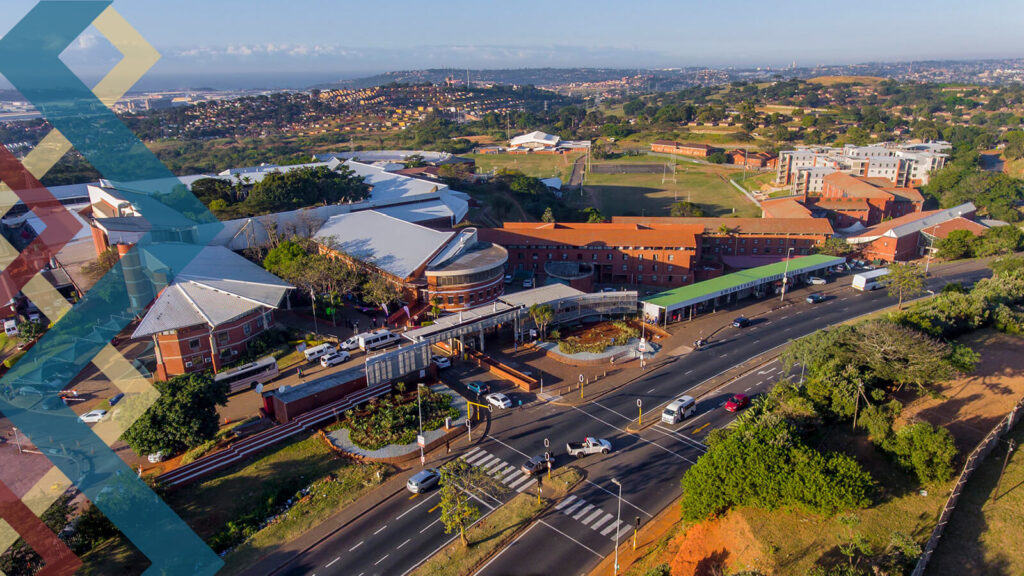
Mangosuthu University of Technology (MUT) is a public university of technology in Umlazi, Durban, KwaZulu-Natal. It describes itself as one of only six universities of technology in South Africa and the only one situated in a township. The idea of a technical institution was raised in 1974 by Dr Mangosuthu Buthelezi, teaching began in 1979 with 15 students, and the Technikon was renamed a university of technology in November 2007.
The 2026 prospectus describes a scenic site overlooking the Indian Ocean, with two campuses, the Main Campus and the North Campus, within walking distance of each other. It offers diplomas and degrees at undergraduate level, plus advanced diplomas, postgraduate diplomas and a Master of Nature Conservation, with Work-Integrated Learning built into the curriculum.
Faculties. The Faculty of Engineering has departments of Chemical Engineering, Civil Engineering and Survey, Electrical Engineering, Mechanical Engineering, and Building and Construction (Construction Management and Quantity Surveying). The Faculty of Management Sciences has Accounting and Law, Human Resource Management, Marketing, Office Management and Technology, and Public Administration and Economics. The Faculty of Applied and Health Sciences (called Natural Sciences on some pages) has Agriculture, Biomedical Sciences, Chemistry, Community Extension, Environmental Health, Information and Communication Technology, and Nature Conservation.
Strengths and partnerships. The Co-operative Education directorate places about 1500 students a year for Work-Integrated Learning in over 200 organisations. The Technology Station in Chemicals, part of the Technology Innovation Agency's national programme, serves local industry in sectors such as detergents, cosmetics, water management and bio-energy. The Centre for Algal Biotechnology works on microalgae and biofuels.
Student life. The site gives a student population of 14 500 with 50/50 gender parity, with 90% of students accommodated on campus and in 43 outsourced residences, and a dedicated residence for international students. There is an on-campus clinic, a counselling unit, a student gymnasium, many sport codes, MUT Radio and a long list of clubs and societies. First-year students apply through the Central Applications Office (CAO). Non-South African applicants need a valid passport, medical insurance and a police clearance certificate.
The Bursaries page lists external bursary opportunities. The Eskom Bursary Programme for 2027 was open with a closing date of 22 September 2026. The Afrimat bursary seeks first-year Electrical or Mechanical Engineering students from the uMkhanyakude District, particularly Hluhluwe and surrounds, three students per programme, with a 65% average; documents include proof of registration, proof of residence, fee statements, the application form, mid-year results, student ID and university banking details; closing date 15 November 2026.
The contact page lists a Bursaries Officer (031 907 7126), the Financial Aid Bureau (031 907 7106) and an NSFAS office (031 907 7353). Students whose employer or sponsor will pay fees must present the original commitment letter to the Financial Aid Office at registration.
The Scholarships page describes NSFAS as the government scheme for academically deserving students, and a bursary as a non-repayable grant for financially needy, academically deserving students. The 2026 prospectus states average tuition of about R14 530 per semester and residence of about R13 000 per semester.
Browse the scholarships listed for Mangosuthu University of Technology and check each award’s eligibility.
View scholarships for Mangosuthu University of Technology →Each faculty sets requirements using a points aggregate from the best five subjects, and some departments add a compulsory entrance test. Not all applicants who meet the minimum can be accepted; selection prioritises the best qualified applicants and those who chose MUT as first or second choice. Minimum entry is an NSC with a diploma pass, or N3 with a 50% pass in Mathematics and English; at least five subjects at level 4 for diploma study (level 3 for access courses); English Home Language or First Additional Language at level 4; the subject combination and level for the qualification; and the minimum points listed in the CAO handbook. The prospectus states a minimum of 25 points including level 4 in English.
90-100% = 8 points (level 8 per the table), 80-89% = 7, 70-79% = 6, 60-69% = 5, 50-59% = 4, 40-49% = 3. For the old Senior Certificate: Higher Grade A to E = 8 to 4 points, Standard Grade A to E = 6 to 2 points.
Management Sciences: English, Mathematics and Accounting, all at 50% or above, with a minimum of 25 points for all programmes. Engineering: English, Mathematics and Physics at 50% or above. Applied and Health Sciences: English, Mathematics, Physical Science, Agricultural Science or Life Sciences at 50% or above. Departmental screening may apply.
First-year applications are made online through the Central Applications Office (www.cao.ac.za) using one form and one fee. The Apply page says applications open in January and close 30 September, with late applications until 30 November for a CAO late fee; the 2026 prospectus says they open on 1 March. Engineering second-semester applications close 31 May, and Analytical Chemistry second-semester applications close 31 May. Documents for South African applicants: Grade 11 final results, Grade 12 June results, NSC or Statement of Results, and ID; transfer students add an academic record and certificate of good conduct. MUT charges an application fee of R520, non-refundable and credited to the deposit if registration is successful.
Non-South African applicants need a valid passport, valid medical insurance and a police clearance certificate, plus SGCE, GCE, GCSE, IGCSE or Cambridge School Certificate. Stated grades: A-Level A to E, AS-Level A to D, O-Level and IGCSE A to C, HIGCSE 1 to 3. The prospectus notes that for SADC learners three of the five subjects must come from the same sitting.
Applications with certified copies of certificates and academic records go to the Head of Admissions ([email protected]). Advanced diplomas generally need a relevant three-year diploma with a 60% aggregate (or two years of relevant experience); the Postgraduate Diploma in Marketing needs a degree or advanced diploma with 60%; Nature Conservation routes run from advanced diploma and BTech to a postgraduate diploma and a Master of Nature Conservation with 60% in final-level major subjects. The Advanced Diploma in ICT needs a relevant diploma or degree with a 60% average.
Study programmes offered at Mangosuthu University of Technology.
Experiences shared by students of Mangosuthu University of Technology.
Studied here? Share your experience to help other applicants.

Book a free consultation with our expert counsellors and take the first step towards your dream university.
Copyrights © 2026 StudyMapped. All rights reserved.

Enter your credentials to continue.
Join us and start your study abroad journey.


