
University in Germany
München, Bayern, Germany
University profile
Ludwig-Maximilians-Universität München (LMU Munich) is a public research university in Munich, the capital of Bavaria. Founded in 1472 in Ingolstadt as Bavaria's first university, it moved to Landshut in 1800 and to Munich in 1826. LMU describes itself as a leading research university in Europe and is a University of Excellence in Germany's Excellence Strategy.
Teaching and research are organised in 18 faculties: Catholic Theology, Protestant Theology, Law, Business Administration (Munich School of Management), Economics, Medicine, Veterinary Medicine, History and the Arts, Philosophy, Philosophy of Science and Religious Studies, Psychology and Educational Sciences, Study of Culture, Languages and Literatures, Social Sciences, Mathematics, Informatics and Statistics, Physics, Chemistry and Pharmacy, Biology, and Geosciences. In the winter semester 2025/26 LMU had 52,658 students and in 2024 it counted 840 professors, including those of its University Hospital.
The university has more than 300 degree programmes, many of them Bachelor and State Examination courses taught in German, together with an increasing number of English-taught Master's programmes, double degrees and doctoral programmes. Research is grouped into six profile areas: Digits and Data, Earth and Environment, Languages and Cultures, Life and Health, Physics, and Systems and Communities.
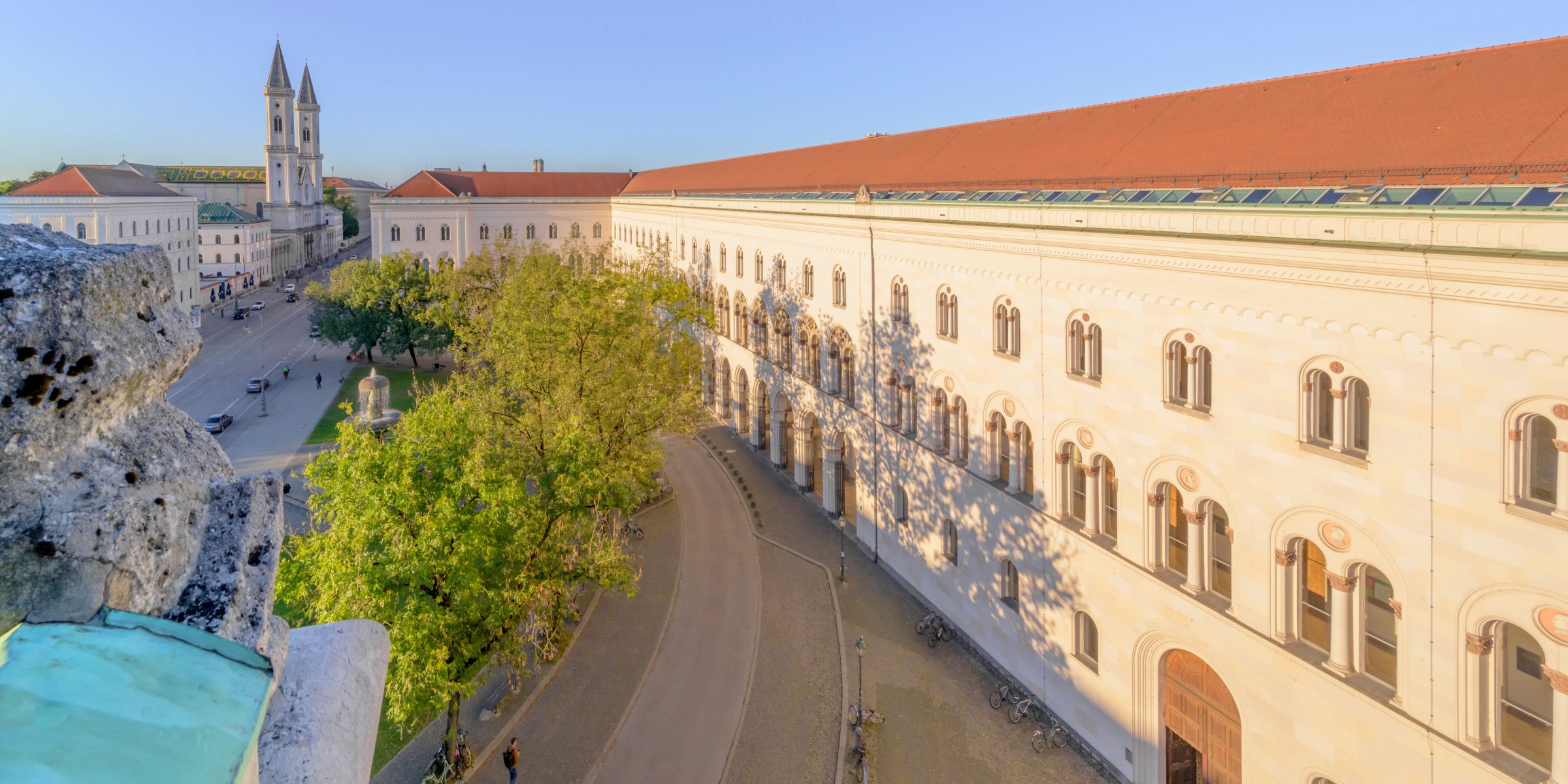
LMU's 125 buildings stand in and around Munich and include the historic Main Building at Geschwister-Scholl-Platz, teaching and research buildings, libraries, hospital complexes, agricultural facilities and the Wendelstein Observatory in the Bavarian Alps. A campus development programme will bring previously scattered faculties together at five large campus sites.
Student life includes more than ninety kinds of sport through the Munich University Sports Center, a wide range of student groups, and student housing run by the Studierendenwerk München Oberbayern, which houses about 13% of Munich's students. In the winter semester 2025/26, 11,658 of LMU's students were international. International degree students apply through the International Office, which also runs welcome events, and the University Library and the Graduate Center serve study and doctoral work.
In Germany students do not pay tuition fees for most degree programmes. Every student pays the basic fee of the Studierendenwerk München Oberbayern each semester (the Semesterbeitrag, not tuition): 97 euros for the summer semester 2026. The semester ticket supplement has been discontinued since the winter semester 2023/24.
LMU students with excellent academic performance and above-average commitment receive 300 euros a month for one year, funded by foundations, companies and private donors.
The International Office administers the SIST LMU Study Scholarship (Bavaria-funded; academic excellence, knowledge in the field and financial need), the SIST LMU Study Completion Scholarship and Equality Scholarship (DAAD-funded, semester-long), LMU Nothilfe (one-off 650 euros for short-term unexpected hardship), and a grant of up to 150 euros for German language courses. Applications need an application form, a declaration of financial need and a reference.
A one-off 100 to 500 euros for books and learning materials for needy students with at least average academic performance, or a printing cost subsidy for doctoral candidates; the 2026 deadline was 4 November 2026.
LMU scholarships overview | Scholarships for international students | Deutschlandstipendium
Deutschlandstipendium at LMU Munich →
Oskar Karl Forster Scholarship (book money and printing subsidy) →
Browse the scholarships listed for LMU Munich and check each award’s eligibility.
View scholarships for LMU Munich →Applicants need the Abitur or an equivalent school leaving certificate. School leaving certificates from EU states are generally deemed equivalent; certificates from other countries are checked for equivalence (Anabin or the DAAD admissions database), and a six-semester degree from a German university also qualifies. Applicants whose certificate is not equivalent must complete a recognised preparatory course of at least one year (Studienkolleg) and pass its final examination. Some programmes add an admission restriction (numerus clausus), an aptitude assessment, pre-registration or study orientation, to be completed with the institute or faculty as well. Medicine, Dentistry, Veterinary Medicine and Pharmacy have national admission restrictions, with further conditions for non-EU applicants.
International applicants generally apply to the International Office, and in some cases to the Office of the University Registrar or the Foundation for University Admission. Deadlines are 15 January for the summer semester and 15 July for the winter semester (receipt at LMU). From the summer semester 2027 a new application portal is used, and undergraduate applicants obtain preliminary examination documentation (VPD) from uni-assist, which can take about eight weeks and is valid for one year. Documents include the certified school certificate with translation (English, French, Italian, Catalan, Latin, Portuguese, Romanian and Spanish need none), evidence of German, and a CV. Applicants with certificates from China, India and Vietnam submit the APS certificate. Letters of recommendation are not required.
Proof of German is required for Bachelor and State Examination programmes and for German-taught Master's programmes. Accepted certificates are DSH-2, TestDaF level 4 in all sections, telc German C1 University, DSD II, the German language test II of the Munich Institute of Languages and Interpreters, Goethe Certificate C2 (GDS) and ÖSD C2. Non-EU applicants to subjects without admission restriction may apply with at least B2, shown by an intensive course certificate or B2 certificate not older than 12 months, and must then reach DSH-2 or an equivalent C1/C2 certificate before registration.
Studienkolleg places cannot be applied for directly; applicants apply to LMU for a degree programme and are invited to an entrance examination (German and Mathematics) held in September and February. Non-EU applicants need an intensive German course certificate at B2 level. The course lasts one year (two semesters).
Applicants need a first academic degree in a field similar to the chosen programme, as set out in the programme's examination and study regulations. They apply separately to the institute or programme and through the LMU application portal. Aptitude assessments are set by each faculty. English-taught Master's and double degree programmes do not require proof of German.
A Master's degree, State Examination or equivalent is the general entry, and a supervisor's written agreement (Betreuungszusage) is needed before applying to the doctoral committee. Candidates choose individual doctoral studies or a structured doctoral programme coordinated by the GraduateCenter. Registration at the International Office is not mandatory for many doctoral studies; where it applies the deadlines are 15 January and 15 July.
Admitted applicants register with the letter of admission, passport copy and proof of health insurance status.
LMU's 125 buildings are spread across Munich and its surroundings. All campuses are described as offering teaching and research facilities, services and activities for students and staff.
Campus development will bring previously scattered faculties together so that LMU has five large campus sites. Sport is based at the Munich University Sports Center in the Olympiapark, with further facilities at Lake Starnberg and the Olympic Regatta Course in Oberschleissheim, and sports complexes in Freising and Landshut. Student housing is mainly managed by the Studierendenwerk München Oberbayern, with rooms in student housing costing between 400 and 600 euros.
Study programmes offered at LMU Munich.
Experiences shared by students of LMU Munich.
Studied here? Share your experience to help other applicants.

Book a free consultation with our expert counsellors and take the first step towards your dream university.
Copyrights © 2026 StudyMapped. All rights reserved.

Enter your credentials to continue.
Join us and start your study abroad journey.


