
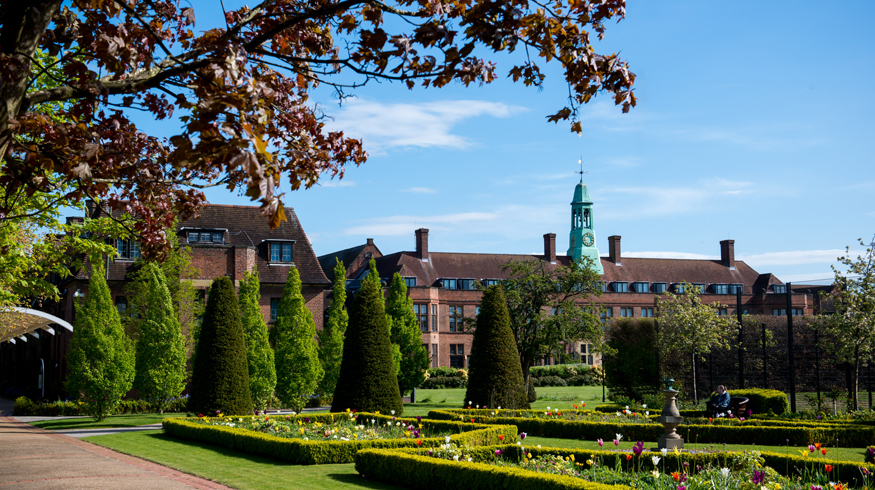
Liverpool Hope University campus

University in United Kingdom

Liverpool Hope University

Liverpool, England, United Kingdom

University profile

About Liverpool Hope University

Liverpool Hope University is an ecumenical Christian university in Liverpool, formed when three church colleges came together: the Anglican S Katharine's College (1844) and Christ's College (1964), and the Catholic Notre Dame College (1856). It is the only university foundation in Europe where Catholic and Anglican colleges have joined to form an integrated, ecumenical Christian foundation, and its philosophy is to 'educate in the round' – mind, body and spirit – in the quest for Truth, Beauty and Goodness. The name 'Hope' comes from Hope Street, which links Liverpool's Anglican and Catholic cathedrals, and graduation ceremonies alternate between the two cathedrals.

Teaching takes place on two main campuses. Hope Park, the largest, is an educational village in Childwall, a suburb about four miles from the city centre, with halls, libraries, the i3 learning resource centre, sports facilities, cafés and a shop. The Creative Campus near the city centre houses creative and performing arts, the Capstone Theatre and the Cornerstone Gallery. Aigburth Park is a residential-only campus, and Plas Caerdeon is an outdoor education centre in Snowdonia, North Wales.

Academic work is organised in nine schools:

  • Liverpool Hope Business School
  • School of Law and Criminology
  • School of Creative and Performing Arts
  • School of Humanities
  • School of Teacher Education
  • School of Education and Social Sciences
  • School of Health and Sport Sciences
  • School of Computer Science and the Environment
  • School of Psychology

Undergraduate degrees span business, law, the arts, humanities, theology, education and teacher training with QTS, social work, psychology, sport science, computer science, artificial intelligence and robotics, and many degrees are also offered with a foundation year. Postgraduate study includes MA, MSc, MBA, online PGCerts, PGCEs, MPhil, PhD and professional doctorates. Single and combined honours Psychology degrees are accredited by the British Psychological Society.

All first-year students are guaranteed accommodation on campus, with halls at Hope Park, the Creative Campus and Aigburth Park linked by a free weekday shuttle bus. Student support covers wellbeing, counselling, disability and learning support, and a Chaplaincy open to people of any faith or none. International students can enter directly or through the Liverpool Hope International Study Centre, which runs foundation, International Year One and Pre-Master's pathways at Hope Park.

Liverpool Hope gained the right to use the university title from the Privy Council in July 2005 and research degree awarding powers in 2009. It is registered with the Office for Students, is a company limited by guarantee (03285547) and a registered charity (1060579), and received a Silver rating in the Teaching Excellence Framework 2023.

University information

Tuition fees

  • Home undergraduate, 2026/27: £9,790 a year full-time (the same for students from the Isle of Man and the Channel Islands); £7,335 a year part-time.
  • Home undergraduate, 2027/28: £10,050 a year full-time.
  • International undergraduate, 2026/27: £15,225 a year.
  • Postgraduate taught, 2026/27: £8,150 to £14,175 for home students. International fees range from £16,500 to £17,500, with the MBA, MSc International Business Management and MSc Digital Marketing at £17,500 and the PGCE at £16,500. MA Social Work costs £4,200 a year.
  • Postgraduate research, 2026/27 (home, per year): £2,750 for a Professional Doctorate; £8,151 for a full-time lab-based MPhil/PhD and £5,151 for a non-lab-based one.
  • Postgraduate research, 2026/27 (EU/international, per year): £7,500 for a Professional Doctorate; £18,250 for a full-time lab-based MPhil/PhD and £15,750 for a non-lab-based one.

Undergraduate scholarships and bursaries (home students)

  • Access to Hope Scholarship: 10 scholarships of £3,000 a year for the normal length of the course, for home students starting in September 2026 who make Liverpool Hope their firm UCAS choice.
  • Liverpool Hope Sanctuary Scholarship: three scholarships, each covering the full tuition fee and accommodation for the length of the course, for undergraduate or postgraduate students who have sought refuge in the UK and cannot get student finance. Applicants must hold an offer for 2026 entry and live within commuting distance.
  • Care Leavers Bursary: for UK care leavers under 25 on full-time undergraduate degrees, and for students living in Foyer or supported housing.
  • Performance Scholarship: worth £3,000 over the course, for new home undergraduates starting in 2026/27.
  • Student Futures Internships: a bursary of up to £1,200 for a university project, open to students at all levels.

Home students can also use government tuition fee and maintenance loans through Student Finance England, Wales, Northern Ireland or SAAS. See Undergraduate scholarships.

International scholarships (2026/27 entry)

  • Hope Inspiring Futures Scholarship (undergraduate): at least £2,000 off the first-year fee, with the exact amount given in the offer letter. Students who achieve a 2:1 in year one get a further £1,000 off in year two, and another £1,000 off in year three if they keep that grade. Applied automatically with the offer.
  • Hope Inspiring Excellence Scholarship (postgraduate): £2,500 off the fee for the MBA and for the MSc in International Business Management, International Project Management, Digital Marketing Management, Data Science, Public Health, Advanced Computer Science or Artificial Intelligence.
  • Hope Inspiring Ambition Scholarship: £2,000 off any postgraduate course except PGCEs. MA Social Work students get £1,000 off in each of years one and two.
  • Early Payment Discount: £500 off for undergraduate and postgraduate applicants who pay their fees in full by 18 December for the January intake.
  • GREAT Scholarship: £10,000 for postgraduate offer holders from Ghana and Indonesia, with two awards for September 2026 entry.
  • Commonwealth Shared Scholarships: full tuition fees, return airfare and a monthly allowance for MA Disability Studies or MSc Public Health, with two awards for September 2026 entry.
  • Liverpool Hope Alumni Scholarship: fees reduced to the home rate for international students who completed a full-time Liverpool Hope undergraduate degree.

See International scholarships.

Postgraduate funding

Home students with a first or 2:1 from Liverpool Hope get 20% off postgraduate taught fees if they graduated within the last three years, or 10% if they graduated earlier. A 20% discount also applies to University of Liverpool graduates with a first or 2:1 who take the Master's in Social Work. Employer-funded courses do not qualify. Other sources of funding include:

  • the government Postgraduate Loan of up to £13,206 for Master's study
  • the Postgraduate Doctoral Loan of up to £31,122
  • Department for Education teacher training bursaries
  • the NHS Social Work Bursary
  • the Disabled Students' Allowance of up to £25,000

See Postgraduate loans and scholarships.

For questions about fees, contact [email protected] (+44 (0)151 291 3339). For questions about funding, contact [email protected].

Hope Inspiring Futures Scholarship →

GREAT Scholarship →

International Postgraduate Scholarship →

GEMS Scholarship →

Find scholarships on our site

Browse the scholarships listed for Liverpool Hope University and check each award’s eligibility.

View scholarships for Liverpool Hope University →

Undergraduate applications

All full-time undergraduate degrees are applied for through UCAS, using institution code L46 and abbreviated name LHOPE. Applications open on 1 September for entry the following autumn. The normal closing date for UK applicants is usually 15 January, although later applications may still be considered. UCAS Extra runs from 26 February to 4 July for applicants who have used all five choices without an offer. Clearing follows after that. International applicants can apply through UCAS between 1 September and 30 June. Most undergraduate degrees can also be studied part-time.

Typical offers

Entry requirements differ by course and are set out on each course page. For example, single honours Psychology asks for BBB at A level or 120 UCAS Tariff points from at least two A levels, BTEC DDM, IB 26 points, Access to HE with 120 Tariff points, or a T Level at Merit, plus GCSE Mathematics at grade C/4. Combined honours Psychology asks for BBC, 112 points or BTEC DMM. Degrees with a Foundation Year suit applicants without the qualifications for direct entry, those who want to try university before choosing a subject, and those returning to study after time away.

Admissions policy

Each application is assessed on its own merits, mainly on qualifications and the applicant's goals for their chosen course. Some degrees require an Enhanced Disclosure and Barring Service check. Recognition of Prior Learning can give credit for earlier study, and an Applicant Appeals and Complaints Procedure is available.

International applicants

International undergraduates and MA Social Work applicants (UCAS course code L501) apply through UCAS. PGCE applicants apply through the Department for Education. Country-specific entry requirements are set out on the 'Your country / region' pages. The Liverpool Hope International Study Centre at Hope Park offers an International Foundation Programme, International Year One and a Pre-Master's programme. Applicants from Bangladesh, Ghana, Pakistan, parts of northern India, Iran, Nepal, Nigeria and Sri Lanka face additional requirements and enhanced checks, and a CAS may not be issued in every case, so they are advised to contact Admissions before applying.

Deadlines for the January 2027 intake, for students who need a visa:

  • Applications: 20 November 2026
  • Evidence that conditions have been met, and deposit received: 30 November 2026
  • Target CAS issue: 9 December 2026
  • Induction and teaching start: 11 January 2027
  • Latest enrolment: 27 January 2027

Deadlines for PGCE and MA Social Work are earlier.

English language requirements

Students on the Student Route must reach CEFR level B2 for degree-level study, and test results must be no more than two years old by the start date. Typical minimums:

  • IELTS: 6.0 with 5.5 in each component (undergraduate); 6.5 with 6.0 in each component (postgraduate). IELTS Online is not accepted.
  • Pearson (PTE): 59 with 59 in each component (undergraduate); 64 with 60 in each (postgraduate).
  • LanguageCert Academic: 65 with 33 in each component (undergraduate); 70 with 65 in each (postgraduate).
  • Oxford ELLT: 6 with 5 in each component (undergraduate); 7 with 6 in each (postgraduate).
  • Cambridge English: 169 with 162 in each component (undergraduate); 176 with 169 in each (postgraduate).

TOEFL iBT, the Kaplan Test of English, the Oxford Test of English, Trinity ISE and Euroexams are also accepted, as are GCSE English Language at C/4, IGCSE English at C and IB English at 4 or above. Nationals of majority English-speaking countries and Canada are exempt. Some courses require higher scores for accreditation.

Postgraduate taught

Master's applications are made through the university's online Apply system, with a passport copy, academic qualifications, English language evidence, any previous UK visas and a personal statement. For January 2027, applicants who do not need a visa must apply by 14 January 2027 at 5pm GMT. MA Social Work applications go through UCAS, PGCE and School Direct applications go through the Department for Education, and online courses have their own application routes.

Postgraduate research

PhD applicants normally need a Master's degree, although applicants with a 2:1 Bachelor's degree may be considered. MPhil applicants need a 2:1 or above. All research applicants must pass a doctoral research interview. Professional Doctorate applicants normally need at least a second-class honours degree and three years of relevant professional experience. Applicants whose first language is not English need IELTS 6.5 with 6.0 in each component. Applicants should contact the relevant academic school first to confirm that their proposal fits its research areas and that supervision is available.

  • Hope Park, Childwall, Liverpool (L16 9JD) – the main teaching campus, about four miles from the city centre. Facilities include the i3 building (a learning resource centre), the library with the Sheppard-Worlock Library's Special Collections and Archives, first-year halls, the Eden Building Chaplaincy, cafés including Starbucks and Caffe Nero, a shop and a launderette. The Health and Sports Science Avenue holds the Health Sciences Building and Hope Park Sports.
  • Hope Park Sports – a fitness suite, strength and conditioning suite, six-court sports hall, dance studio, two squash courts, a full-size 3G pitch, an astro pitch, outdoor tennis and netball courts, and a Physiotherapy and Sport Rehabilitation Clinic. Student membership costs £30 a year and runs from 1 September to 31 August.
  • Creative Campus, Liverpool city centre – home of the School of Creative and Performing Arts, in Grade II-listed buildings alongside a purpose-built Arts Centre with Fine Art studios, a film viewing gallery and exhibition space. It includes the Capstone Theatre (also home to the Music department), the Cornerstone Gallery and studios, kilns, workshops and metalwork studios, two libraries and a Reading Room, a Student Success Zone open 24 hours in term time, Café 1846, a launderette and Gerard Manley Hopkins Hall.
  • Aigburth Park, Liverpool – a residential campus about three miles from the city centre and Hope Park, near Sefton Park. It has two halls, St Michael's and St Julie's, with a computer area, internet in all rooms, a launderette, on-site pastoral care and welfare support, and a common room. Accommodation here is for continuing, postgraduate and international students.
  • Plas Caerdeon, Snowdonia National Park, North Wales – an outdoor education centre on 18 acres of woodland overlooking the Mawddach Estuary. It runs residential outdoor activity courses, supports fieldwork and research, and has self-catering cottages. It is a member of the Association of Heads of Outdoor Education Centres.

A free weekday shuttle bus runs between Hope Park, the Creative Campus and Aigburth Park during peak term times.

Explore Study Programmes

Study programmes offered at Liverpool Hope University.

Accounting & Finance BA (Hons)
Bachelor'sUnited Kingdom
 
Acting BA (Hons)
Bachelor'sUnited Kingdom
 
Advanced Computer Science (MSc)
Master'sUnited KingdomIntake : September 2027
 
Advanced Mentoring and Coaching (MA)
Master'sUnited Kingdom
 
Advanced Mentoring and Coaching (PGCert)
PostgraduateUnited KingdomIntake : September 2027
 
Advanced Musculoskeletal (MSK) Practice (MSc)
Master'sUnited KingdomIntake : January 2027 & September 2027
 
Applied Developmental Psychology (MSc)
Master'sUnited KingdomIntake : September 2027
 
Artificial Intelligence (MSc)
Master'sUnited Kingdom
 
Artificial Intelligence BSc (Hons)
Bachelor'sUnited Kingdom
 
Business Management BA (Hons)
Bachelor'sUnited Kingdom
 
Business Sustainability (MSc)
Master'sUnited KingdomIntake : September 2027
 
Catholic Pastoral Leadership (PG Cert online)
PostgraduateUnited KingdomIntake : January 2027 & September 2027
 

Student Reviews

Experiences shared by students of Liverpool Hope University.

No student reviews yet

Studied here? Share your experience to help other applicants.

Sign in to write a review →

Ready to start your study abroad journey?

Book a free consultation with our expert counsellors and take the first step towards your dream university.

Copyrights © 2026 StudyMapped. All rights reserved.