
University in Germany
Leipzig, Sachsen, Germany
University profile
Leipzig University (Universität Leipzig) was founded in 1409 and is one of the oldest universities in Germany. It is a public comprehensive university and a member of the German U15 network, covering subjects from the humanities and social sciences to the natural sciences, life sciences and medicine. It is the most popular institution of higher education in the Free State of Saxony, with 31,232 students in 2025 and 152 degree programmes.
The university has 14 faculties: Theology, Law, History, Art and Area Studies, Philology, Education, Social Sciences and Philosophy, Economics and Management Science, Sport Science, Mathematics and Computer Science, Life Sciences, Physics and Earth System Sciences, Chemistry, Veterinary Medicine, and Medicine. Together they include more than 130 institutes and centres, alongside 21 central institutions. Law, medicine, teaching and pharmacy are especially prominent, with more than a third of students enrolled in these subjects.
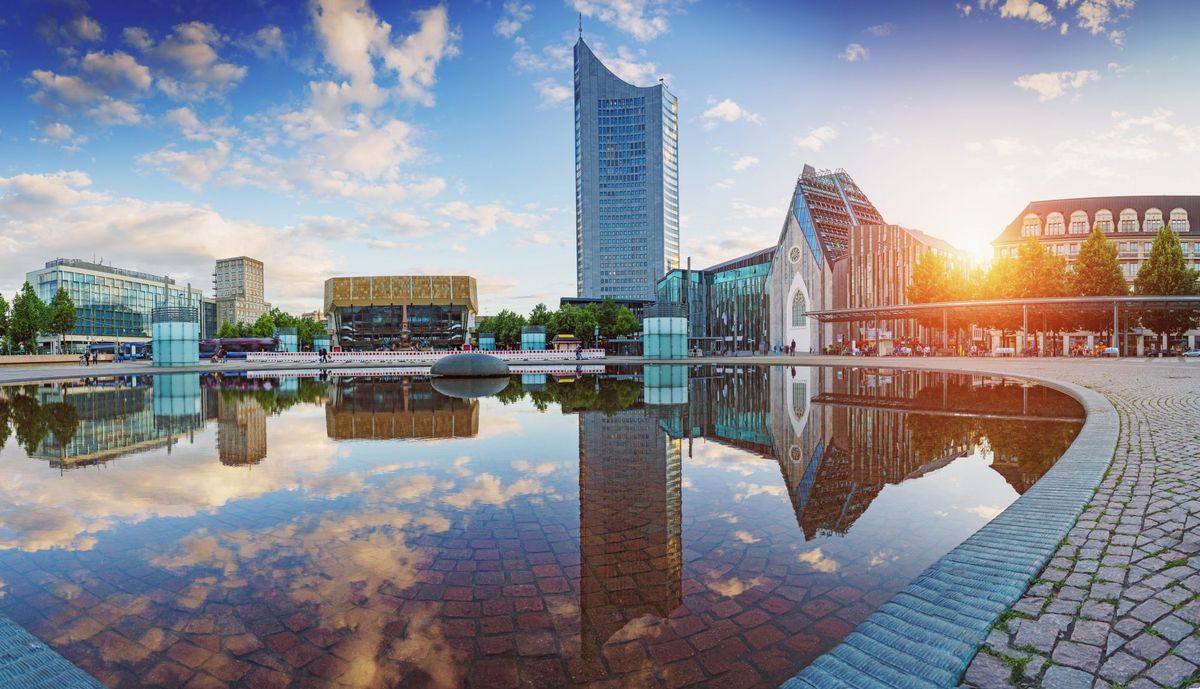
Its main campus lies on Augustusplatz in the centre of the city, where the Neues Augusteum and the Paulinum (Assembly Hall and University Church of St Paul) are landmark buildings. Other faculty buildings are spread across Leipzig, for example Chemistry on Johannisallee, Life Sciences on Talstraße, Law at the Juridicum on Burgstraße and Medicine around Liebigstraße. The University Library (including the Bibliotheca Albertina), the university archives, art collections, the oldest botanical garden in Germany, three museums and teaching collections are part of the university, as are the University Orchestra, University Choir and Unibigband.
Research is organised in three core domains with five areas of excellence: Modern Diseases, Integrative Biodiversity, Life:Earth:Humans, Global Dynamics, and Data Science and AI. The Leipzig Center of Metabolism (LeiCeM) is a Cluster of Excellence, and the university works closely with Max Planck, Fraunhofer, Leibniz and Helmholtz institutes in the Leipzig Science Network.
In 2025, 3,699 students (11.8 per cent) were international, with China, Ukraine, Russia, India and Vietnam the largest countries of origin. The Studienkolleg Sachsen, hosted at the university, offers a one-year preparatory course, and 39 degree programmes are international. The university is a member of the Arqus European University Alliance and the Utrecht Network, and has bilateral agreements with around 50 universities abroad. It is a public body under the supervision of the Saxon State Ministry for Science and the Arts.
The semester fee for winter semester 2026/27 is EUR 332.30: student body EUR 11.50, Studentenwerk Leipzig EUR 90, Semester Deutschlandticket EUR 226.80 and mobility fund EUR 4. This is the Semesterbeitrag, not tuition. Newly enrolled students pay an additional one-time EUR 10 for the UniCard. Re-enrolment is by payment of the fee: 1 June to 15 August for the winter semester and 1 December to 15 February for the summer semester.
The Deutschlandstipendium pays EUR 300 per month, funded equally by the Federal Government and private sponsors. It is open to existing and new students showing talent and performance as well as social commitment and personal circumstances, is awarded for at least two semesters and no longer than the standard period of study, is not deducted from BAföG and is tax-free. Faculty award committees select recipients. See the official Deutschlandstipendium page.
The university's scholarships page points to political, religious and economic foundations, the Studienstiftung des deutschen Volkes and the Hans Böckler Foundation. BAföG advice is provided by the Studentenwerk Leipzig. Doctoral candidates can use state postgraduate scholarships, re-entry scholarships and the Sylff programme, and Erasmus+ scholarships support exchange students.
Browse the scholarships listed for Leipzig University and check each award’s eligibility.
View scholarships for Leipzig University →Applicants need a direct higher education entrance qualification (HZB) recognised for German universities, which can be checked in the Anabin or DAAD admission databases. A Feststellungsprüfung certificate must qualify for all universities, not only universities of applied sciences. Applicants with an indirect HZB can attend the one-year Studienkolleg Sachsen. The TestAS aptitude test can improve the HZB mark by up to 0.4 points if both modules are passed with excellent results. Some programmes require an aptitude test.
Applicants with international qualifications or a Studienkolleg certificate apply through the uni-assist portal; others apply through the university's AlmaWeb portal. Up to two programmes can be applied for, only one of them without admission restrictions. Winter semester, programmes with admission restrictions: beginning of April (uni-assist) or beginning of May (AlmaWeb) to 15 July; without restrictions: to 1 September. Summer semester: beginning of November to 15 January (with restrictions) or 1 March (without). Documents in languages other than English must be submitted with a certified translation into German or English.
German-taught programmes require DSH-2 or an equivalent: TestDaF TDN 4 in all categories, DSD II, Goethe-Zertifikat C2 (Grosses Deutsches Sprachdiplom), Feststellungsprüfung, interDaF C1 level 2, ÖSD C2 or telc Deutsch C1 Hochschule. For most programmes, German at B2 level is sufficient at application and the recognised certificate is required by enrolment; for Medicine, Dentistry, Pharmacy and Veterinary Medicine it is required by the application deadline. English-taught programmes require English at CEFR B2, with details in the courses of study overview.
The one-year preparatory course requires an indirect HZB and German at B1 or better (for example DSD II, DSH-1, Goethe-Zertifikat B2, telc B2, TestDaF TDN 3). Applications run through uni-assist: beginning of April to 15 June for the winter semester and beginning of November to 15 December for the summer semester. Admission is followed by an entrance exam, and the course ends with the Feststellungsprüfung. Typically 20 places are available in each Schwerpunktkurs per semester.
A recognised first university degree, for example a bachelor's degree, is required by enrolment. Most master's programmes require an aptitude test (EFP) or a review of subject-specific admission requirements (FZV) based on transcripts, work samples or interviews. German-taught programmes need DSH-2 or equivalent (B2 sufficient at application); English-taught programmes need B2 English. Applicants with international degrees apply through uni-assist; those with a German first degree use AlmaWeb. International degree holders: restricted programmes and applicants from non-EU/EEA countries apply from beginning of April to 31 May (winter) and beginning of November to 31 December (summer); unrestricted programmes for EU/EEA applicants run to 1 September and 1 March. Documents include school certificate, degree certificates, transcript of records, grading system, language proof, CV in German or English and, for applicants from China, India or Vietnam, the APS certificate. Several programmes (such as Global Studies, European Studies and Sustainable Development) have their own procedures.
Doctorates are possible in all subjects, independently or in structured or binational programmes, with a supervisor and a supervision agreement recommended for all doctoral candidates. The Graduate Academy and the Leipzig Research Academy provide support and qualification programmes.
Students from outside the EU/EEA need a student visa and must not enter on a tourist visa. Proof of statutory health insurance is required, and newly enrolled students enrol in person and pay the semester fee, plus a one-off EUR 10 for the UniCard.
Leipzig University is based in the city of Leipzig, with a large central campus on Augustusplatz that includes the Neues Augusteum and the Paulinum. Faculties and institutes are located at sites across the city:
Facilities include the University Library (Universitätsbibliothek Leipzig, with the Bibliotheca Albertina), university archives, art collections, Germany's oldest botanical garden, three museums and teaching collections. The UniCard serves as student ID, library card and, with the semester fee, the Deutschland-Semesterticket. Student halls of residence are run by Studentenwerk Leipzig at addresses across the city, such as Arno-Nitzsche-Straße, Mainzer Straße and Straße des 18. Oktober.
Experiences shared by students of Leipzig University.
Studied here? Share your experience to help other applicants.

Book a free consultation with our expert counsellors and take the first step towards your dream university.
Copyrights © 2026 StudyMapped. All rights reserved.

Enter your credentials to continue.
Join us and start your study abroad journey.


