
University in United Kingdom · Featured · Top university
London, England, United Kingdom
University profile
King's College London is a public research university in central London, founded in 1829 under a royal charter granted by King George IV, with the Duke of Wellington among its founders. It was one of the two founding colleges of the University of London in 1836 and remains part of the University, while holding financial and academic autonomy since 1994 and awarding its own degrees since 2008. The university has more than 42,000 students and over 300,000 alumni, and 14 people from King's and its associated institutions have been awarded the Nobel Prize.
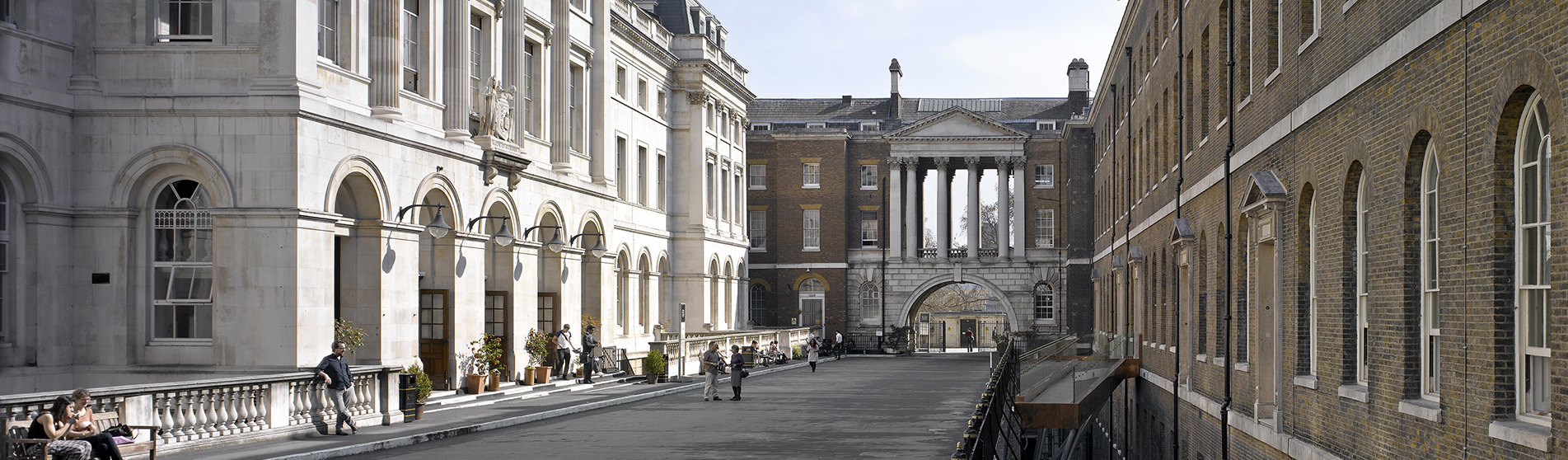
Teaching and research take place across five London campuses: four beside the River Thames (Strand, Waterloo, Guy's and St Thomas') and a fifth at Denmark Hill in Camberwell. The health campuses sit alongside Guy's, St Thomas' and King's College hospitals, and a staff and student shuttle bus links the Guy's and St Thomas' sites.
Academic work is organised in nine faculties:
King's has a long international reputation in the humanities, law, science, psychiatry, medicine, dentistry, nursing and the social sciences. The nursing faculty descends directly from the world's first professional school of nursing, founded by Florence Nightingale in 1860, and the Institute of Psychiatry, Psychology & Neuroscience is closely associated with the South London and Maudsley NHS Trust. Undergraduates choose from over 180 courses, and the King's Language Centre teaches 27 languages from beginner to near-native level.
The university runs 14 residences of its own, and students can also apply to five University of London intercollegiate halls; undergraduate residences have the Resilife social programme and postgraduate residences the GradPlus programme. Student services include counselling, disability support, money and housing advice, an NHS health centre and the King's Edge extracurricular programme, the King's Start-up Accelerator and volunteering.
The student community includes more than 18,000 international students, and over 190 countries are represented across students and staff. International applicants without qualifications accepted for direct entry can take the one-year King's International Foundation programme, which has four subject pathways leading to King's degrees, and the university runs a Visas & International Student Advice service.
Home undergraduate tuition fees are £9,790 for new students starting in September 2026. Students from the EU, EEA or Switzerland starting in 2021 or later pay the international (overseas) rate. International undergraduate fees and all postgraduate fees vary by course and are listed on each course page; fees for continuing overseas students may rise by no more than 7% a year (or the previous November's CPI rate if higher).
Full-time home undergraduates (and PGCE students) assessed by Student Finance with a household income of £42,875 or less receive a non-repayable bursary each year without applying. For students starting in 2025/26 or 2026/27: £2,000 for household income of £25,000 or less, £1,900 for £25,001 to £33,500, and £1,600 for £33,501 to £42,875. Eligibility is checked automatically, with students contacted by the end of November 2026 and later assessments running until 30 June 2027. King's Living Bursary 2026-27
The King's Doctoral College administers studentships and bursaries for master's and doctoral programmes. These include King's Joint PhD Scholarships (full tuition fees, stipend and an annual research grant) for joint PhDs with the University of Hong Kong, National University of Singapore or University of São Paulo, King's China Council Scholarships with the China Scholarship Council, and Harold Moody PGR Studentships. UK Postgraduate Master's Loans of up to £13,206 and Doctoral Loans of up to £31,122 are available for courses starting on or after 1 August 2026. Most King's funding deadlines fall early in the year, around February. Scholarships and studentships
Chevening Scholars at King's receive 20% cover of their tuition fees from King's. Chevening Scholarships at King's
All scholarships and bursaries for UK and international students are listed in the King's funding database, and the Student Funding Office ([email protected]) advises prospective and current students. King's funding opportunities
King's Business School Global Scholarships →
King's-China Scholarship Council PhD Scholarship (K-CSC) →
King's College London Marshall Scholarship →
Internationally Qualified Sonographer Scholarship (Clinical Ultrasound PgCert) →
Browse the scholarships listed for King's College London and check each award’s eligibility.
View scholarships for King's College London →All applicants for full-time undergraduate courses apply through UCAS, either through a school or college or as an individual. Applications open on 1 September for entry the following autumn. For 2027 entry the deadline is 13 January 2027 at 18:00 (UK time), and 15 October 2026 at 18:00 for Medicine and Dentistry; applications received after these dates are treated as late, including from international students. Applicants may choose up to five courses, no more than four of them in Medicine or Dentistry. After applying, applicants also receive a King's Apply account for tracking and messages. The International Foundation programme, post-qualification nursing courses and medical electives are applied for directly through King's Apply.
Entry requirements vary by course and are set out on each course page, including international equivalents by country. Conditional offers are based on three A-levels; where four or more are taken, the best three grades are considered, and AS-levels are not considered for most programmes. King's does not use UCAS tariff points, expressing requirements as qualifications and grades instead. A-level/BTEC combinations, the International Baccalaureate, Scottish Highers and Advanced Highers, T levels, Access to HE Diplomas and other qualifications are considered, with some combinations of level 3 qualifications assessed case by case.
UK-based undergraduate applicants who have completed the K+ widening participation programme, received free school meals, or are care-experienced or estranged may receive contextual offers up to two A-level grades (or equivalent) below the advertised requirements. Applicants close to the interview or admissions test threshold may be offered an interview or an offer, and those who narrowly miss their conditional offer receive additional consideration. Evidence is submitted through King's Apply after the UCAS application.
Courses are placed in English bands. Test results must come from a single sitting and be dated within two years of the course start:
Nationals of listed majority English-speaking countries who have completed an A-level-equivalent qualification in such a country do not need a separate test. Applicants who need a Student visa must use tests from the visa-approved sections of the list.
Students whose national school qualifications are not accepted for direct entry can take the one-year King's International Foundation programme, with pathways in Health, Life & Biosciences; STEM & Natural Sciences; Politics, Culture & Social Sciences; and Business & Economics. Students who meet the progression requirements receive two guaranteed offers to King's degrees. Entry requires IELTS for UKVI (Academic) 6.0 overall with no skill below 5.5 (PTE Academic UKVI 59, minimum 54 in each skill); the Extended International Foundation takes students from 5.5 overall with no skill below 5.0.
Applications are made through the King's Apply portal (PGCE applicants apply through DfE Apply). Applications usually include transcripts with official English translations, one referee contact, English language evidence and a personal statement. For September 2027 entry, applications open in mid-October 2026; the initial deadline for most courses is March 2027, with final deadlines in July 2027 for overseas fee status applicants and August 2027 for home fee status applicants where courses remain open. Some courses require Occupational Health, DBS or ATAS clearance. English requirements range from IELTS Academic 6.5 overall with 6.0 in each skill (Band D) to 7.0 overall with 6.5 in each skill (Band B).
Doctoral applicants apply to a specific PhD programme, whose opening and closing dates and intakes vary. Science, medicine and engineering applicants usually apply for pre-defined, often funded projects, while arts, humanities and social sciences applicants usually develop their own research proposal. UK applicants are advised to apply at least two months, and international applicants at least four months, before the programme deadline.
International postgraduate taught applicants receive their CAS number only after accepting an unconditional offer.
Residences: King's residences include Angel Lane, Atlas, Battersea, Canada Water, City (postgraduate only), Great Dover Street, Hayloft Point, Julian Markham, Moonraker Point, Orchard Lisle and Iris Brook, Stamford Street Apartments, Vauxhall (postgraduate only), Vega and Wolfson House, alongside five University of London intercollegiate halls. Rooms are offered to students who have made King's their firm choice, and a King's Affordable Accommodation Scheme operates in some residences.
Other facilities: an NHS Health Centre for students, counselling and disability services, parenting rooms and prayer rooms on every campus, and student access to Senate House Library and the British Library.
Reasons students choose King's College London for their study abroad journey.
Study programmes offered at King's College London.
Experiences shared by students of King's College London.
Studied here? Share your experience to help other applicants.
A glimpse of campus life and the academic environment.




Book a free consultation with our expert counsellors and take the first step towards your dream university.
Copyrights © 2026 StudyMapped. All rights reserved.

Enter your credentials to continue.
Join us and start your study abroad journey.


