
University in Germany
Karlsruhe, Baden-Württemberg, Germany
University profile
The Karlsruhe Institute of Technology (KIT) is a public corporation in Karlsruhe, Baden-Württemberg, formed on 1 October 2009 by the merger of the Universität Karlsruhe (TH), founded in 1825, and Forschungszentrum Karlsruhe, founded in 1956. It describes itself as The University in the Helmholtz Association and combines university teaching with a large national research centre. KIT is one of Germany's Universities of Excellence, a status confirmed in the 2019 Excellence Strategy competition. In winter semester 2025/2026 it had 23,083 students, and in 2025 it employed 10,131 people, including 424 professors.
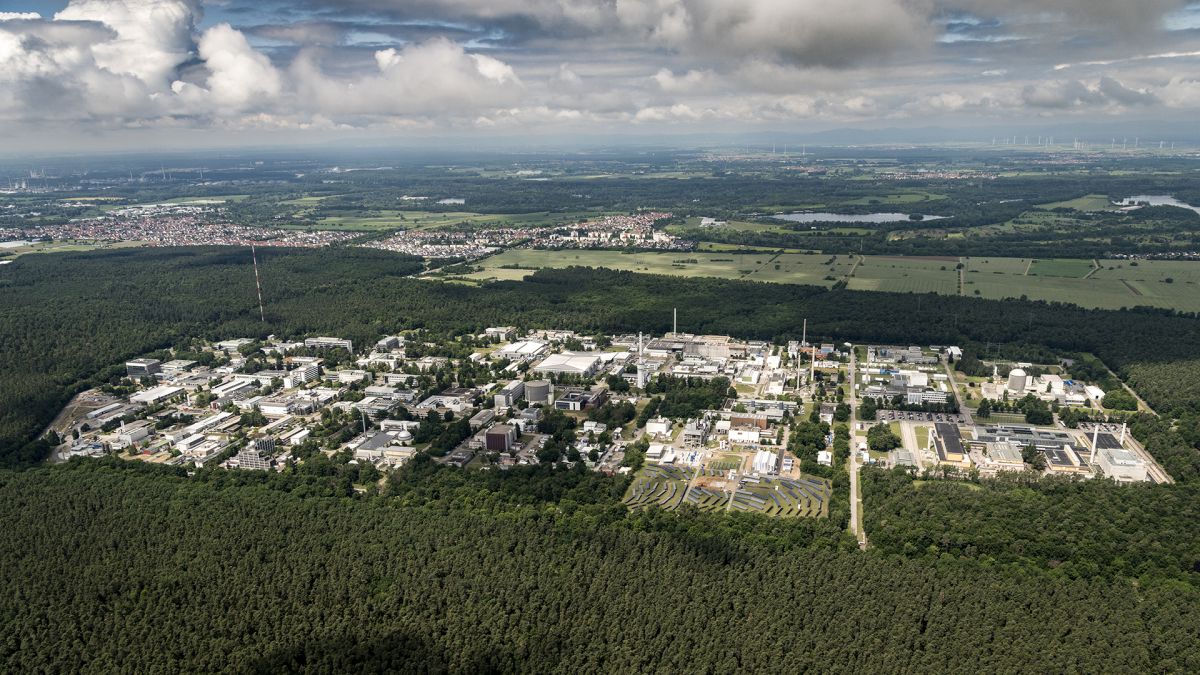
KIT is spread across several sites. Campus South lies in the centre of Karlsruhe at Kaiserstraße 12, while Campus North, the former research centre, is about 10 km away near Eggenstein-Leopoldshafen. Campus East and Campus West are further sites in Karlsruhe, and KIT also has locations in Garmisch-Partenkirchen, Ulm and Dresden.
Teaching is organised in eleven KIT departments: Architecture; Civil Engineering, Geo- and Environmental Sciences; Chemistry and Biosciences; Chemical and Process Engineering; Electrical Engineering and Information Technology; Humanities and Social Sciences; Informatics; Mechanical Engineering; Mathematics; Physics; and Business and Economics. Research and innovation work is grouped into five divisions (Biology, Chemistry and Process Engineering; Informatics, Economics and Society; Mechanical and Electrical Engineering; Natural and Built Environment; Physics and Mathematics) and nine KIT Centers, from Energy and Mobility Systems to Health Technologies and Mathematics in Sciences, Engineering and Economics.
Engineering sciences account for the largest share of students (14,238 of 23,083 in winter semester 2025/2026), followed by mathematics and natural sciences (4,167), economics (2,936), arts (834), social sciences and sports (638) and other courses (270). In the same semester KIT offered 45 undergraduate bachelor's programmes, 61 consecutive master's programmes and 6 master's programmes offering additional training. Degrees awarded are the Bachelor and Master of Science, Education and Arts.
More than 40,000 students live and study in Karlsruhe, over half of them at KIT. Student life includes the student union (AStA), student parliament, departmental student representations (Fachschaften), cultural groups, and KIT University Sports with more than 300 courses and a fitness studio. Housing is mainly through the Studierendenwerk Karlsruhe, and the Hans Dickmann Kolleg (HaDiKo) offers 999 rooms. International applicants are served by the International Students Office, an International Student Hub, a Buddy Program and a Pre-Arrival Course. KIT is a corporation governed by public law.
Every student pays general fees each semester (the Semesterbeitrag, not tuition): an administrative charge of EUR 80, a Studierendenwerk charge of EUR 92 and a Students Union charge of EUR 12. Doctoral researchers pay the same three charges, a total of EUR 184 per semester.
Under the Baden-Württemberg Act on State University Fees (LHGebG), international students from non-EU countries in bachelor's, teacher's and consecutive master's programmes, and free movers, pay tuition of EUR 1,500 per semester, giving EUR 1,684 including the general fees. Exemptions apply to EU/EEA citizens, holders of a German Abitur gained in Germany or at a German school abroad, students under partner and exchange programmes, doctoral students, holders of a Baden-Württemberg Stiftung scholarship, students with established living conditions in Germany, students who completed a bachelor's and consecutive master's in Germany, and certain refugees. A second-degree fee of EUR 650 per semester applies to second-degree students. Information: tuition fees and general fees.
The International Students Office offers a one-time grant from DAAD STIBET I funds and the Baden-Württemberg Internationalisation Funds to international students in unforeseen, temporary financial distress who are registered for their graduation thesis. Applicants should have performed well (at least 2.5), work part-time or explain why not, and be in the last stage of study. The aid is granted once for up to 6 months, at least EUR 250 per month. A tax ID is needed. 2026 deadlines: 1 February, 1 April, 1 June, 1 September and 15 October. Applications go to finaid at intl.kit.edu. See financial aid.
All students of any nationality, enrolled at KIT or about to start, can apply for EUR 300 per month for one year (half from the state and half from private sponsors), regardless of income. Selection weighs academic or school achievement, social commitment and personal circumstances. The 2026 application phase ran from 13 to 30 April; the next period is 14 to 29 April 2027, with decisions in October and November. Details: Deutschlandstipendium at KIT.
KIT lists further support through the Career Service, the AStA emergency aid, the Studierendenwerk solidarity fund, the KIT Foundation and religious student communities. Doctoral researchers are usually funded through a research assistant post at KIT, a doctoral programme or a scholarship; see the KHYS basic funding page.
Deutschlandstipendium at KIT →
KIT Graduation Grant for International Students (DAAD STIBET I and MWK funds) →
KIT Foundation Scholarships for Students in Special Life Situations →
Browse the scholarships listed for Karlsruhe Institute of Technology (KIT) and check each award’s eligibility.
View scholarships for Karlsruhe Institute of Technology (KIT) →Applicants need a higher education entrance qualification (Hochschulzugangsberechtigung): the Abitur (allgemeine Hochschulreife) allows any degree programme, while a subject-linked qualification (fachgebundene Hochschulreife) allows only selected programmes. Professionally qualified applicants holding a master craftsperson certificate or equivalent are treated as equal to holders of an entrance qualification. For international applicants, many school-leaving certificates need further proof such as a university entrance examination, successful university study at home, or the German assessment test (Feststellungsprüfung, FSP) taken at a Studienkolleg. Holders of a foreign bachelor's degree usually qualify for all subjects. Country rules are checked against the DAAD admission database and Anabin.
Applicants from outside the EU/EEA apply through the International Students Office via the online portal, and EU/EEA applicants, German applicants with foreign certificates and international applicants holding a German Abitur apply through the Studierendenservice. Programmes with restricted admission (NC) also require registration at hochschulstart.de. Some programmes have aptitude requirements: a subject-specific task for Architecture, a sport entry exam for Sportwissenschaft, and selection interviews for Chemistry.
Bachelor, non-EU applicants: 15 July for the winter semester (first semester entry is winter only); 15 January for the summer semester applies to higher semesters, the Studienkolleg German course and the FSP preparatory course. German and EU applicants: 15 July for limited-capacity bachelor programmes and 15 September for programmes without limits (winter semester); for higher semesters, 15 January (limited) and 15 March (unrestricted) for the summer semester. Master: 15 July winter and 15 January summer for limited-capacity programmes, and 30 September winter and 31 March summer for programmes without limits, for EU and non-EU applicants alike. The deadlines are preclusive and some programmes set their own. The online portal opens about six weeks before the deadline, with winter semester portals opening on 15 May and summer semester portals on 1 December.
Applicants who did not gain their entrance qualification in Germany must prove German proficiency. For application to a German-taught bachelor's programme, level B1 is needed; enrolment requires DSH-2 (HRK-accredited) or an equivalent: TestDaF with at least 4x4 (TDN 4 in all parts), the German test of the Studienkolleg Feststellungsprüfung, Goethe Certificate C2, DSD II, or telc Deutsch C1 Hochschule. Exemptions apply to holders of certain secondary school diplomas from Luxembourg, the German-speaking community of Belgium and South Tyrol, graduates of bilingual German secondary schools, and graduates of German schools abroad. A German course at the KIT Studienkolleg is available for applicants who do not yet meet the requirement; it lasts a full semester and a new application for the degree programme is needed afterwards.
Applicants need a recognised first degree and apply through the online portal of the International Students Office or Studierendenservice as described above. Documents include the bachelor's certificate and official translation, transcript of records, module descriptions for the mandatory courses named in the programme details, and, for some programmes, internship certificates, a motivation letter or recommendation letters. Each programme sets its own minimum requirements and the decision rests on the content of the previous studies and grades; some programmes require GRE or GATE/GMAT, and several have restricted admission (NC). Applicants from China, Vietnam and India must submit an original APS certificate (group certificates are not accepted).
English-taught master's programmes usually accept TOEFL iBT with a minimum of 90, IELTS Academic 6.5 with no section below 5.5, Cambridge CAE or CPE, UNIcert level II or higher, or a university degree taught only in English; some programmes set different requirements.
Admission to a doctorate follows the doctoral regulations of the respective KIT department. As a rule, applicants need a diploma, Magister, master's or state examination from a German university or an equivalent foreign degree, with a good to very good result expected. Special admission rules exist for highly qualified bachelor's degree holders, and the Doctoral Admissions Committee checks the degree. Language requirements are agreed with the supervisor; a very good command of English is expected, though TOEFL or IELTS is not usually required, and German is recommended.
Admitted applicants must accept the study place in the application portal, otherwise the place goes to other applicants; original documents are presented at enrolment.
A KIT shuttle links Campus North, Campus East and Campus South. The KIT Library has branches including Campus North and Campus South, and KIT University Sports runs sports facilities and more than 300 courses. Student housing includes the Hans Dickmann Kolleg (HaDiKo) with 999 rooms, as well as Studierendenwerk residences.
Study programmes offered at Karlsruhe Institute of Technology (KIT).
Experiences shared by students of Karlsruhe Institute of Technology (KIT).
Studied here? Share your experience to help other applicants.

Book a free consultation with our expert counsellors and take the first step towards your dream university.
Copyrights © 2026 StudyMapped. All rights reserved.

Enter your credentials to continue.
Join us and start your study abroad journey.


