
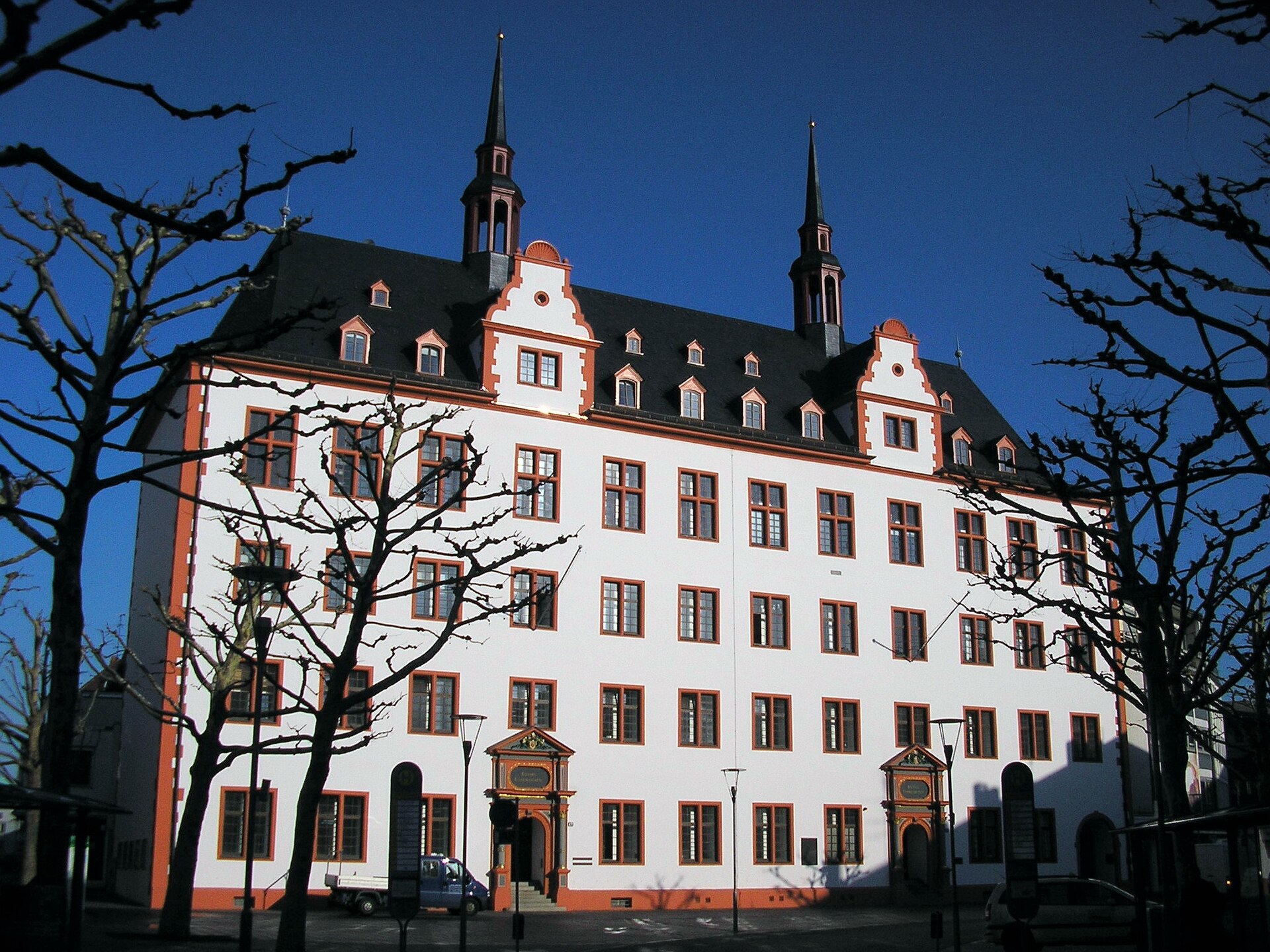

University in Germany
Mainz, Rheinland-Pfalz, Germany
University profile
Johannes Gutenberg University Mainz (JGU) is a large comprehensive university in Mainz, the capital of Rhineland-Palatinate. It was founded in 1477, closed in the wake of the French Revolution wars and reopened in May 1946 under the name of the city's most famous son, Johannes Gutenberg, the inventor of printing with movable type. More than 35,000 staff and students from over 120 nations work and study at JGU, with around 30,000 students enrolled.
Research, teaching and knowledge transfer are organised in ten faculties and two schools of the arts, covering nearly the whole range of academic disciplines through about 75 subjects and some 259 degree programmes:
JGU is one of the few campus universities in Germany: nearly all institutes sit on the Gutenberg Campus close to the city centre, together with teaching and research buildings, student residences, day-care centres, sports facilities, cafes and canteens, the University Library and the Botanic Garden. The University Medical Center and the Germersheim campus are the main sites away from it. The university runs a TRIGA research reactor and a number of central institutions, among them the Gutenberg Research College, the Gutenberg Graduate School of the Humanities and Social Sciences, the Data Center and the International Preparatory and Language Center (ISSK).
Student life includes more than 70 University Sports courses, theatre groups, a university choir and orchestra, CampusTV and Campusradio, the Studium Generale and supplementary qualifications. Rooms in student residences managed by the Studierendenwerk Mainz can be applied for in advance, and an enrolment certificate is needed to move in. The Welcome Week for new international students takes place before the regular introduction week.
Around 4,500 international students from more than 130 countries are enrolled. JGU belongs to the Rhine-Main Universities alliance with Goethe University Frankfurt and the Technical University of Darmstadt, to the U15 group of research-intensive German universities and to the FORTHEM European University alliance, and it states about 1,000 collaborations with more than 500 partner universities. JGU is a state university of Rhineland-Palatinate; its first degree programmes are tuition-free.
The first degree at JGU is tuition-free, and from the winter semester 2025/26 second degree courses are generally free as well. Tuition of 700 euros per semester and degree programme is charged only to students who begin their studies after turning 60 or turn 60 during them. Every student pays a semester contribution (Semesterbeitrag), which is not tuition and does not go to the university: it funds the semester ticket for regional transport and contributions to the Studierendenwerk, the student body committee, University Sports and the AStA hardship funds. For the winter semester 2026/27 it is 366.90 euros at the Mainz campus, 389.80 euros at Germersheim and 378.80 euros at the Trier Medical Campus; for the summer semester 2026 it was 349.10, 371.80 and 360.80 euros respectively. Late re-registration costs 25 euros. Monthly living costs of 1,000 to 1,200 euros are advised, with rooms near the university at 320 to 450 euros.
Students with excellent achievements who are also socially engaged can apply for the Deutschlandstipendium, open to international students too. Recipients receive 300 euros per month for a year, funded equally by a sponsor and the Federal Ministry of Education and Research. Details: Deutschlandstipendium at JGU.
The Excellence Track programme supports physics students beginning their Master's degree with 934 euros per month for a maximum of two years.
The DAAD scholarship for finishing a degree and its funding for volunteer work are managed on site at JGU ([email protected]). Further funding routes include the DAAD scholarship database, BAföG advice through the Office for Educational Support, the Master Plus programme of the Claussen-Simon-Stiftung, and scholarships for early-career researchers and artists for JGU doctoral students. The Studierendenwerk Mainz provides an emergency fund for international students, graduation loans and a loan office, and the AStA offers a semester ticket subsidy and interest-free loans. See Financial matters at JGU.
Deutschlandstipendium at Johannes Gutenberg University Mainz →
AStA Student Hardship Fund (Studentischer Hilfsfonds), JGU Mainz →
Rhineland-Palatinate Scholarship Foundation Funds at JGU (Stipendienstiftung RLP) →
Browse the scholarships listed for Johannes Gutenberg University Mainz and check each award’s eligibility.
View scholarships for Johannes Gutenberg University Mainz →Citizens of EU or EEA states, holders of a German Abitur or German university degree, and holders of a European Baccalaureate with an officially converted grade do not need to apply as international applicants. Everyone with a school or university certificate from abroad, German citizens included, first needs a certificate of recognition from JGU, which confirms the entrance qualification and converts grades into the JGU system. Recognition can be requested throughout the year; the usual documents are the school leaving certificate with transcript, the university entrance examination certificate where the country requires one, any university certificates with transcripts, a copy of the passport ID page and a curriculum vitae. Translations must come from an officially certified body.
If the recognition certificate states that university admission follows only after the assessment test (Feststellungsprüfung), applicants prepare at the Studienkolleg of the ISSK, or take the external assessment test with proof of German at C1 level. The focus courses are the S/G course (languages, humanities, arts and social sciences), the M course (medical and biology-related programmes), the T/TI course (technology, mathematics and natural sciences) and the W/WW course (economics and social sciences). Studienkolleg and external assessment test applications run from mid-September to 15 November for courses starting in February, and from mid-March to 15 May for courses starting in August. An additional assessment test in another focus area is applied for from mid-December to 15 January or mid-June to 15 July.
Applications are made online through the JOGU-StINe portal. Non-selective Bachelor programmes accept applications from early December to 1 March (summer semester) and early June to 1 September (winter semester). Selective programmes (numerus clausus or aptitude test) have deadlines of 15 January and 15 July; for international applicants to selective single-subject programmes the winter semester period runs from mid-May to 15 July and the summer semester period from mid-November to 15 January, and up to two selective programmes may be applied for per semester. Medicine, Dentistry and Pharmaceutical Sciences are allocated nationwide via hochschulstart.de. Art applications go through the Mainz Academy of Fine Arts with a portfolio (30 April for the winter semester, 31 October for the summer semester), and Music through the Mainz School of Music. Each degree description lists its entry requirements.
Most programmes require German at DSH-2 level, and the degree descriptions state any higher or lower level. The following are accepted as equivalent to DSH-2: the German Abitur, the Deutsches Sprachdiplom of the Kultusministerkonferenz Level II, the Goethe-Zertifikat C2 (Grosses Deutsches Sprachdiplom), TestDaF with at least TDN 4 in all four sections, the Studienkolleg assessment test in German, and telc Deutsch C1 Hochschule with the grade satisfactory or better. DSH-1 and telc Deutsch C1 without the Hochschule supplement are not accepted as DSH-2. Applicants without the certificate can apply with certain B2-level certificates and sit the DSH at JGU if admitted. The preparatory German language course at the ISSK takes two semesters from a B1 certificate or one semester from a B2 certificate and ends with the DSH; applications run from mid-May to 15 July and mid-November to 15 January. Some degree programmes taught in English or another language set their own language proof, as stated in the degree description.
A Master's entrance qualification is generally a university degree, such as a Bachelor's degree, in the relevant field. Applicants who lack the final certificate by the deadline but have earned at least 135 credits apply with a transcript of records and current grade average; applicants with foreign degrees can obtain a provisional recognition certificate if the home university confirms completion by 31 March (summer semester) or 30 September (winter semester). The recognition certificate must show eligibility for Master's study, and it should be requested at least six weeks before the application deadline. Subject-specific requirements such as prior knowledge, language level or an aptitude test are set in each degree description, and the faculty checks them. Non-selective Master's programmes accept applications from early April to 1 September (winter semester); selective programmes and those with an aptitude test from early April to 15 May. For the summer semester 2027 the periods are 9 November to 4 December 2026 for selective programmes and 9 November 2026 to 1 March 2027 for non-selective ones.
Doctoral candidates not yet enrolled at JGU enrol, if possible, by the re-registration deadlines of 15 January or 15 July, and at the latest by the last business day before the start of the lecture period; admission to doctoral study can be requested at any time. Researchers and doctoral candidates coming to JGU for research are advised through the Welcome Center of the International Office.
The letter of admission contains the bank details for the semester fee, which must be paid to accept the place. Enrolment requires proof of health insurance in Germany (EU citizens may use the European Health Insurance Card to obtain an exemption certificate), the semester fee payment, and for non-EU citizens a copy of the passport with visa, which can be submitted after enrolment. Most nationals need a visa applied for at the German mission at home, at least three months before arrival for exchange stays, followed by a residence permit after arrival and registration with the City of Mainz within 14 days.
The University Library holds about 3.3 million printed media, 1.25 million e-books, 91,000 e-journals and 561 databases, with 3,489 workspaces. The Botanic Garden (Anselm-Franz-von-Bentzel-Weg) is open to members of the university and the public, and University Sports offers more than 70 courses. Student residences are managed by the Studierendenwerk Mainz, and about ten residences lie on campus, beside it and in the city.
Experiences shared by students of Johannes Gutenberg University Mainz.
Studied here? Share your experience to help other applicants.

Book a free consultation with our expert counsellors and take the first step towards your dream university.
Copyrights © 2026 StudyMapped. All rights reserved.

Enter your credentials to continue.
Join us and start your study abroad journey.


