
University in France
Toulouse, Occitanie, France
University profile
ISAE-SUPAERO (Institut Supérieur de l'Aéronautique et de l'Espace) is a French graduate engineering school and research institute in aeronautics and space, based in Toulouse. It was created on 1 October 2007 by the merger of two Toulouse engineering schools, ENSICA and SUPAERO, and is a public scientific, cultural and professional establishment (EPSCP – grand établissement) under the Ministry of Armed Forces, with the Direction générale de l'armement (DGA) as supervising agency. Its mission is to educate high-level scientific, humanistic and innovative aerospace engineers.
Teaching is organised as one general engineering programme (the Diplôme d'ingénieur ISAE-SUPAERO), a specialist industrial engineering programme by apprenticeship run through the ISAE Group, a defence and security engineering programme developed with ENSTA, the English-taught Master's degree in Aerospace Engineering (MAE), research Master's programmes, 16 Advanced Master's (Mastères Spécialisés) and five doctoral schools. Postgraduate programmes are offered through the Toulouse School of Aviation and Aerospace Engineering (TSAAE), which brings together ISAE-SUPAERO and ENAC under a single application platform. The Institute has more than 1,940 enrolled students and 28,000 alumni.
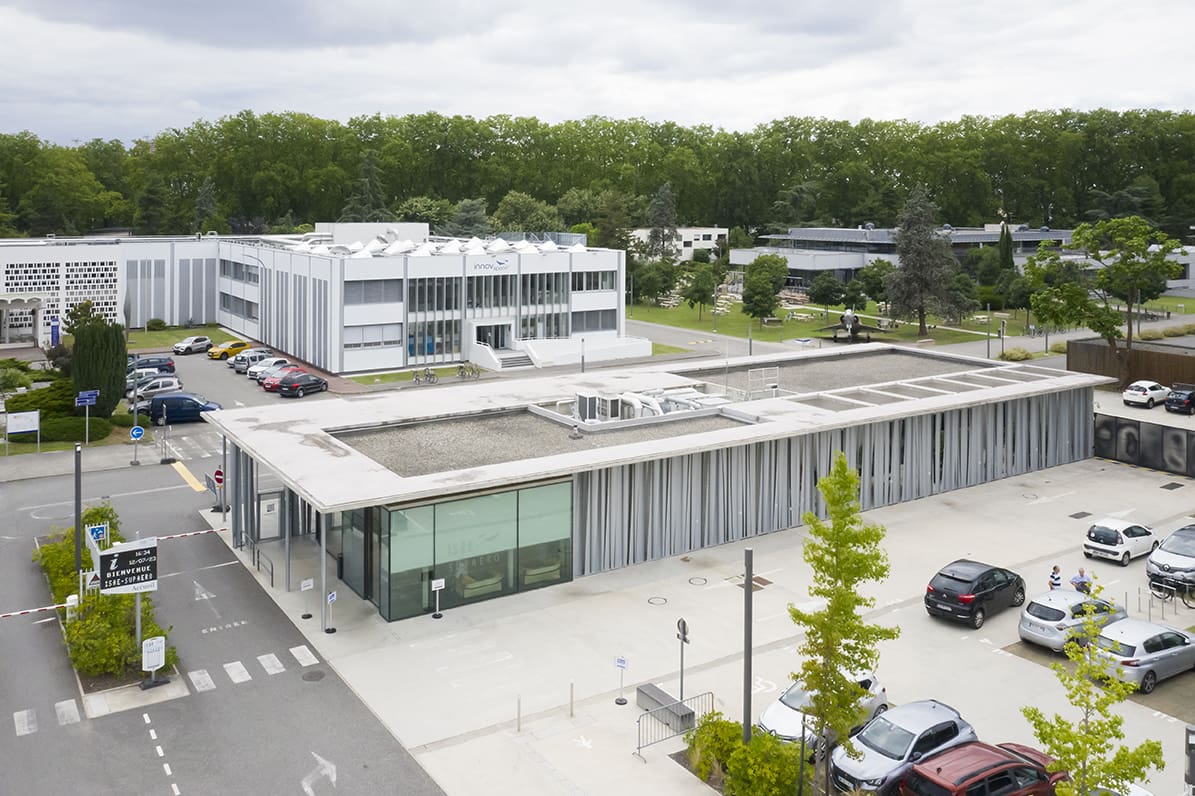
The campus lies in the Rangueil scientific complex, about 20 minutes from the centre of Toulouse, on 19 hectares of wooded grounds next to Paul Sabatier University and close to the CNRS laboratory LAAS and the Midi-Pyrénées Observatory. ONERA's Toulouse research centre is also on the campus. Six residences provide 959 housing units on site, and more than 130 clubs and associations and 12 sports facilities, including a 25 m indoor pool and a climbing wall, support student life. Students can also learn to fly with the school's own aircraft and instructors.
Research is carried out in five departments: Aerodynamics, Energetics and Propulsion (DAEP); Design and Operation of Aerospace Vehicles (DCAS); Complex Systems Engineering (DISC); Electronics, Optronics and Signal Processing (DEOS); and Mechanics of Structures and Materials (DMSM), alongside the Languages, Arts, Cultures and Societies department (LACS). An 800 m² innovation space houses a Digital Lab, a FabLab and a start-up incubator, with 13 start-ups supported.
International students come from 66 nationalities, and 37% of newly recruited students across all programmes are international. The Master's in Aerospace Engineering is taught entirely in English, and the school holds the three-star "Bienvenue en France" label from Campus France and the Qualité Français Langue Étrangère label. The general engineering programme is accredited by the CTI and carries the EUR-ACE label; the apprenticeship engineering course is also CTI-accredited, the Advanced Master's programmes are accredited by the Conférence des Grandes Écoles, and the Institute holds ISO 9001 and Qualiopi certification.
Diplôme d'ingénieur ISAE-SUPAERO, 2026-2027: €2,936 for French and European students (EU, Switzerland, EEA) and €5,034 for non-European students. Students holding a CROUS social-criteria grant are exempt from tuition fees and from the CVEC.
Ingénieur by apprenticeship: free of charge for the apprentice; the training is funded in whole or part by the host company's OPCO.
Master's in Aerospace Engineering, 2026: €15,149 per year for applicants from outside the EU and a reduced €5,458 per year for EU, Swiss and EEA nationals; fees are reviewed annually for inflation.
Advanced Master's, 2025-2026: most programmes (AES, TAS AERO, EMS, HADA, SPAPS, TAS ASTRO, SPA, ASAA, AERO OPS SA) are €14,500 for EU applicants (€12,000 reduced rate for recent graduates without professional experience and job-seekers) and €23,000 for non-EU applicants (€17,000 reduced rate where an employer or public body pays); SEN and TAS ASTRO-SEEDS are €17,000 (reduced €12,000 and €13,500 for EU), TAS AERO FTE is €20,000 (reduced €15,500), and IEVEx is €9,500 (€8,500 for Ministry of Armed Forces employees). Application fee €100.
Doctorate: registration fee €391 per year; the CVEC (contribution vie étudiante et de campus) is €103 per year.
Candidates who apply in the first application session (October to November 2026) can apply for: full scholarships from the ISAE-SUPAERO Foundation, MBDA and Airbus (CEDAR) and a partial GIFAS scholarship. Listed awards include a tuition waiver with a €6,300 per year living stipend for non-European students, a tuition waiver with a stipend of about €4,000 for non-European students, a tuition waiver for EU students in the space field, and a tuition waiver with a €3,500 per year stipend open to all in aeronautics. Eligibility: be an MAE applicant (excluding double degrees), academic excellence (GPA of at least 3.5/4, an average of at least 80% or at least 15/20), a professional project in line with aerospace and the scholarship field, and a statement of financial need. After submitting the application, a Scholarships tab opens for a motivation letter for one or more scholarships; results are posted about two weeks after the first jury, in early February.
The MBDA excellence scholarships (2025-2029) fund 12 high-potential students, covering tuition and part of living expenses, a programme begun in 2013 that has supported 46 students.
The Thales scholarship covers living costs over the last two years of study; the GIFAS scholarship supports stays abroad; Erasmus+, Occitanie region and ISAE-SUPAERO Foundation grants fund mobility; the Parcours Talents scheme for scholarship students entering year 3 includes tuition exemption, a reserved residence room and a complementary bursary of €4,000. Meals at €1 are available. About 20% of students are on scholarship or grants.
Two Safran scholarships for the IEM programme cover full tuition (apply to IEM, then email a cover letter titled "Application for the IEM scholarship" to [email protected]; the 2025 deadline was 26 March 2025 with results in early May). CPF is usable for AIBT, ASAA and SEN, Transitions Pro for the same three, and AIBT can be taken by apprenticeship or professionalisation contract. Employer support is possible, and international applicants may hold scholarships from their home government; see Campus France.
Details: Advanced Master's fees and funding; MAE fees and scholarships.
MBDA Excellence Scholarships at ISAE-SUPAERO →
SAFRAN Scholarship for the Advanced Master in Innovation, Entrepreneurship and Management (IEM) →
Thales Scholarship at ISAE-SUPAERO →
Browse the scholarships listed for ISAE-SUPAERO and check each award’s eligibility.
View scholarships for ISAE-SUPAERO →Year 1 entry (Mines-Ponts concours): students from classes préparatoires (CPGE) are admitted through the Concours commun Mines-Ponts: MP 63 places, MPI 10, PC 32, PSI 80, PT 6 and TSI 2. Admission sur titre: holders of a L3, bachelor's degree or equivalent can apply to year 1 (10 places, recruited jointly with the Mines-Ponts and ParisTech schools) via geiuniv.com. For the 2026 cycle registration ran from 6 January to 19 February 2026, written tests were on 25 March 2026 and orals in May 2026. Two places go to students from La Prépa des INP.
Year 2 entry: holders of an M1 or equivalent, 2 to 3 places, same calendar and platform (geiuniv.com).
International applicants: admission is on file under academic cooperation agreements for a double degree or substitution (year 2 or 3), or into year 2 for holders of a bachelor's degree of four years or more (via geiuniv.com).
Year 3 entry: exchange students under cooperation agreements are admitted on file; polytechniciens join year 3 after an option placement; the Parcours Talents scheme is open to French-national scholarship students in the last year of an engineering course who are eligible for the corps de l'Armement.
Specialist industrial engineering for aeronautics and space, delivered through the ISAE Group apprenticeship scheme with a host company under an apprenticeship contract (RNCP 34749).
Taught entirely in English. Applicants need a bachelor's degree obtained abroad or equivalent in mechanical engineering, mechatronics, aerospace, electronics, electrical engineering, computer science, telecommunications or similar, or a French bachelor's in science and engineering; excellent mathematics or physics graduates may also apply. Applications are made online on the TSAAE platform. Required documents: CV in English; motivation letter for each programme choice; copy of the last diploma or enrolment certificate; transcripts for the last three years of study; work certificates for professionals; two letters of recommendation (one academic and one professional) uploaded by referees; and an English test. There is no interview. Accepted English tests (taken less than two years before): TOEFL iBT 87, IELTS Academic 6, Cambridge CAE/FCE 170, Linguaskill 170, TOEIC 785 (four skills) or 850 (listening and reading). Nationals of Australia, Canada, Ireland, New Zealand, South Africa, the United Kingdom and the United States are exempt. Applicants without a test result can apply with proof of a booked test and be admitted conditional on passing before classes start. The first application round for 2027 entry runs to 27 November 2026. On admission, a non-refundable deposit of €1,200 against tuition is due within about three weeks.
Open to holders of an engineering degree conferring the grade of master (CTI list), an RNCP level 7 title, a national master's, DEA, DESS or bac+5 diploma, a foreign diploma recognised at equivalent level, or an M1-level diploma with at least three years of related professional experience; special admission exists for validated M1 without experience, a bachelor's with three years' experience, or VAPP with five years. Applicants apply online on the TSAAE platform (up to five Advanced Master's at once) with CV, motivation letter, last diploma, transcripts for three years, two recommendation letters and an English test (TOEFL iBT, IELTS Academic 6, Cambridge 170, Linguaskill); the application fee is €100 (non-refundable). Documents must be translated into French or English. For AM SPA, non-native French speakers need a B2 certificate. Admitted students pay a non-refundable deposit of €1,500 (2025-2026).
Applicants need a national master's degree or another degree conferring the grade of master (or equivalent studies or validated experience) and demonstrated aptitude for research. Registration is through the ADUM portal: the applicant enters the thesis details and uploads the CV, M1 and M2 grades, motivation letter and recommendation letters; the file is validated by the thesis director, co-director and laboratory director, then examined by the doctoral school and the ISAE-SUPAERO doctoral committee. The academic year begins on 1 October. Registration fees and the CVEC must be paid before the student card is issued.
Study programmes offered at ISAE-SUPAERO.
Experiences shared by students of ISAE-SUPAERO.
Studied here? Share your experience to help other applicants.

Book a free consultation with our expert counsellors and take the first step towards your dream university.
Copyrights © 2026 StudyMapped. All rights reserved.

Enter your credentials to continue.
Join us and start your study abroad journey.


