
University in France
Futuroscope-Chasseneuil, Nouvelle-Aquitaine, France
University profile
ISAE-ENSMA (École Nationale Supérieure de Mécanique et d’Aérotechnique) is a public engineering school at Futuroscope, Chasseneuil-du-Poitou, 12 km from Poitiers in Nouvelle-Aquitaine. It is a member of the ISAE Group of French aeronautics and space engineering schools and trains engineers for transport (aeronautics and ground transportation), space and energy, with a profile oriented mainly towards design, research and development. Since 2017 it has been a public scientific, cultural and professional institution (EPSCP) among the non-university institutes and schools.
The school awards the Diplôme d’Ingénieur, a Master-level degree accredited by the CTI, through three routes: a three-year programme under student status (entry mainly through the Concours Mines-Télécom, with admissions on academic qualifications at several levels), a three-year apprenticeship programme in industrial engineering for aeronautics and space run jointly by ISAE Group schools, and validation of professional experience (VAE). It also runs the Master of Science in Aeronautics and Space with four tracks (TAT, Computer Science for Avionics, the English-taught AME and the English-taught Turbulence track), one research Master in Materials Science with the University of Poitiers, and doctoral training within the MIMME doctoral school.
Research is carried out in two laboratories shared with the University of Poitiers and the CNRS: the P’ Institute (Pprime) and the LIAS (computer science and automatic control for systems). The school dedicates half of its surface area (17,000 m²) to research and operates the PROMETEE experimental platform, which was commissioned in 2018. Industrial partners include Safran, Airbus, CNES, CEA, Stellantis and ArianeGroup.
Student life is built around about seventy-five clubs and associations run by the student body, covering aeronautics (ENSMAIR, ENSMA Planeur, ENSMAstro), science and engineering projects (ENSMA Space Project, Micro Drone, ENSMArathon Shell, ENSMA Steel), humanitarian and environmental causes, sport and culture. Sport is part of the engineering curriculum, with a gymnasium, climbing wall, outdoor tennis courts and a football/rugby pitch. Housing is available on the Futuroscope site: CROUS runs the Gemini residence and the Centre de Vie residence at Jaunay-Clan, about a hundred beds across the two are reserved for arriving first-year students, and Habitat de la Vienne and private residences are nearby. A university restaurant operates at the Gemini residence.
International students from more than 25 nationalities attend the engineering programme, the international Master tracks, research projects and PhDs. Every engineering student must spend at least three months abroad, and the school belongs to Erasmus+, GE4 and BCI (Quebec) and takes part in BRAFITEC and ARFITEC. It was awarded the Campus France ‘Welcome to France’ label with three stars in 2025, for the second time.
Registration fees for the engineering programme are €628 for 2025-2026. The MSc AME (Aeronautical Mechanics and Energetics) charges €7,000 per year for non-European students and €3,500 per year for European students; the amounts may be revised each year by the Ministry of Higher Education and Research. Doctoral tuition was €380 for 2023-2024, excluding the CVEC (contribution vie étudiante et de campus), which is paid separately.
Outgoing students can draw on Erasmus study grants (€200 to €310 per month) and Erasmus internship grants (€420 to €520 per month), Nouvelle-Aquitaine region grants (€80 to €110 per week outside Europe), CampusMouv’86 and the Vienne departmental council, plus the school’s own FSMI social mobility fund (€350 to €450 per month) and AMI international mobility aid (€400 per month). The EUR InTree graduate school also provides mobility grants for internships abroad.
More information: study abroad and international students.
Bourses ESPACE (Fondation Ailes de France) for ISAE-ENSMA students and doctoral candidates →
Browse the scholarships listed for ISAE-ENSMA and check each award’s eligibility.
View scholarships for ISAE-ENSMA →First-year entry is mainly through the Concours Mines-Télécom, a national competitive examination for students from classes préparatoires (151 places across the Maths and Physics, Physics and Chemistry, Physics and Sciences for the Engineer, Technology and Sciences for the Engineer, Physics and Technology for the Engineer, and Mathematics, Physics, Engineering and Computer Science courses), plus 2 places through the Concours ATS. Thirteen places are filled on academic qualifications: holders of a Bachelor’s degree or L3 in mechanics, mathematics or physics (4), BUT holders or second-year BUT students in specialities such as mechanical and industrial automation engineering, thermal and energy engineering, industrial engineering and maintenance, electrical engineering and industrial computing, science and materials engineering, and mathematics and physics (4), L2 Physics students entering the intensive programme of the University of Poitiers (4), and L2 students of the intensive programme of the University of Toulon (1). Second-year entry is open to a small number of first-year Master students in mechanics, physics, mechanical technology, mechanical engineering or materials engineering, and to double-degree students from partner establishments.
Applications on qualifications are made online with a motivation letter, a CV, two recommendation letters completed by two teachers, and the relevant transcripts (BUT, L1 to L3, or L1 to M1). For the 2026 cycle the online application opened on 3 March 2026 and closed on 30 April 2026 for BUT, L3 and M1 entry. Documents that cannot be uploaded go to [email protected]. Registration fees for 2025-2026 are €628.
The three-year ‘génie industriel pour l’aéronautique et l’espace’ apprenticeship programme is open to holders of a scientific BUT3, a scientific BTS followed by a prépa ATS year, and related scientific Licence or Bachelor degrees. First-time foreign applicants may apply with an equivalent diploma, a B2 French certificate (unless French is the official language of their country) and a letter describing how they will look for an apprenticeship contract in France. Recruitment for 2027 runs through the ISAE Group platform from 1 December 2026 to 5 February 2027, with written tests (mathematics, French, English) on 4 March 2027 and interviews from 14 to 21 April 2027; the application fee is €60 (€30 for scholarship holders).
The engineering programme is taught in French; exchange students need an official certificate at minimum B1 in the language of instruction (DELF for French). English courses are compulsory for engineering students, who need a TOEIC score for the degree (a minimum score of 785 is stated for double-degree eligibility, together with a 12.5/20 average over the first two years).
The Master is open to holders of a Licence or Bachelor in science. For the TAT and Computer Science for Avionics tracks (taught in French), M1 applications with an L3 are made on monmaster.gouv.fr (17 February to 16 March 2026); M2 applications with an M1 opened on 3 March 2026 and closed on 30 April 2026. The file contains a motivation letter, CV, transcripts and two assessment letters signed by two teachers. The English-taught AME track (options EPROP and HTM) accepts holders of a Bachelor (bac+3 or equivalent) in aerospace engineering, mechanics or mechatronics, or a Licence in sciences and engineering, with TOEFL iBT 79, TOEFL paper 550, IELTS 6.0 or TOEIC 750 (other tests such as Cambridge CAE are accepted). Free applications close on 16 November 2026, 8 January 2027, 1 March 2027 and 3 May 2027, with admission juries on 30 November 2026, 25 January 2027, 15 March 2027 and 18 May 2027. The International MSc in Turbulence ends after the 2026-2027 academic year with no recruitment for 2026-2027.
Applicants first contact the P’ Institute or LIAS to find a topic and a thesis director, then register with the DRDV ([email protected]) from 1 September in line with the signature of the work contract or the start of funding; registration is needed before signing the contract. The doctoral school is MIMME ([email protected]).
Partner-university students may choose the engineering programme, the MSc AME or Turbulence track, or a research project in a laboratory. Deadlines are 30 April (autumn semester or full year) and 15 October (spring semester). Erasmus students complete digital learning agreements through OLA.
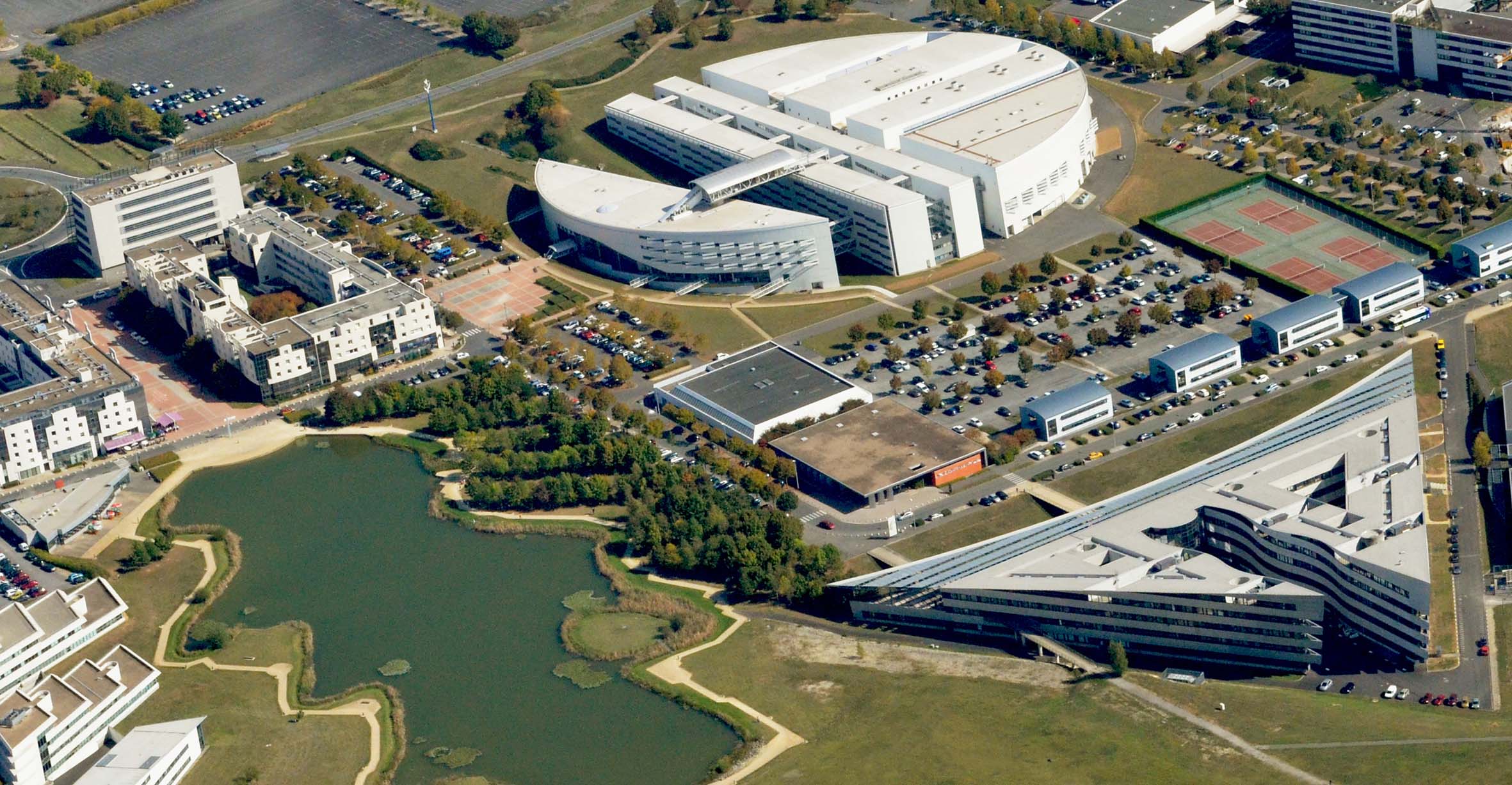
Futuroscope campus, Chasseneuil-du-Poitou (Téléport 2, 1 avenue Clément Ader): the main site since 1993, 12 km from Poitiers, with teaching buildings, the library, the student house and two research laboratories’ premises (P’ Institute and LIAS Futuroscope).
The LIAS laboratory is also present at ENSIP in Poitiers, and the International MSc in Turbulence spends its first year at Centrale Lille.
Study programmes offered at ISAE-ENSMA.
Experiences shared by students of ISAE-ENSMA.
Studied here? Share your experience to help other applicants.

Book a free consultation with our expert counsellors and take the first step towards your dream university.
Copyrights © 2026 StudyMapped. All rights reserved.

Enter your credentials to continue.
Join us and start your study abroad journey.


