
University in Canada
Quebec City, Quebec, Canada
University profile
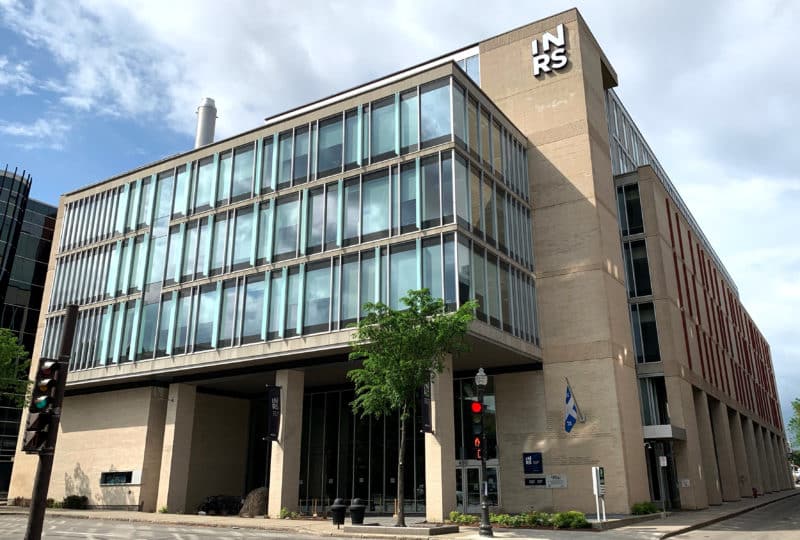
The Institut national de la recherche scientifique (INRS) is a French-language university of the Université du Québec network, founded by the Government of Quebec in 1969 and devoted exclusively to graduate research and training. It offers master's and doctoral programmes, as well as some graduate diplomas and short programmes, and students work within a professor's research team. Its administration, directions and services are based at 490, rue de la Couronne in Quebec City.
The institute is organized into five thematic, interdisciplinary research and training centres: Eau Terre Environnement (Quebec City), Énergie Matériaux Télécommunications (Varennes and Montreal), Armand-Frappier Santé Biotechnologie (Laval), Urbanisation Culture Société (Montreal and Quebec City) and Ruralités durables (Baie-Saint-Paul). Research is grouped into four themes: advanced materials, energy transition and emerging technologies; natural resources, ecosystems and climate change; global health and biotechnologies; and social, urban and cultural transformations.
INRS cites 55 years of thematic research and interdisciplinary training, more than 1,500 professors, students, postdoctoral trainees and staff, and first place in Canada for research intensity for 2023. It also reports more than 1,500 publications produced in international collaboration. Interuniversity joint research units (unités mixtes de recherche) link INRS with UQAC, UQAR, UQAT, UQO and UQTR on sustainable health, digital transformation for regional development, Indigenous studies, cybersecurity and materials for the energy transition.
French is the language of study, teaching, research and work. Applicants who did not study in French must show level B2 French, with English-language alternatives available under the institute's language policy, and French courses at all levels are open to the student community. Student life includes student associations at each centre, the student newspaper La Synthèse, an ambassador programme, green committees, scientific communication activities and the Apprentis chercheurs programme. Support services include a psychologist, a social worker, a learning specialist (orthopédagogue), accessibility accommodations and financial support during parental leave.
International students receive guidance on immigration procedures, housing in Quebec and practical life in the province. Foreign students not covered by the Quebec health insurance plan are enrolled in a collective health and hospitalization plan at registration, and study permit and Certificat d'acceptation du Québec (CAQ) validity is checked at each registration.
INRS runs its own scholarship programmes for all full-time registered students. See INRS scholarships and financial aid and the scholarship directory. Questions: [email protected].
Minimum funding guaranteed to full-time master's and doctoral students in these sectors (amounts as of 1 May 2026): $3,345 per trimester for a professional master's for six consecutive trimesters; $7,355 per trimester for a master's with thesis for six consecutive trimesters; $8,760 per trimester for a doctorate for twelve consecutive trimesters. Supplements beyond these periods are at the professor's discretion. Funding is adjusted when an external scholarship is held.
Universal doctoral scholarships of $5,000 in the first year and $4,000 in each of the two following years, plus specialization scholarships for master's (1 to 2 years) and doctoral (1 to 4 years) students of at least $2,000, varying with professors' offers. The admission file serves as the application and there is no deadline. Contact: [email protected].
All doctoral students admitted automatically receive a scholarship covering the surcharge for international and non-Quebec Canadian students. For research master's students, some centres award it by competition, assessed each trimester. Students on the professional master's and the master's in knowledge mobilization and transfer are not eligible. French and Francophone Belgian students do not pay the surcharge.
INRS Scholarships and Financial Support — Social Sciences Sector →
INRS Financial Support — Health Sciences and Pure and Applied Sciences Sectors →
Browse the scholarships listed for Institut national de la recherche scientifique and check each award’s eligibility.
View scholarships for Institut national de la recherche scientifique →INRS admits students at master's and doctoral level only. For most research master's and doctoral programmes, a professor must agree to supervise the candidate before the application is completed; INRS offers a "Trouver ma direction" questionnaire and a directory of master's and doctoral projects to help. This prerequisite does not apply to professional (non-thesis) programmes, some social-science master's programmes with thesis, DESS and short programmes. Each programme has its own admission conditions in the programme directory.
Documents not in French or English must come with a translation by a certified translator.
Candidates who did not study in French must provide proof of B2 French (Common European Framework), unless a programme requires a higher level. Accepted tests: TCF and TEF (comprehension only counted), TEFAQ, TEF Canada, DELF and DALF. Exempt are applicants who passed the Quebec uniform French exam, met the requirement at another francophone university, hold a degree from a francophone university or a bachelor's or master's completed mainly in French, or hold a French general baccalauréat. Applicants without functional French may be admitted by showing functional English through an English-language university degree or B2 English: TOEFL iBT 72, IELTS Academic 5.5, PTE Academic 59 or CAEL 60. Test results are valid for two years and must be submitted with the application.
Credentials earned outside Quebec must be checked against INRS's diploma equivalency tables, which set the minimum credential for entry to master's (2nd cycle) and doctoral (3rd cycle) programmes by country (for example, a bachelor's degree for the master's and a master's degree for the doctorate in the United States, China and India). A recognized equivalence does not guarantee admission. International students need a valid study permit and CAQ where applicable. Prior learning recognition (RAC) is available.
Apply online through the IDÉ portal and pay the admission fee by credit card via a link sent at submission. Deadlines: fall term 30 March, winter term 1 November, summer term 1 March. Exceptions: international applicants to the professional master's in water sciences, 15 February (fall); international applicants to urban studies programmes, 1 March (fall) and 1 August for winter (master's only). Applications received after these dates may still be reviewed. The selection committee reviews complete files and the Registrar's Office emails the admission decision. Candidates from INRS or the Université du Québec network, open-house participants and those who met an INRS representative at a recruitment fair are exempt from the admission fee.
Tuition is $103.92 per credit ($1,558.80 for 15 credits). A year has three trimesters. Quebec residents on a master's with thesis pay $1,732.40 per trimester in total (including general, student-service, federation and association fees) for the first three trimesters, then a $430.76 registration fee ($604.36 total). International students on a master's with thesis pay $11,147.90 per trimester including a $9,115.50 surcharge ($607.70 per credit) and $300 foreign health insurance; international doctoral students pay $10,055.00 per trimester, including a $8,022.60 surcharge. French and Francophone Belgian students do not pay the surcharge and pay $2,032.40 per trimester (including $300 health insurance, unless exempt). Non-Quebec Canadian students pay a surcharge of $220.43 per credit ($3,306.45 per 15 credits) on the master's. ASEQ health and dental insurance is $137.57 per trimester. Student association fees range from $10 to $20 by centre.
INRS operates from sites in five Quebec locations:
The libraries of INRS are grouped as the Service de documentation et d'information spécialisées (SDIS), holding more than 50,000 print and digital documents, with loans through the Sofia catalogue shared by Quebec university libraries, databases, geospatial data and research data management support. Campuses offer relaxation areas, study and team-work spaces, and in some centres active-living rooms, bicycle racks and showers.
Study programmes offered at Institut national de la recherche scientifique.
Experiences shared by students of Institut national de la recherche scientifique.
Studied here? Share your experience to help other applicants.

Book a free consultation with our expert counsellors and take the first step towards your dream university.
Copyrights © 2026 StudyMapped. All rights reserved.

Enter your credentials to continue.
Join us and start your study abroad journey.


