

University in France
Strasbourg, Grand Est, France
University profile
INSA Strasbourg (Institut national des sciences appliquées de Strasbourg) is a public scientific, cultural and professional establishment (EPSCP) under the Ministry in charge of higher education. It is a grande école specialising in engineering and architecture, and it is the only school in France that awards both engineering and architecture diplomas. It joined the INSA Group in 2003, the largest network of engineering schools in France, which brings together seven national institutes of applied science and a shared entry system.
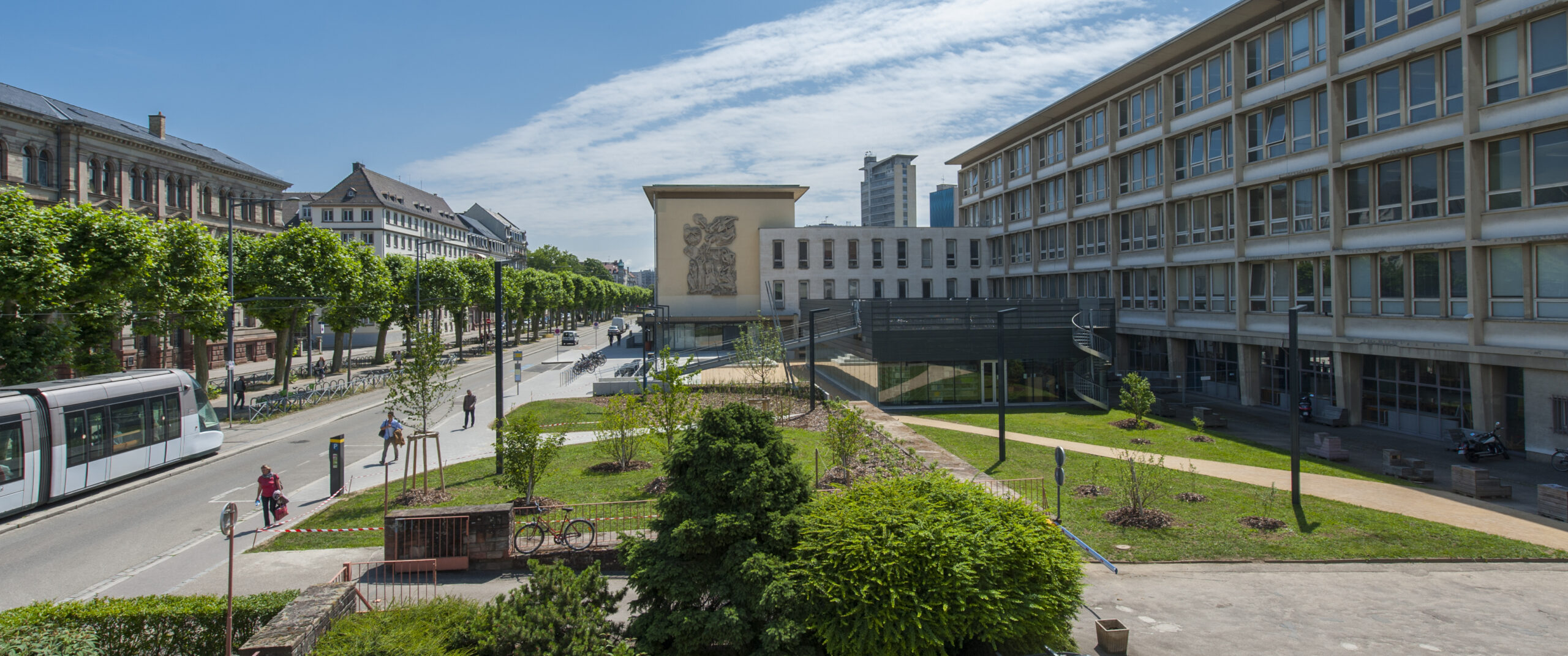
The school stands on the Esplanade university campus in Strasbourg, a short distance from the city centre. It has about 2,000 students (2,015 recorded in 2017) and awards some 320 engineering diplomas and 50 architecture diplomas each year. Teaching staff comprise 112 full-time teacher-researchers or lecturers and more than 300 part-time or non-tenured instructors, supported by around 80 tenured administrative and technical staff.
Engineering courses are five-year programmes accredited by the Commission des titres d'ingénieur (CTI) and carry the European EUR-ACE label. All students follow a common first year (Science, technology and humanities, STH 1) and then choose one of the engineering specialities: civil engineering, surveying engineering (topographie), electrical engineering, HVAC and energy engineering, mechanical engineering, mechatronics and plastics engineering (plasturgie). Five specialities are also available as sandwich (work-study) courses. The School of Architecture awards the INSA Strasbourg diploma in architecture, accredited by the Ministry of Culture, and a dual architect-engineer pathway leads to both diplomas after up to seven years.
Specific strands include DeutschINSA, a Franco-German bilingual course at three language levels with double master's options with partners in Germany and Austria, and themed courses for music students and top-level athletes. Study abroad is compulsory: every student spends at least three months abroad to validate the diploma. The school offers 28 double degrees, 120 bilateral agreements and the Erasmus+, Brafitec, Arfitec and Mexfitec exchange programmes. About 12% of students are international, from more than 40 nationalities.
Student life is organised through the Bureau des Élèves (BDE) and eight other associations, sport through the university SIUAPS, and the school has a nurse on site and a disability support officer. Residences nearby include the Maisons de l'Ingénieur et de l'Architecte (MIA1 and MIA2) and the university halls of residence reserved by the international office. Through the INSA Group the school is a member of the ECIU University alliance.
INSA Strasbourg is public and fees are set by the relevant ministry or by the Board of Administration (engineering diploma). Students in apprenticeship, professionalisation contracts or continuing education pay no registration fees, and holders of CROUS grants are exempt.
French and EU students: engineering diploma EUR 630 per year (reduced rate EUR 420); architecture diploma years 4 and 5 EUR 537; Master EUR 255 (reduced EUR 167); HMONP EUR 660.
Non-EU students (differentiated fees): engineering years 1 and 2 EUR 2,902 (reduced EUR 1,934); years 3 to 5 EUR 3,950 (reduced EUR 2,633); Master EUR 3,950 (reduced EUR 2,633); architecture years 4 and 5 EUR 537.
Non-EU students enrolling for the first time in engineering years 1 to 4 may benefit from a partial exemption that brings their fees to the level paid by national and EU students. The list of eligible countries is in the information note on differentiated fees. Students who repeat the first year lose eligibility. Other students in financial difficulty may request a fee exemption from the registrar's office each year (2026/2027 deadline for current students 10 June 2026; for new entrants 11 September).
Social emergency aid (food, rent, health costs, digital access, international mobility) comes from the school's solidarity funds, financed by the CVEC (contribution vie étudiante et de campus), and from the Fondation INSA Strasbourg. It is coordinated with the CROUS social worker and open to engineering, architecture, double-degree, exchange and master's students. State grants and university housing are requested through messervices.etudiant.gouv.fr by 31 May.
For the Campus France Eiffel scholarship the school favours candidates coming through double-degree agreements announced by their home institution. Unsolicited applications for year 4 entry outside a partnership are examined only for excellent profiles ranked in the top three and only if the speciality has no double-degree applications. Eligible candidates send transcripts, class rank, CV, motivation letter and a French-level certificate before 30 October of the year before entry.
Erasmus+ study grants (amount depends on the host country), Brafitec (Brazil, flat EUR 1,500), Arfitec (Argentina, flat EUR 1,300), Strasbourg twin-city Mobilitwin grants (for example Boston EUR 2,000, Dresden EUR 1,000), Franco-German University grants (EUR 350 per month for three double degrees) and an international mobility aid of EUR 400 per month for students on social-criteria grants. Details on the school's mobility funding page. Fees are on the cost of studies page.
Browse the scholarships listed for INSA Strasbourg and check each award’s eligibility.
View scholarships for INSA Strasbourg →Admission at every level (Bac, Bac+1, Bac+2, Bac+3, Bac+4) is by competitive selection on qualifications, an application file and, in some cases, an interview. Entry in years 1, 2 and 3 follows the conditions common to the INSA Group, handled by the INSA Group admissions service ([email protected]).
Year 1 (Bac level). Recruitment is common to the seven INSA schools for holders of a scientific baccalaureate or equivalent, on file and sometimes interview. Applicants with a French general baccalaureate, European baccalaureate or Franco-German baccalaureate apply through Parcoursup (19 January to 12 March in 2026). Applicants with a foreign baccalaureate apply on the INSA Group website (19 January to 19 March in 2026). Year 1 is a common orientation year; the speciality is chosen at its end. International and themed courses (DeutschINSA, Music, top-level athletes) are allocated after admission.
Year 4 (Bac+4). A competitive entry on qualifications is open to candidates who have validated 240 ECTS credits (60 per post-baccalaureate year) or the foreign equivalent in a scientific programme in the field of the speciality applied for, at the latest at administrative enrolment. The application file is sent by email; in 2026 applications opened on 5 January and closed on 13 February, with interviews in May. A minimum French certificate is not required at selection, but the jury checks at interview that French is adequate, and foreign-diploma entrants must provide a TCF (or equivalent) at level B2 to obtain the INSA Strasbourg engineering diploma. The application fee is EUR 105 (non-refundable; holders of French government social-criteria grants are exempt).
Applicants of non-EU nationality living outside the EU must first register on the Campus France 'Études en France' portal; this procedure is separate from the application to the school.
Apprenticeship and continuing education. Engineer training by apprenticeship (FIP), continuing education, validation of prior learning (VAE) and the Fontanet scheme have their own admission pages.
Entry in year 1 (Bac+1) is open to candidates with one year of higher education after the baccalaureate (CPGE, Licence and similar), either by competitive written examination at the level of the first year of scientific preparatory classes, or, for holders of a foreign diploma, by a competition on qualifications and interview. Entry in year 4 (Bac+4) is by competition on qualifications for holders of an engineering diploma and a bachelor-level architecture diploma, or on qualifications and interview for holders of a foreign architecture diploma. The application fee is EUR 105.
INSA Strasbourg is co-accredited for the Master's in Urban Planning and Development (M2 Architecture, structures et projets urbains, 24 places, open to architects, engineers and M1-level graduates in architecture, geography, surveying or social sciences) and in Materials Science and Engineering (applications through the University of Strasbourg). Foreign candidates for the urban planning M2 must show French at TCF B2 or DELF B2. For 2026 the file deadline was 19 June, with decisions in July.
Exchange students apply through the international relations office of their home institution, via the Moveon platform. Deadlines are 15 April for the first semester (September to January) and 15 October for the second semester (January to May). The minimum French level for courses, all taught in French, is B1-B2; some courses are taught in English (electrical engineering year 5, architecture year 4, surveying engineering year 5, thermal, energy and environmental engineering year 4). The n+i network allows graduates with at least a bachelor's degree to complete the engineering degree.
Applicants at Advanced, Confirmed and Expert levels need respectively German at least B1, B1+ and B2.
PhD studies are organised with the University of Strasbourg, which awards the degree; teams are attached to three doctoral schools. Open PhD and post-doctoral positions are advertised on the French pages of the school's website.
Esplanade campus, Strasbourg: the single site of the school, at 24 boulevard de la Victoire, hosting the School of Architecture, the engineering specialities, the research units' INSA teams, the continuing education centre and the international relations office.
Experiences shared by students of INSA Strasbourg.
Studied here? Share your experience to help other applicants.

Book a free consultation with our expert counsellors and take the first step towards your dream university.
Copyrights © 2026 StudyMapped. All rights reserved.

Enter your credentials to continue.
Join us and start your study abroad journey.


