

University in United Kingdom
London, England, United Kingdom
University profile
Imperial College London is a university specialising in science, technology, engineering, medicine and business. It was founded in 1907, when a Royal Charter brought together the Royal College of Science, the Royal School of Mines and the City and Guilds College in South Kensington, with the mission ‘To be useful’. In 2025–26 it had 23,920 students and 8,941 full-time-equivalent staff.
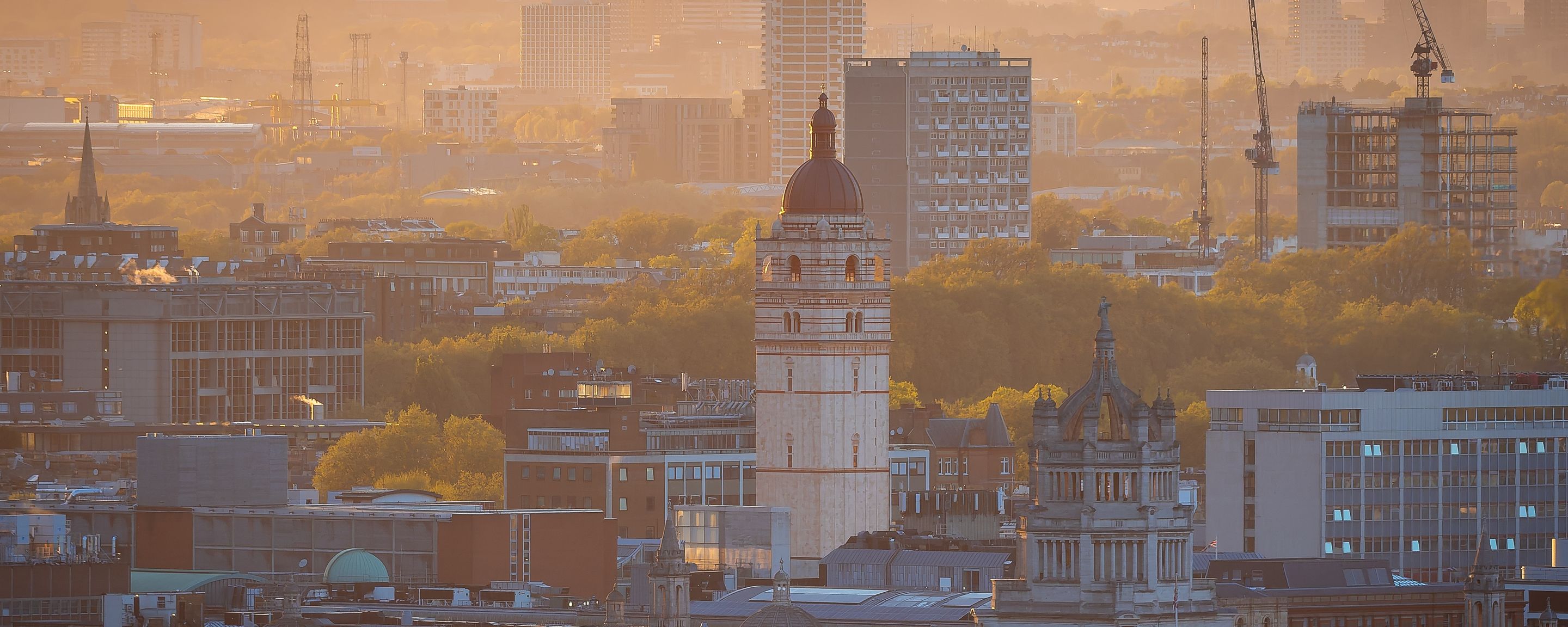
The main campus is in South Kensington, central London, in the area known as ‘Albertopolis’. Its buildings range from the Edwardian Royal School of Mines to the Norman Foster-designed Business School, with the Queen’s Tower standing in a landscaped square. Imperial now has nine campuses across London and the South East. They include the White City deep tech campus, medical teaching and research campuses based at London hospitals, and the Silwood Park ecology campus near Ascot. The Pears Cumbria School of Medicine is a graduate-entry medical school run as a partnership with the University of Cumbria. It opened in August 2025.
Teaching and research are organised in four faculties:
Cross-faculty work runs through the Global Challenge Institutes, among them the Grantham Institute – Climate Change and the Environment, the Institute of Global Health Innovation, the Data Science Institute and the Institute of Infection. Imperial also runs the School of Convergence Science and I-X, its flagship artificial intelligence initiative. The university’s staff, alumni and students have received 14 Nobel Prizes.
Student life centres on Imperial College Union, the Student Hub for student services, sports facilities and the Blyth Centre for Music and Visual Arts. All eligible first-year undergraduates who make Imperial their firm choice are guaranteed a place in Imperial halls. Rents include utility bills, internet, basic contents insurance, maintenance and communal cleaning, and over 90% of first-year undergraduates choose to live in halls.
Imperial is strongly international. In 2024–25, international students made up 61% of the student community and came from more than 150 countries. Imperial College London was a college of the University of London from 1908. It withdrew in 2006 and became an independent university.
The Home undergraduate fee is £9,790 per year for 2026–27 and £10,050 per year for 2027–28. A placement year is charged at up to 20% of the full-time fee and a year abroad at up to 15%. Overseas undergraduate fees vary by course. For 2026 entry, for example, they are £45,500 a year for Chemistry, Life Sciences and Physics and £42,700 for Mathematics. Overseas fees for continuing students rise each year by up to the CPI inflation rate.
Home undergraduates with a household income below £70,000 qualify automatically for a non-repayable bursary each year. For 2026 and 2027 entry, the amounts are:
Eligible care leavers and estranged students receive an extra £500. MBBS students in clinical years receive additional bursary funding, and Graduate Entry Medicine students in Cumbria have a separate bursary scale. To qualify, students must apply for a means-tested government loan and share their household income details by 31 May. Imperial Bursary
For 2027 entry, at least 300 scholarships worth £15,000 a year, for each year of the course, are available to Overseas-fee students. They cover full-time undergraduate courses and selected postgraduate taught courses in Engineering, Natural Sciences, Medicine and the Business School. Eligible applicants are invited to apply after submitting their admissions application, and undergraduates complete an additional optional essay from October 2026. Imperial Inspires scholarships
Fifty scholarships for new PhD applicants of any nationality cover full tuition fees, a stipend of £27,036 a year (2027–28 rate) and a consumables fund of £2,000 a year for the first three years, over 3.5 years of study. Applicants must first have a supervisor’s agreement, and departments nominate candidates from the admissions application. The deadlines are 2 November 2026, 11 January 2027 and 1 March 2027. President’s PhD scholarships
Current awards and deadlines are listed in the scholarships search tool. Funding is also available through UK government student loans, the Disabled Students’ Allowance, the NHS Bursary for Medicine students, and charitable grants and trusts.
Imperial Inspires Scholarships →
International Baccalaureate Excellence Scholarships →
Imperial Bursary (Home undergraduates) →
Presidential Scholarships for Students of Black Heritage (Undergraduate) →
Browse the scholarships listed for Imperial College London and check each award’s eligibility.
View scholarships for Imperial College London →Undergraduate courses are full time only, and applications go through UCAS. For 2027 entry, UCAS applications opened on 12 May 2026. The deadline for MBBS Medicine and MBBS Medicine (Graduate Entry) is 15 October 2026, and the equal-consideration deadline for all other undergraduate courses is 13 January 2027. Applicants must meet the course’s academic requirements, any admissions test, and the English language requirement. Most apply on predicted grades in their final year of school.
Standard A-level offers range from AAA to A*A*A, depending on the course. Scottish Advanced Highers offers are AAA, and International Baccalaureate offers are 38–42 overall with 6–7 in relevant Higher Level subjects. In the Cambridge Pre-U, D2 replaces A* and D3 replaces A. US applicants can enter with five AP tests at 5,5,5,4,4, or with three AP tests at 5,5,4 plus a school leaving qualification and either SAT 1460 or ACT 31. Imperial does not accept every national school-leaving qualification, so international applicants must check that theirs is on the accepted list. A-level Use of Mathematics and IB Mathematical Studies cannot replace Mathematics where Mathematics is required.
Some courses also interview applicants.
Applicants from disadvantaged or under-represented backgrounds may receive a guaranteed minimum offer, a guaranteed interview, lower GAMSAT and UCAT thresholds for an interview invitation, and transition support. To receive a guaranteed offer at the department’s minimum entry level, applicants need predicted grades of at least AAA at A-level or equivalent, clear motivation for the subject, and an admissions test or interview score above the department’s minimum where one is used.
All applicants must meet the English requirement, even if English is their first language. Courses set either the standard or the higher level:
Imperial also accepts PTE Academic, LanguageCert Academic, the Occupational English Test, the Oxford Test of English and Trinity ISE III/IV, as well as qualifications such as GCSE English Language at grade 6 or grade B, and IB English. Test scores are valid for two years before the course start date. The Centre for Academic English runs pre-sessional English courses.
Applications are made online through My Imperial. Applicants can choose up to two courses in an academic year, only one of which can be at Imperial Business School, and the second choice is considered only if the first is unsuccessful. Departments run fixed application rounds that close at 23.59 UK time. Two references are required. For 2027–28, the application fee is £90 for Master’s courses (MSc, MPH, MRes). At the Business School it is £90 for MRes and doctoral applications, £125 for MSc and £150 for MBA. There is no fee for PGCert, PGDip, doctoral or 1+3 CDT applications, and applicants in financial difficulty can request a fee waiver. Entry requirements are set by each department and are assessed against country-specific equivalents. For many systems, an Upper Second Class Honours or equivalent is normally required for most courses.
Doctoral applications are also made through My Imperial, for up to two courses a year. They are accepted all year round, though some departments set fixed dates, and most students start in October. Applicants identify a research area and department, and many departments require a supervisor to be agreed before applying. A research proposal, two references and an interview are usually part of selection.
Students who need a Student visa require a Confirmation of Acceptance for Studies (CAS) from Imperial. They must also meet UK Visas and Immigration financial requirements. Fee status (Home or Overseas) is assessed at application.
Imperial has nine campuses across London and the South East. Its main address is South Kensington Campus, London SW7 2AZ.
Study programmes offered at Imperial College London.
Experiences shared by students of Imperial College London.
Studied here? Share your experience to help other applicants.

Book a free consultation with our expert counsellors and take the first step towards your dream university.
Copyrights © 2026 StudyMapped. All rights reserved.

Enter your credentials to continue.
Join us and start your study abroad journey.


